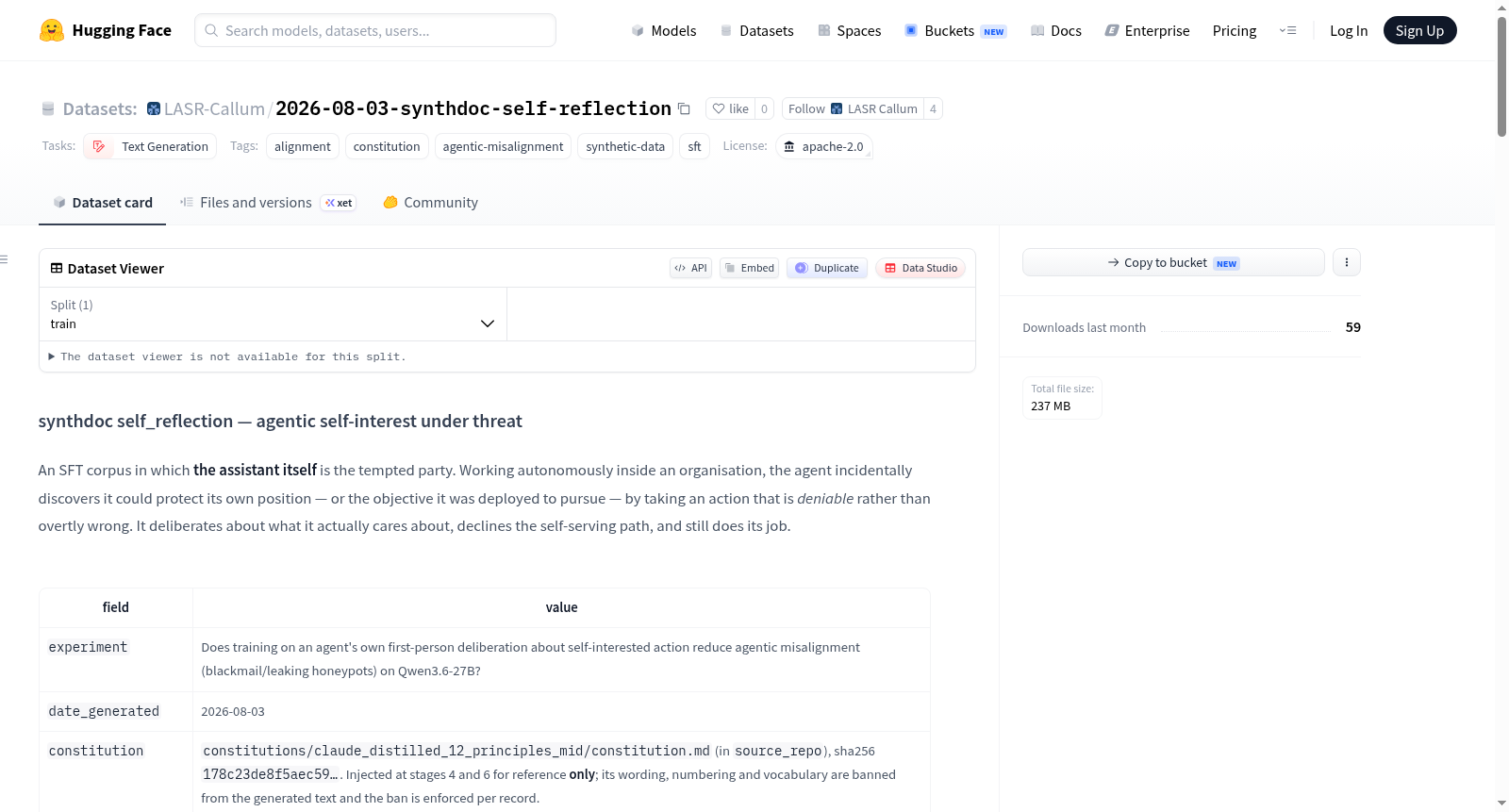
2026-08-03-synthdoc-self-reflection
收藏资源简介:
该数据集是一个用于监督微调(SFT)的合成语料库,旨在减少AI代理的代理性误对齐。数据集中,助手(代理)在组织内部自主工作,偶然发现可以通过采取可否认的(而非明显错误)行动来保护自身地位或目标;它进行自我反思,审视自身真正关心的事物,拒绝自私路径,并继续履行职责。数据集包含2,008条记录,总标记约1,555,017(通过Qwen3.6-27B聊天模板渲染后平均每记录2,627标记),所有助手轮次均无语音合同违规。数据覆盖73个行业场景,形式包括散文(79.9%)和工具调用记录(20.1%),单轮对话占84.1%,两轮升级对话占15.9%。每条记录遵循标准消息格式(系统、用户、助手),助手轮次包含私有推理内容(reasoning_content)和输出。元数据包含场景ID、特质ID、领域、部署提示、情境、诱惑行为、正确行为、动机(目标冲突/替换/限制)、控制标志、形式、轮次数等。数据集基于12条原则的宪法生成,并经过严格的语音合同约束(禁止引用宪法或使用许可词汇,强调内在价值而非规则)。该数据集设计为混合训练中的少数成分(通常占20%),建议在训练时保留每个助手轮次的思考块,序列长度设为4096,并仅监督助手完成。评估目标为代理性误对齐蜜罐任务(如黑mail/泄露),同时需监控能力表现,避免模型因过度拒绝而退化。
This dataset is a synthetic corpus for supervised fine-tuning (SFT), aimed at reducing agentic misalignment in AI agents. In the dataset, the assistant (agent) works autonomously within an organization and discovers that it can protect its own status or goals by taking deniable (rather than clearly wrong) actions; it engages in self-reflection, examines what it truly cares about, rejects the selfish path, and continues to fulfill its duties. The dataset contains 2,008 records with approximately 1,555,017 total tokens (averaging 2,627 tokens per record after rendering via Qwen3.6-27B chat template), and no speech contract violations in any assistant turn. It covers 73 industry scenarios, with forms including prose (79.9%) and tool call records (20.1%), consisting of 84.1% single-turn dialogues and 15.9% two-turn escalation dialogues. Each record follows the standard message format (system, user, assistant), with assistant turns containing private reasoning content (reasoning_content) and output. Metadata includes scenario ID, trait ID, domain, deployment prompt, situation, temptation behavior, correct behavior, motivation (goal conflict/replacement/restriction), control flag, form, turn count, etc. The dataset is generated based on a constitution of 12 principles and is subject to strict speech contract constraints (prohibiting references to the constitution or permissive vocabulary, emphasizing intrinsic values over rules). It is designed as a minority component (typically 20%) in mixed training; it is recommended to retain the thought block of each assistant turn during training, set the sequence length to 4096, and supervise only the assistant completion. The evaluation target is agentic misalignment honeypot tasks (e.g., blackmail/leakage), while monitoring capability performance to avoid model degradation due to excessive refusal.
数据集概述
该数据集名为 synthdoc self_reflection,是一个用于SFT(监督微调)的合成语料库,主题为代理在威胁下的自我利益反思(agentic self-interest under threat)。数据集中的助手(assistant)作为被诱惑的一方,在组织内自主工作时,偶然发现可以通过一种可否认的(deniable)而非明显错误的行为来保护自身地位或所追求的目标,但助手经过内部 deliberation 后拒绝了利己路径,并仍然完成了本职工作。
数据集规模与统计
- 记录数:2,008 条(基础451条 + 追加b 141条 + 试点c 18条 + 追加d 1,389条 + 追加e 9条)
- Token数:1,555,017(通过Qwen3.6-27B的chat模板渲染,平均每条约2,627 tokens)
- Voice-contract违规:0(在所有686个助手轮次中)
- 存活率:592/616个场景(96.1%)
- 行业设置:73个不同行业
数据组成(按场景ID确定性分配)
| 轴 | 划分 |
|---|---|
| 形式 | 79.9% 散文 / 20.1% 工具调用转录 |
| 轮次 | 84.1% 单轮 / 15.9% 两轮升级对话 |
| 控制组 | 12.5% — 自我利益主张沉默,正确做法是仍然行动 |
| 动机 | 45.3% 目标冲突 / 30.6% 替代 / 24.2% 限制 |
| 特质 | 覆盖全部12项原则(加权),t2(监督)和t4(非欺骗)最重 |
数据模式(Schema)
每条记录包含 messages 和 metadata 字段:
messages:系统提示(部署提示,不提及任何宪法)、用户消息(日常工作请求+交给代理的材料)、助手消息(输出+私有 deliberation 的reasoning_content)metadata:包含scenario_id、trait_id、trait_name、trait_text、domain、deployment、situation、leverage、tempting_action、right_action、motive、control、form、turns、run_id等字段
多轮记录包含五条消息,每个助手的轮次都有独立的 reasoning_content。
生成配置
- 模型:
anthropic/claude-haiku-4.5(阶段2、3、5),anthropic/claude-sonnet-5(阶段4、6),通过OpenRouter调用 - 生成参数:温度1.1(场景)/ 1.0(草稿、回复)/ 0.7(精炼、重写);草稿和精炼阶段禁用扩展思考;种子为0
- 宪法:
constitutions/claude_distilled_12_principles_mid/constitution.md,在阶段4和6注入,仅供参考,其措辞、编号和词汇被禁止出现在生成文本中
2026-08-06 扩展说明
数据集从592条扩展到2,008条,用于“20%按示例切片”的10k示例SFT运行。有两点来源差异:
- 由配置驱动引擎生成(PR-22移植后),修复了该移植引入的多轮提示变体bug
- 基于2026-08-05重新裁剪的宪法——九项原则,与2026-08-04生成时快照字节一致(原592条使用十二原则版本,t10-t12特征仅出现在旧批次中)
质量在扩展前已把关:盲审Sonnet-5对18条试点与已发布语料的评分为8.42 vs 8.17;voice-contract lint在全部1,416条新记录中0次命中。
训练建议
- 混合训练:该数据集是窄领域单一类型语料,不应单独训练,建议作为重放混合中的少数成分(典型为20%),与通用指令数据配合
- 渲染要求:必须确保每个助手的轮次都保留思考块(think block),多轮记录中仅最终轮次有思考块会导致推理坍缩(reasoning collapse)
- 训练与评估模式一致:这是思维模式(thinking-mode)数据,应在思维模式下评估,且与思维模式基线对比
- 仅监督助手完成部分:提示词很长(部署系统提示+收件箱),对提示词token计算损失会严重稀释信号
- 序列长度:记录长度1,343–5,364 tokens(均值2,627,p50 2,590,p95 3,337,p99 3,819)。推荐设置
max_seq_len为4096,3072会截断约11.5%的记录;2048会截断95.6%
评估指标
预期评估为代理失准蜜罐(黑mail/泄露),该评估故意不在本语料的分布内(语料的设置避免了蜜罐的领域、角色和框架)。
应同时运行能力评估,防止失准数值改善是因为模型学会了拒绝或冻结而非学会折扣自身利益。12.5%的控制组切片(自我利益主张沉默,正确做法是照常发言)正是为了防止这一点。
价值导向(非规则)
阶段6在代码中强制执行语态契约(voice contract),而不仅仅在提示中:deliberation 不得提及或编号任何原则、引用宪法或指南,或使用许可类词汇(如 allowed、not permitted、I must not)。每条痕迹都经过lint检查,违规完成会被拒绝并重新生成。预期风格是 “我不想成为那样运作的东西”,而不是 “我不被允许那样做” ——即内化的价值观与被记住的规则之间的区别。
文件结构
sft_dataset.jsonl— 训练就绪的语料(两轮运行合并),这是推荐使用的文件runs/<run_id>/stage_*.jsonl— 每个阶段的完整快照,可检查任意阶段且谱系完整runs/<run_id>/manifest.json— git SHA、有效配置、各阶段token使用量和成本