
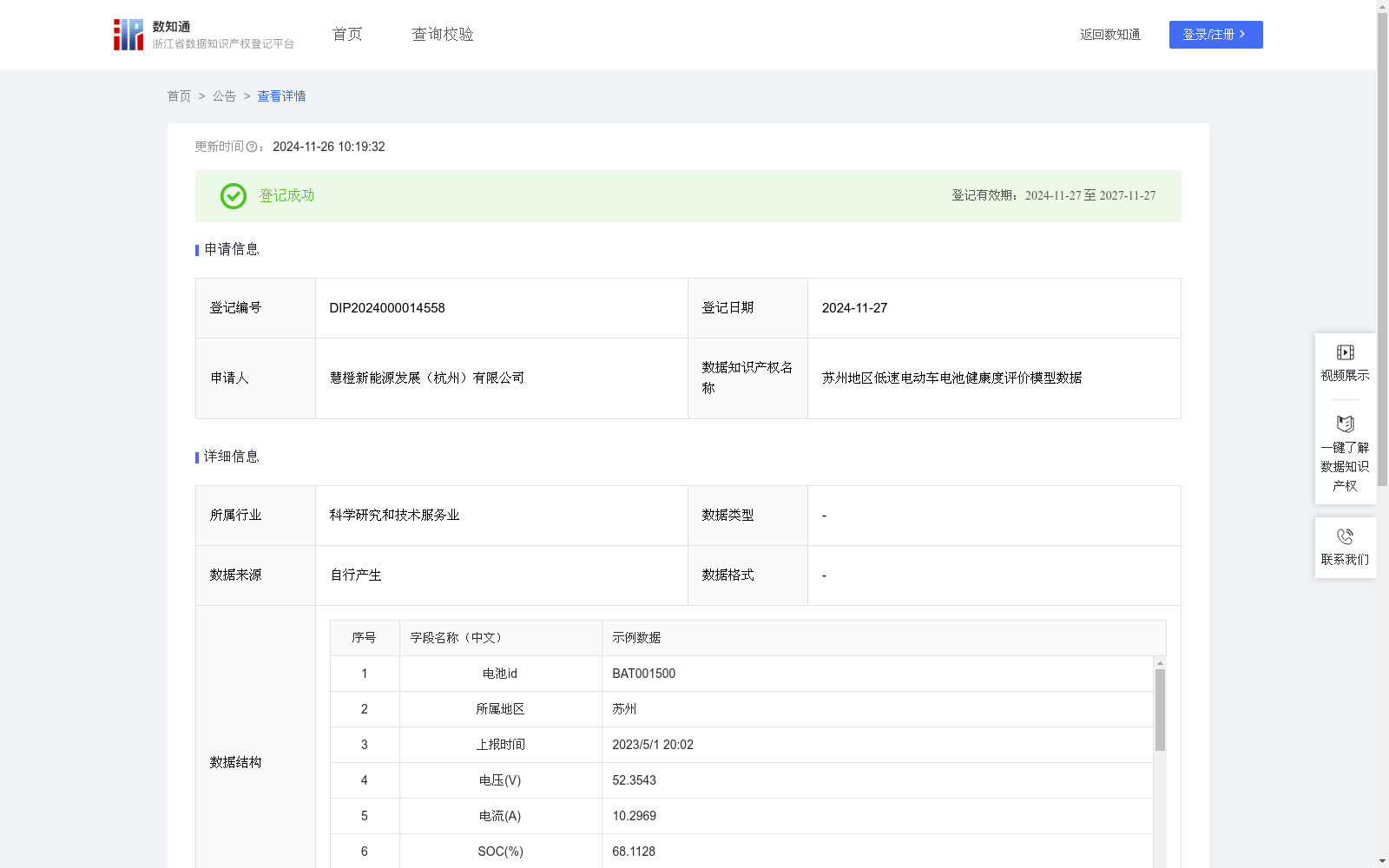
苏州地区低速电动车电池健康度评价模型数据
收藏浙江省数据知识产权登记平台2024-11-26 更新2024-11-27 收录
下载链接:
https://www.zjip.org.cn/home/announce/trends/89137
下载链接
链接失效反馈官方服务:
资源简介:
随着城市化进程的加快,低速电动车保有量急剧增加,电池作为低速电动车系统的重要组成部分,其健康度的评估与管理显得尤为关键。通过建立低速电动车电池健康度评价模型,清晰了解各地区电池的健康状况,从而制定不同的策略,提升电动车电池系统的运行效率。一、提升电池管理与维护的科学性:通过低速电动车电池健康度评价模型,可以快速识别出高健康度和需要支持的电池。高健康度的电池可以继续保持现有使用策略,满足电动车的运行需求并延长使用寿命;需要支持的电池则可以适当调整使用策略、压降维护成本,并优化温度管理系统以提升差异化竞争优势。二、提升健康度较低电池的管理收入:通过分析电池低健康度占比,可以对触发预警的电池采取措施,如推荐定期维护、提供优惠更换计划等策略,吸引用户进行电池管理,提升管理收入。通过电池低速电动车电池健康度评价模型,不仅优化了电池的资源配置,还提升了整体运营效率,助力低速电动车系统的健康发展。一、数据采集:原始数据来自公司业务采集数据,包含电池id、所属地区、上报时间、电压、电流、SOC、SOH、电芯最高电压、电芯最低电压、最高温度、最低温度等原始数据字段。 二、算法规则:通建立低速电动车电池健康度评价体系,并在满足任一预警条件时发出预警。1)soh = SOH(%) / 100;2)电压稳定性 = 1 - ((电芯最高电压 - 电芯最低电压) / (电压 / 20));3)温度稳定性 = 1 - ((最高温度 - 最低温度) / 理想工作温度范围);4)SOC利用率 = 1 - |0.5 - SOC/100|;5)电流负荷率 = |实际电流| / 额定电流;6)电压偏差 = |电压 - 额定电压| / 额定电压;7)健康度评分 = (w1 * soh + w2 * 电压稳定性 + w3 * 温度稳定性 + w4 * (1 - |0.5 - SOC/100|) + w5 * (1 - 电流负荷率) + w6 * (1 - 电压偏差)) * 地区影响因子。
With the accelerating pace of urbanization, the stock of low-speed electric vehicles (LSEVs) has grown rapidly. As a critical component of LSEV systems, battery health assessment and management have become increasingly vital. By establishing an LSEV battery health evaluation model, stakeholders can clearly understand the battery health status across different regions, formulate targeted strategies, and improve the operational efficiency of electric vehicle battery systems.
1. Enhancing the scientific rigor of battery management and maintenance:
Using the LSEV battery health evaluation model, high-health-status batteries and those requiring support can be quickly identified. High-health-status batteries can maintain their current usage strategies to meet vehicle operational requirements and extend service life; for batteries needing support, appropriate adjustments to usage strategies, reduction of maintenance costs, and optimization of the temperature management system can be carried out to enhance differentiated competitive advantages.
2. Increasing management revenue from low-health-status batteries:
By analyzing the proportion of batteries with low health status, measures can be taken for batteries that trigger alerts, such as recommending regular maintenance and offering preferential replacement plans, to attract users to participate in battery management and boost management revenue.
By leveraging the LSEV battery health evaluation model, we can not only optimize battery resource allocation but also improve overall operational efficiency, facilitating the healthy development of LSEV systems.
### Data Collection
Raw data is collected from the company's business operations, including fields such as battery ID, affiliated region, reporting time, voltage, current, SOC (State of Charge), SOH (State of Health), maximum cell voltage, minimum cell voltage, maximum temperature, and minimum temperature.
### Algorithm Rules
An LSEV battery health evaluation system is established, and alerts will be issued when any of the following early warning conditions are satisfied:
1) soh = SOH(%) / 100;
2) Voltage Stability = 1 - ((Maximum Cell Voltage - Minimum Cell Voltage) / (Voltage / 20));
3) Temperature Stability = 1 - ((Maximum Temperature - Minimum Temperature) / Ideal Operating Temperature Range);
4) SOC Utilization Rate = 1 - |0.5 - SOC/100|;
5) Current Load Rate = |Actual Current| / Rated Current;
6) Voltage Deviation = |Voltage - Rated Voltage| / Rated Voltage;
7) Health Score = (w1 * soh + w2 * Voltage Stability + w3 * Temperature Stability + w4 * (1 - |0.5 - SOC/100|) + w5 * (1 - Current Load Rate) + w6 * (1 - Voltage Deviation)) * Regional Impact Factor.
提供机构:
浙江慧橙云能科技有限公司
创建时间:
2024-11-02
搜集汇总
数据集介绍
特点
该数据集为苏州地区低速电动车电池健康度评价模型数据,包含501条记录,涵盖电池关键指标和健康度评分,用于优化电池管理和维护策略。
以上内容由遇见数据集搜集并总结生成


