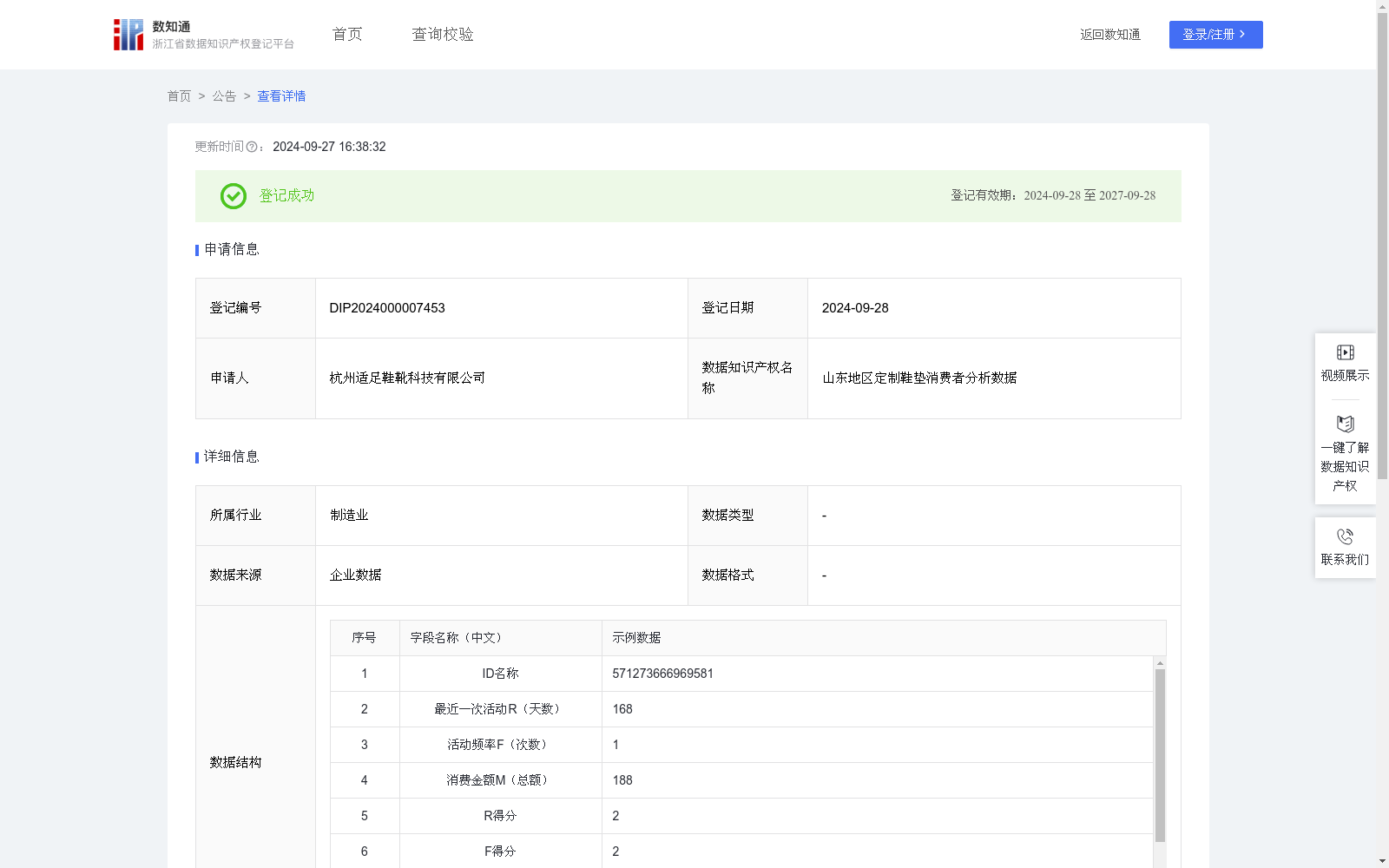
山东地区定制鞋垫消费者分析数据
收藏资源简介:
本数据可用于鞋类企业在开展定制鞋垫业务过程中制定客户营销策略时,能够针对不同的客户推行不同的营销策略,以提升销售转化率和实现精准化营销。精准化营销的关键在于深入了解不同客户群体的需求、购买行为及偏好。通过对山东地区定制鞋垫客户的价值管理,满足不同价值客户的个性化需求,并为行业内开展鞋垫定制业务的鞋企提供参考。客户分类的算法规则采用RFM数据模型排序、聚类的方法,通过对客户最近一次活动R(天数)和活动频率F(次数)的聚类,以及对消费金额M(总额)的排序,实现客户按等级进行分类。 1.数据来源:采集自本企业在山东地区的定制鞋垫销售订单数据。 2.数据处理:对采集到的数据进行降噪、清洗、脱敏、聚集、分析。 3.模型选择:运用RFM模型 提取出客户最近一次活动R(天数)、活动频率F(次数)、消费金额M(总额)进行聚类,并按最近一次活动(R)进行排序。 数据加工:按照从1-5评分,前20%的客户获得5分,接下来的20%用户获得4分,再下来20%的客户为3分,再下来20% 的客户为2分,最后20% 的客户为1分。 根据客户活动频率(F)从高到底依次对用户进行分类,前20%的客户在用户活动频率的分数为5,以此类推。 消费金额(M),前20%的客户在消费金额的分数为5,以此类推。RFM综合评分=(R)得分*0.3+(F)得分*0.3+(M)得分*0.4,评分大于等于4分的为A级客户,大于等于3小于4的为B级客户,大于等于2小于3的为C级客户,低于2的为D级客户。
This dataset can help footwear enterprises formulate targeted customer marketing strategies when launching custom insole businesses, enabling differentiated marketing for different customer groups to improve sales conversion rates and achieve precise marketing. The core of precise marketing lies in deeply understanding the needs, purchase behaviors and preferences of various customer groups. Through customer value management for custom insole customers in Shandong Province, this dataset meets the personalized needs of customers with different value levels, and provides a reference for footwear enterprises carrying out custom insole business in the industry. The customer classification algorithm adopts the RFM data model for sorting and clustering: clustering is performed based on the recency of customer's last activity (R, in days) and activity frequency (F, number of times), while sorting is conducted based on consumption amount (M, total amount), so as to classify customers by grade. 1. Data Source: Collected from the custom insole sales order data of our enterprise in Shandong Province. 2. Data Processing: Noise reduction, data cleaning, personal data desensitization, aggregation and analysis are carried out on the collected raw data. 3. Model Selection: The RFM model is utilized to extract three core metrics: recency of customer's last activity (R, in days), activity frequency (F, number of times) and consumption amount (M, total amount) for clustering, and sorting is performed based on recency (R). Data Processing & Classification: Scoring is conducted on a 1-5 scale for each of the three RFM metrics: - For Recency (R): The top 20% of customers receive a score of 5, the next 20% get 4 points, the subsequent 20% get 3 points, the next 20% get 2 points, and the bottom 20% get 1 point. - For Activity Frequency (F): Customers are ranked in descending order of activity frequency, with the top 20% awarded 5 points, and the scoring follows the same tiered rule as above. - For Consumption Amount (M): Customers are ranked in descending order of total consumption, with the top 20% receiving 5 points, and the rest following the same tiered scoring standard. The comprehensive RFM score is calculated as: Comprehensive RFM Score = (R Score) * 0.3 + (F Score) * 0.3 + (M Score) * 0.4. Based on the comprehensive score, customers are classified as follows: - Class A: Score ≥ 4 - Class B: 3 ≤ Score < 4 - Class C: 2 ≤ Score < 3 - Class D: Score < 2