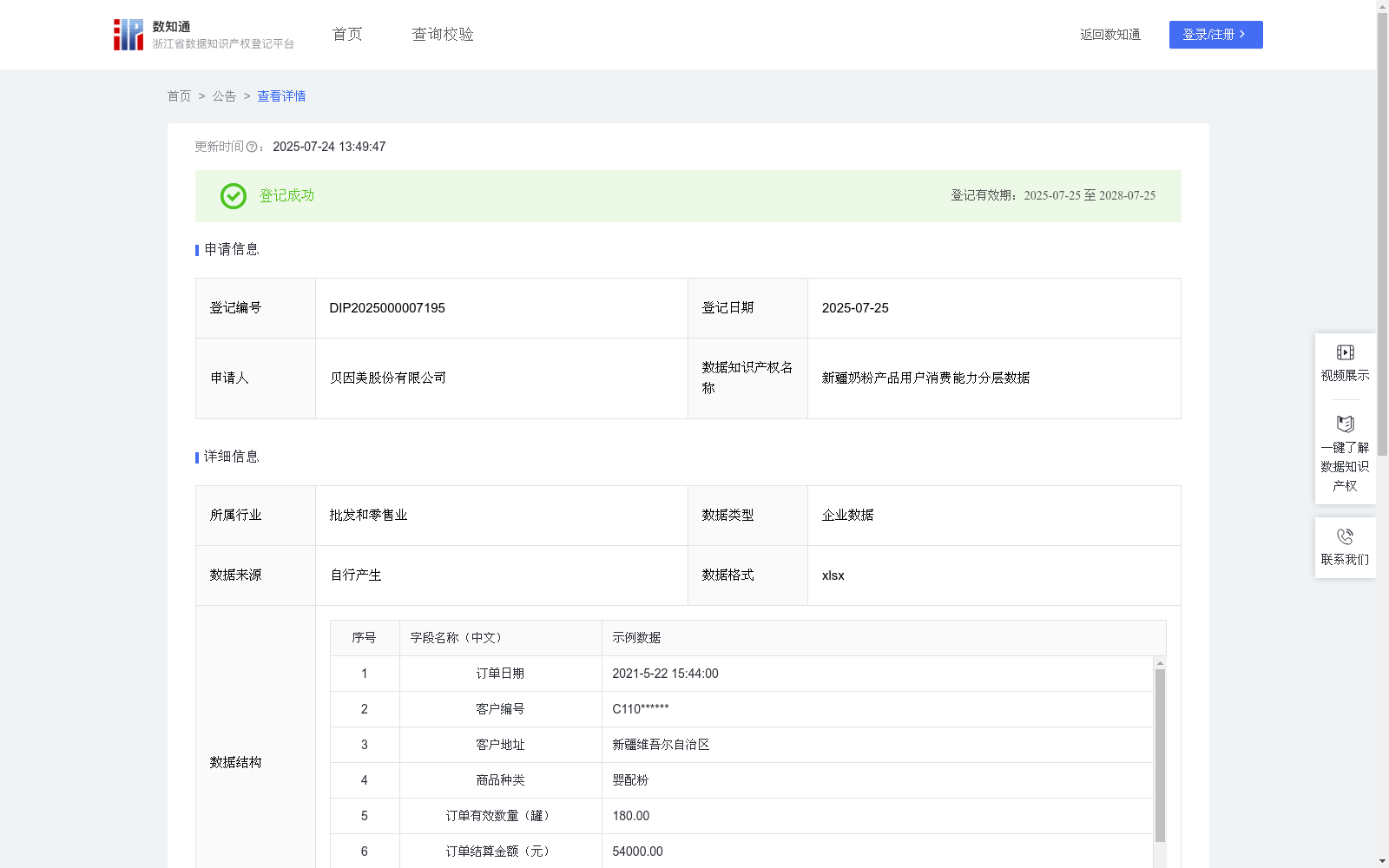
新疆奶粉产品用户消费能力分层数据
收藏资源简介:
奶粉产品的销售受地区发展,人口组成等客观条件影响,因此数据收集整理以省份作为划分区间。本数据通过对新疆维吾尔自治区用户奶粉产品历史下单数据的收集和分析计算,了解该地区该商品用户消费情况,对消费者进行消费级别的划分,为相关产品批发、零售行业制定采购、销售策略提供数据支持,更好地为消费者提供个性化的商品和服务,从而帮助企业更准确地掌握市场动态,提升消费者满意度,行业销售竞争力。(例如:A类消费:建立专门的客户关系管理团队,与他们保持密切的一对一沟通;B类消费:根据消费历史推送个性化推荐;C类消费:推荐性价比高的产品组合,激励消费...)1、数据收集:从数据库中根据新疆维吾尔自治区用户消费记录梳理数据,选中字段为:订单日期,客户编号,客户地址,商品种类,订单有效数量(罐),订单结算金额(元); 2、数据加工:a.先针对订单结算金额字段用SUM函数求和,得到某月总销售金额(元),具体月份以数据包内字段显示为准;b.该客户消费占比=订单结算金额(元)/某月总销售金额(元)*100%;c.用户消费占总消费的比例按从大到小进行排名,消费分类运用ABCDEF序列法,对占比大于等于1%以上,给予“A类消费”分层;占比在小于1%到大于等于0.8%区间,则给予“B类消费”分层;占比在小于0.8%到大于等于0.6%区间,则给予“C类消费”分层;占比在小于0.6%到大于等于0.4%区间,则给予“D类消费”分层;占比在小于0.4%到大于等于0.2%区间,则给予“E类消费”;占比在小于0.2%范围内,则给予“F类消费”分层。(数据包内皆为有效消费数据,因此不存在占比为0的情况) 3、数据应用:为相关产品批发、零售行业制定采购、销售策略提供数据支持(例如:A类消费:建立专门的客户关系管理团队,与他们保持密切的一对一沟通;B类消费:根据消费历史推送个性化推荐;C类消费:推荐性价比高的产品组合,激励消费...具体方案由企业具体制定。),更好地为消费者提供个性化的商品和服务。
The sales of milk powder products are influenced by objective conditions including regional development and population structure. Therefore, the data collection and organization are segmented by provincial-level administrative regions. This dataset is developed by collecting and analyzing historical order data of milk powder products from users in the Xinjiang Uygur Autonomous Region. It aims to understand the consumer spending patterns of this product in the region, classify consumers into different consumption tiers, provide data support for the development of procurement and sales strategies for the wholesale and retail sectors of related products, and ultimately help enterprises accurately grasp market trends, improve consumer satisfaction, and enhance industry sales competitiveness. (For example: Class A consumption tier users: Establish a dedicated customer relationship management (CRM) team to maintain close one-on-one communication with them; Class B consumption tier users: Push personalized product recommendations based on their consumption history; Class C consumption tier users: Recommend cost-effective product portfolios to stimulate additional consumption...) 1. Data Collection: Extract and organize user consumption records of the Xinjiang Uygur Autonomous Region from the corporate database, with selected fields as follows: order date, customer ID, customer address, product category, valid order quantity (in cans), and order settlement amount (in yuan). 2. Data Processing: a. First, use the SUM function to aggregate the order settlement amount field to calculate the total monthly sales amount (in yuan). The specific month shall be subject to the fields contained in the data package; b. Customer consumption proportion = (order settlement amount / total monthly sales amount) × 100%; c. Rank the proportion of each user's consumption in the total regional consumption in descending order. The ABCDEF sequential classification method is then applied to assign consumption tiers: users with a consumption proportion ≥1% are assigned to the "Class A consumption" tier; those with a proportion between <1% and ≥0.8% are assigned to the "Class B consumption" tier; those with a proportion between <0.8% and ≥0.6% are assigned to the "Class C consumption" tier; those with a proportion between <0.6% and ≥0.4% are assigned to the "Class D consumption" tier; those with a proportion between <0.4% and ≥0.2% are assigned to the "Class E consumption" tier; and those with a proportion <0.2% are assigned to the "Class F consumption" tier. (All data in this package are valid consumption records, so there are no cases of 0 consumption proportion.) 3. Data Application: Provide data support for the development of procurement and sales strategies for the wholesale and retail sectors of related products. (For example: Class A consumption tier users: Establish a dedicated customer relationship management (CRM) team to maintain close one-on-one communication with them; Class B consumption tier users: Push personalized product recommendations based on their consumption history; Class C consumption tier users: Recommend cost-effective product portfolios to stimulate additional consumption... Specific strategies shall be formulated by enterprises based on their own actual situations.), so as to better provide personalized goods and services for consumers.