
山西长子西南呈墓地人骨和动物骨C、N同位素和放射性碳定年数据集
收藏国家青藏高原科学数据中心2023-08-20 更新2024-03-01 收录
下载链接:
https://data.tpdc.ac.cn/zh-hans/data/f799a282-ea70-4da7-bc5f-23bef89107e9
下载链接
链接失效反馈官方服务:
资源简介:
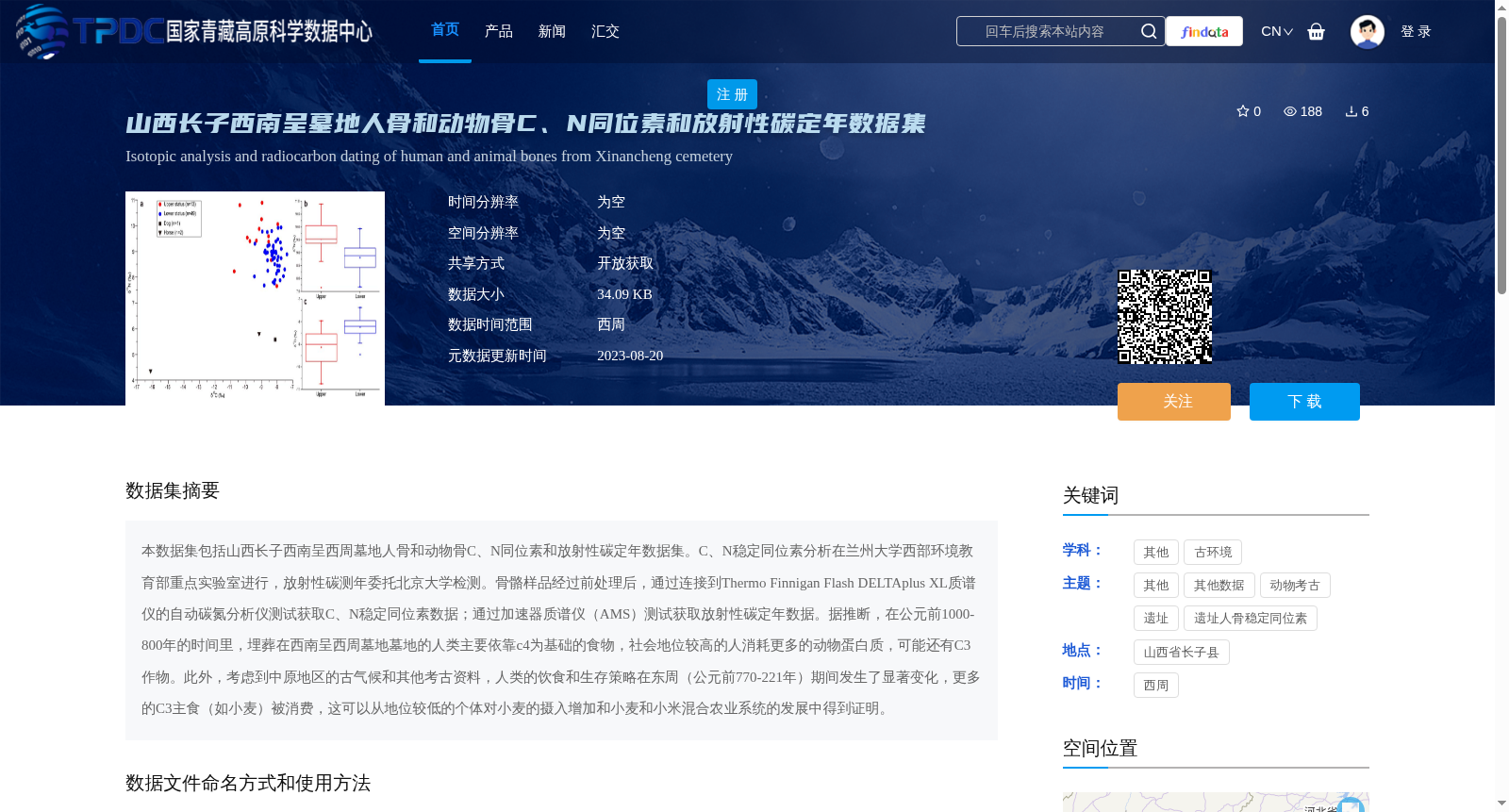
本数据集包括山西长子西南呈西周墓地人骨和动物骨C、N同位素和放射性碳定年数据集。C、N稳定同位素分析在兰州大学西部环境教育部重点实验室进行,放射性碳测年委托北京大学检测。骨骼样品经过前处理后,通过连接到Thermo Finnigan Flash DELTAplus XL质谱仪的自动碳氮分析仪测试获取C、N稳定同位素数据;通过加速器质谱仪(AMS)测试获取放射性碳定年数据。据推断,在公元前1000-800年的时间里,埋葬在西南呈西周墓地墓地的人类主要依靠c4为基础的食物,社会地位较高的人消耗更多的动物蛋白质,可能还有C3作物。此外,考虑到中原地区的古气候和其他考古资料,人类的饮食和生存策略在东周(公元前770-221年)期间发生了显著变化,更多的C3主食(如小麦)被消费,这可以从地位较低的个体对小麦的摄入增加和小麦和小米混合农业系统的发展中得到证明。
This dataset comprises carbon (C), nitrogen (N) isotope and radiocarbon dating datasets derived from human and animal bones excavated at the Xichancun Western Zhou Cemetery in Zhangzi County, Shanxi Province. Stable carbon and nitrogen isotope analyses were conducted at the Key Laboratory of Western China's Environmental Systems (Ministry of Education), Lanzhou University, while radiocarbon dating was commissioned to Peking University for testing. After preprocessing, bone samples were analyzed using an automated C/N elemental analyzer coupled to a Thermo Finnigan Flash DELTAplus XL mass spectrometer to obtain stable C and N isotope data, and radiocarbon dating data were acquired via accelerator mass spectrometry (AMS) measurements. It is inferred that during 1000–800 BCE, humans interred at the Xichancun Western Zhou Cemetery primarily relied on C4-based diets, with individuals of higher social status consuming more animal protein, as well as potentially C3 crops. Furthermore, based on paleoclimatic data and other archaeological records from the Central Plains, human dietary patterns and subsistence strategies underwent significant changes during the Eastern Zhou Dynasty (770–221 BCE), with increased consumption of C3 staple foods such as wheat. This is evidenced by the elevated wheat intake among individuals of lower social status and the development of mixed agricultural systems integrating wheat and millet.
提供机构:
李昕
创建时间:
2023-08-11
搜集汇总
数据集介绍
背景与挑战
背景概述
该数据集提供了山西长子西南呈西周墓地人骨和动物骨的C、N同位素和放射性碳定年数据,揭示了西周时期人类以C4食物为主,社会地位高者摄入更多动物蛋白,东周时期饮食策略转向更多C3主食(如小麦)。数据通过稳定同位素分析和放射性碳测年技术获取,具有重要的考古学和环境研究价值。
以上内容由遇见数据集搜集并总结生成


