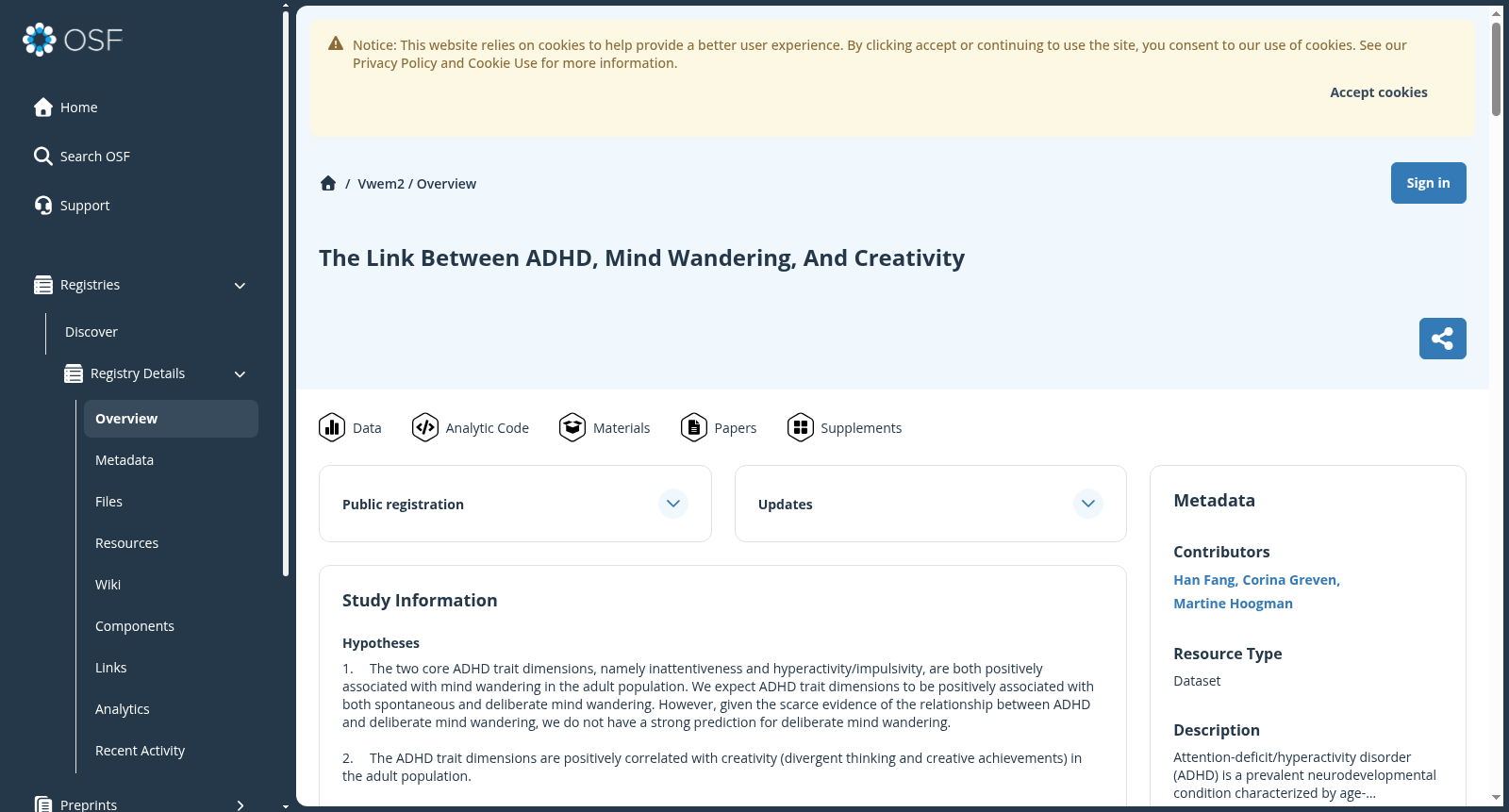
The link between ADHD, mind wandering, and creativity
收藏资源简介:
Attention-deficit/hyperactivity disorder (ADHD) is a prevalent neurodevelopmental condition characterized by age-inappropriate levels of inattentiveness or hyperactivity and impulsivity (American Psychiatric Association & Association, 2013). Research indicates that individuals with ADHD have difficulties in various domains, including academic, occupational, and social functioning (Faraone et al., 2021). Despite the predominant focus on ADHD-related impairments, recent studies have identified that many adults with ADHD experience positive aspects related to their ADHD (Schippers et al., 2022; Sedgwick et al., 2019). Among these positive aspects, creativity, and especially its divergent thinking aspect, is most frequently reported as a positive aspect and also quantitative evidence exists in relation to ADHD (Hoogman et al., 2020; Stolte et al., 2022). However, little attention has been given to examining the underlying factors linking ADHD and creativity. One potential factor that might play a role in the association between ADHD and creativity is mind wandering, often defined as a shift of attention away from an ongoing task toward intrinsically task-unrelated thoughts (Smallwood & Schooler, 2006). Previous research has revealed associations between mind wandering and both inattentiveness and hyperactivity/impulsivity, which are the two core ADHD trait dimensions (Frick et al., 2020). Concurrently, positive effects of mind wandering on divergent thinking, especially during the creative incubation period, have been reported (Baird et al., 2012; Xie et al., 2023). Therefore, introducing mind wandering as a mediator may offer a more comprehensive understanding of the relationship between ADHD and creativity. However, controversial conclusions emerge from recent research. For instance, Figueiredo et al. (2020) found no differences in mind wandering between ADHD and non-ADHD groups. Another example is the series of conceptual replications conducted by Murray et al., which, contrary to the findings of Baird et al. (2012), failed to demonstrate the facilitating effects of mind wandering during a creative incubation interval on divergent creativity (Murray et al., 2021). Moreover, while mind wandering is associated with certain benefits (Smallwood & Andrews-Hanna, 2013), it has also been correlated with negative outcomes, including deficient working memory, emotional dysregulation, and functional impairments independently of ADHD symptoms (Frick et al., 2020; Mowlem et al., 2019). The heterogeneous nature of mind wandering may contribute to these contradictory results. While distinguishing between subtypes of mind wandering can be achieved in various ways, ‘intentionality’ stands out as a crucial dimension. In terms of intentionality, mind wandering can be categorized into two subtypes: deliberate mind wandering and spontaneous mind wandering (Smallwood & Schooler, 2015). To elaborate, deliberate mind wandering involves an intentional, controlled shift of attention to internal thoughts, while spontaneous mind wandering refers to an unintentional, uncontrolled shift of attention to internal thoughts. Studies differentiating deliberate and spontaneous mind wandering found that spontaneous mind wandering was more associated with ADHD traits than deliberate mind wandering (Seli et al., 2015; Smith et al., 2022). Moreover, research exploring the relationship between creativity and deliberate or spontaneous mind wandering indicated that deliberate mind wandering positively correlated with originality—a component of divergent thinking ability (Agnoli et al., 2018; Teng & Lien, 2022). While these findings suggest that different forms of mind wandering, in terms of intentionality, may have varying influences on the link between ADHD and creativity and functional impairments experienced by ADHD individuals, no study to date has specifically explored the distinct roles of deliberate and spontaneous mind wandering in the relationship between ADHD trait dimensions and creativity and functional impairments of ADHD individuals. To investigate the underlying factors of the association between ADHD and creativity, it is necessary to integrate these research fields. Therefore, the main aims of the present study are: (1) to investigate the relationship between ADHD and deliberate and spontaneous mind wandering; and (2) to explore the role of mind wandering in the relationship between ADHD and creativity. Additionally, we have three sub-aims: (1) to confirm the association between ADHD and creativity; (2) to examine the difference in the link between mind wandering and creativity for people with ADHD versus people without ADHD; (3) to investigate the role of mind wandering in the link between ADHD and functional impairments experienced by people with ADHD. Research in this combined field has the potential to illuminate the cognitive mechanisms underlying the link between ADHD and creativity among adults and to understand better the role of mind wandering in impairments experienced in people with ADHD.
注意缺陷多动障碍(Attention-deficit/hyperactivity disorder, ADHD)是一种高发的神经发育性病症,其特征为与年龄不符的注意力不集中、多动及冲动症状(美国精神病学会,2013)。研究表明,ADHD患者在学业、职业及社会功能等多个领域均存在障碍(Faraone等,2021)。尽管既往研究多聚焦于ADHD相关的功能损害,但近期研究发现,众多成人ADHD患者会体验到与自身ADHD相关的积极特质(Schippers等,2022;Sedgwick等,2019)。在这些积极特质中,创造力——尤其是其发散思维(divergent thinking)维度——是最常被报告的积极方面,且已有定量研究证实了ADHD与创造力之间的关联(Hoogman等,2020;Stolte等,2022)。然而,目前针对ADHD与创造力之间关联的潜在影响因素的研究仍较为匮乏。 心智游移(mind wandering)或许是连接ADHD与创造力的潜在影响因素之一,其通常被定义为个体注意力从当前任务转移至与任务无关的内在想法的过程(Smallwood & Schooler,2006)。既往研究已证实,心智游移与ADHD的两个核心症状维度——注意力不集中及多动/冲动——均存在关联(Frick等,2020)。同时,有研究指出,心智游移对发散思维具有积极作用,尤其在创造性酝酿阶段(Baird等,2012;Xie等,2023)。因此,将心智游移作为中介变量(mediator),或可更全面地理解ADHD与创造力之间的关联。 但近期研究得出了相互矛盾的结论。例如,Figueiredo等(2020)未发现ADHD组与非ADHD组在心智游移水平上存在差异。又如Murray等开展的一系列概念性重复研究,与Baird等(2012)的研究结果相悖,未能证实创造性酝酿阶段中心智游移对发散性创造力的促进作用(Murray等,2021)。此外,尽管心智游移与部分益处相关(Smallwood & Andrews-Hanna,2013),但其也与诸多不良后果存在关联,包括工作记忆缺陷、情绪调节障碍,以及独立于ADHD症状之外的功能损害(Frick等,2020;Mowlem等,2019)。 心智游移的异质性特征或许是导致这些矛盾结果的原因。尽管区分心智游移亚型的方式多种多样,但“意向性”是其中一个关键维度。根据意向性维度,心智游移可分为两类:有意向心智游移(deliberate mind wandering)与无意向心智游移(spontaneous mind wandering)(Smallwood & Schooler,2015)。具体而言,有意向心智游移指个体有意地、可控地将注意力转移至内在想法,而无意向心智游移则指个体无意识、不可控地将注意力转移至内在想法。区分有意向与无意向心智游移的研究发现,无意向心智游移与ADHD特质的关联要强于有意向心智游移(Seli等,2015;Smith等,2022)。此外,针对创造力与有意向/无意向心智游移之间关系的研究表明,有意向心智游移与发散思维能力的组成部分之一——原创性——呈正相关(Agnoli等,2018;Teng & Lien,2022)。 尽管上述研究提示,基于意向性维度划分的不同类型心智游移,可能对ADHD与创造力之间的关联,以及ADHD患者所经历的功能损害存在差异化影响,但迄今为止尚无研究专门探讨有意向与无意向心智游移在ADHD症状维度与创造力、ADHD患者功能损害之间关联中的独特作用。为探究ADHD与创造力之间关联的潜在机制,有必要整合上述研究领域。因此,本研究的主要目标为:(1)探讨ADHD与有意向、无意向心智游移之间的关联;(2)探究心智游移在ADHD与创造力之间关联中的作用。此外,本研究还包含三个子目标:(1)验证ADHD与创造力之间的关联;(2)对比ADHD患者与非ADHD群体中,心智游移与创造力之间关联的差异;(3)探究心智游移在ADHD与成人ADHD患者所经历的功能损害之间关联中的作用。本领域的联合研究有望阐明成人ADHD患者与创造力之间关联的认知机制,并进一步增进我们对心智游移在ADHD患者功能损害中所起作用的理解。