
Datasheet_YEH.csv
收藏DataCite Commons2024-10-24 更新2025-01-06 收录
下载链接:
https://figshare.com/articles/dataset/Datasheet_YEH_csv/27297258
下载链接
链接失效反馈官方服务:
资源简介:
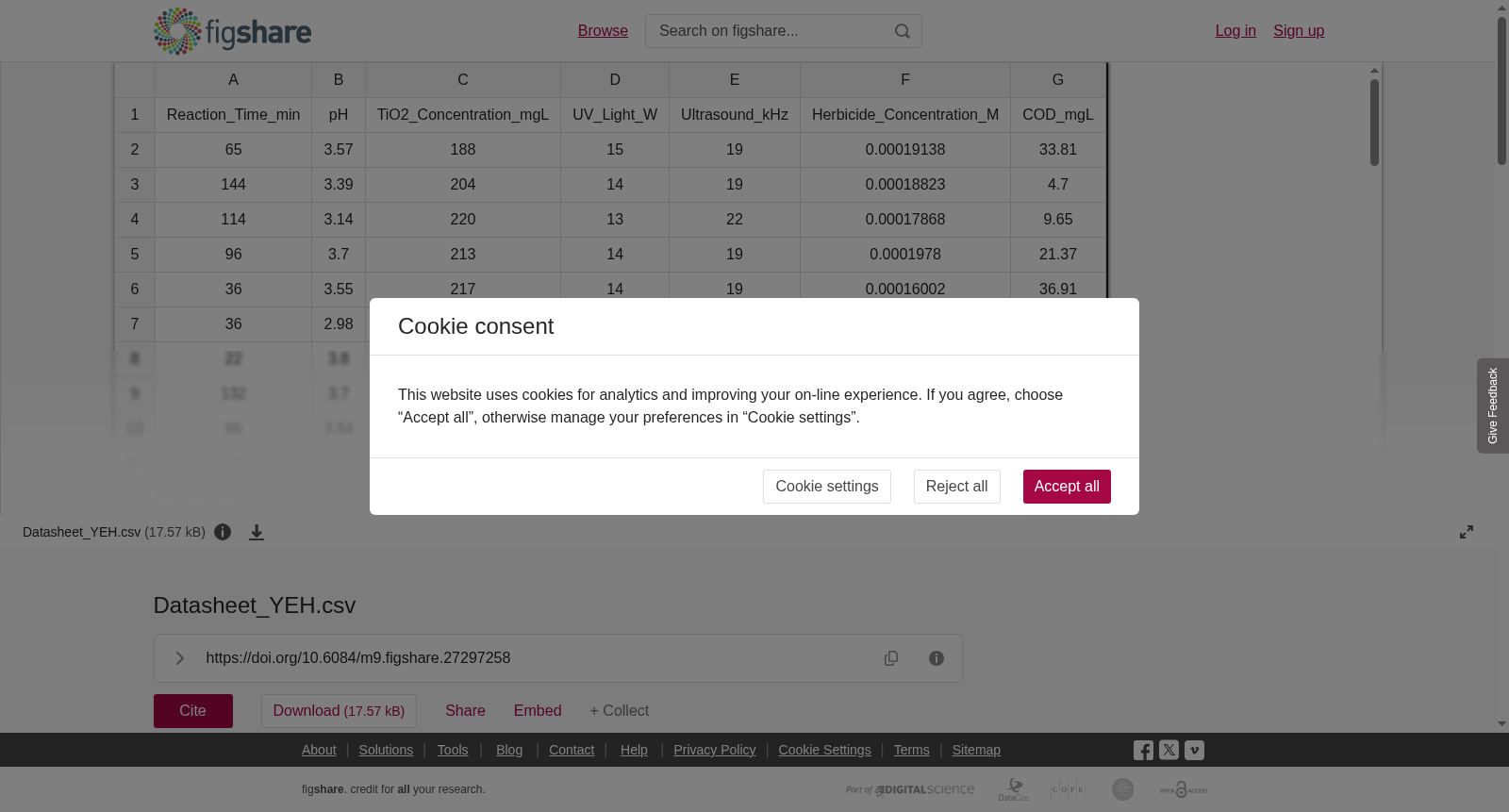
This study presents advanced research on using Artificial Neural Networks (ANNs) to predict Chemical Oxygen Demand (COD) in wastewater treatment, specifically focusing on herbicide degradation. Here are the key aspects:Research Objective:- To develop and evaluate ANN models for predicting COD removal during the degradation of commercial herbicides (Alazine and Gesaprim)- To compare different backpropagation algorithms for training the neural networks- To identify the most influential parameters affecting COD removal<br>Methodology:1. Experimental Setup:- Used a photochemical reactor with 250ml capacity- Employed UV lamp (15W, 352nm) and ultrasonic probe (500W, 20kHz)- Monitored six key variables: * Reaction time * pH * TiO₂ concentration * UV light intensity * Ultrasound frequency * Herbicide concentration<br>2. Neural Network Implementation:- Tested five backpropagation algorithms: * Gradient Descent * Conjugate Gradient * Scaled Conjugate Gradient * Quasi-Newton * Levenberg-Marquardt- Conducted 30 independent runs for each algorithm- Split data: 70% training, 30% testing<br>Key Findings:1. Algorithm Performance:- Levenberg-Marquardt algorithm showed superior performance- Achieved R² value of 0.9999- Demonstrated lowest Mean Square Error (MSE)- Showed statistical significance in performance difference compared to other algorithms<br>2. Parameter Influence:- Reaction time was the most influential parameter (59.91% relative importance)- Followed by: * Herbicide concentration * TiO₂ concentration * pH * Ultrasound frequency * UV light intensity<br>3. Model Accuracy:- Successfully predicted COD values with high precision- Showed strong correlation between experimental and predicted values- Demonstrated robust performance across different operating conditions<br>Significance:- Provides a reliable tool for real-time monitoring of wastewater treatment- Offers potential for process optimization in industrial applications- Contributes to more efficient herbicide removal from contaminated water- Advances the field of environmental engineering through AI application<br>Our research represents a significant advancement in applying machine learning to environmental engineering, particularly in wastewater treatment optimization and herbicide degradation monitoring.<br>
本研究围绕人工神经网络(Artificial Neural Networks,ANNs)用于污水处理化学需氧量(Chemical Oxygen Demand,COD)预测展开前沿研究,重点聚焦除草剂降解过程。核心研究内容如下:
研究目标:
- 构建并评估用于预测商用除草剂(Alazine与Gesaprim)降解过程中COD去除效果的ANN模型
- 对比不同反向传播算法用于神经网络训练的效果
- 识别对COD去除效果影响最显著的参数
研究方法:
1. 实验方案:
- 采用容量为250mL的光化学反应反应器
- 配置15W、波长352nm的紫外灯与500W、频率20kHz的超声波探头
- 监测6项关键变量:反应时间、pH值、二氧化钛(TiO₂)浓度、紫外光强、超声波频率及除草剂浓度
2. 神经网络实现:
- 测试5种反向传播算法:梯度下降法、共轭梯度法、缩放共轭梯度法、拟牛顿法及莱文贝格-马夸特(Levenberg-Marquardt)算法
- 每种算法独立开展30次重复实验
- 将数据集按70%用于训练、30%用于测试的比例划分
关键发现:
1. 算法性能:
- 莱文贝格-马夸特算法表现最优
- 决定系数(R²)达0.9999
- 均方误差(Mean Square Error,MSE)最低
- 与其他算法相比,其性能差异具有统计学显著性
2. 参数影响度:
- 反应时间为影响最显著的参数,相对重要性占比达59.91%
- 其余参数影响度排序依次为:除草剂浓度、二氧化钛(TiO₂)浓度、pH值、超声波频率、紫外光强
3. 模型精度:
- 可高精度预测COD数值
- 实验值与预测值间相关性极强
- 在不同运行工况下均表现出优异的鲁棒性
研究意义:
- 为污水处理的实时监测提供可靠工具
- 为工业应用中的工艺优化提供可行路径
- 助力受污染水体中除草剂的高效去除
- 通过人工智能技术的应用推动环境工程领域发展
本研究将机器学习技术应用于环境工程领域,特别是在污水处理优化与除草剂降解监测方面,实现了重要进展。
提供机构:
figshare创建时间:
2024-10-24
搜集汇总
数据集介绍
背景与挑战
背景概述
该数据集支持一项研究,该研究使用人工神经网络预测废水处理中除草剂降解过程的化学需氧量(COD),重点关注Alazine和Gesaprim两种商业除草剂。研究通过比较五种反向传播算法,发现Levenberg-Marquardt算法性能最佳(R²为0.9999),并识别反应时间为最关键的影响参数(相对重要性59.91%),为废水处理的实时监测和优化提供了AI驱动的工具。
以上内容由遇见数据集搜集并总结生成


