<b>Bromelain Restores Glutamatergic Homeostasis via Regulation of NR2A, GLT-1, EAAC1, and xCT in Arsenic-Induced Cerebral Cortex and Hippocampal Neurotoxicity</b>
收藏资源简介:
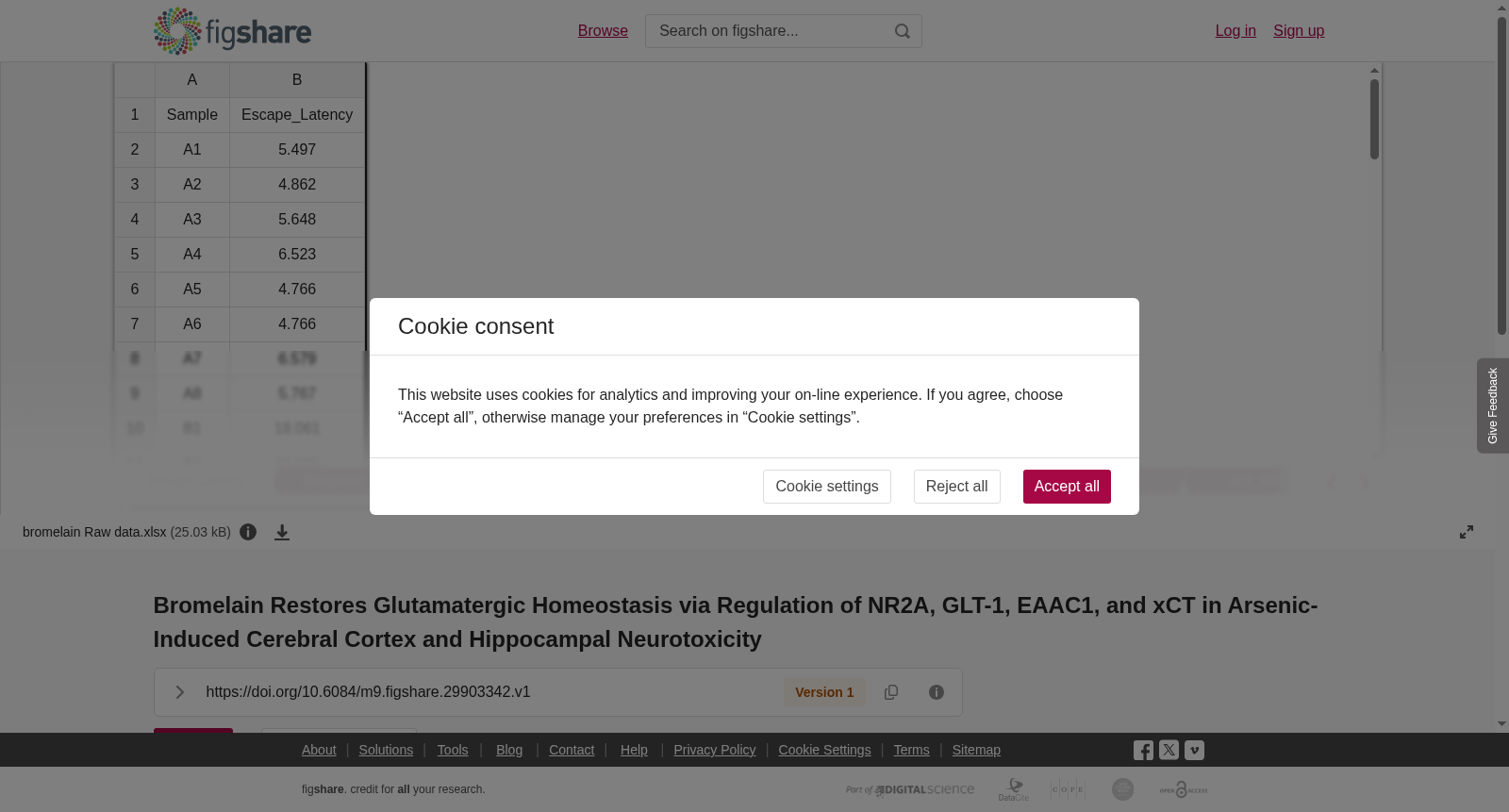
Hippocampal-dependent cognitive impairment induced by chronic exposure to arsenic occurs through excitotoxicity. Pineapple proteolytic enzyme bromelain exhibits neuroprotective effects; however, its role in modulating glutamate-mediated toxicity remains unclear. This study examined the action of bromelain in arsenic-induced cognitive impairment based on the regulation of the NMDA receptor and glutamate transporter in the prefrontal cortex and hippocampus of rats. Seventy-two male Wistar rats were randomized into nine groups (n=8): control; arsenic-only (20 mg/kg, 14 days); three bromelain-only groups (5, 10, 15 mg/kg); three arsenics + bromelain groups (same arsenic dose plus bromelain for 14 days); and arsenic + donepezil (2 mg/kg). Behavioral evaluation was carried out using the Morris water maze, whereas ELISA and RT-qPCR were used to assess brain glutamate levels and gene expression of NR2A, xCT, EAAC1, and GLT1. Below are raw data for • Escape Latency • Mean Glutamate Levels (mM)• NR2A (PFC & HPC)• xCT (PFC & HPC)• EAAC1 (PFC & HPC)• GLT1 (PFC & HPC) <br>
慢性砷暴露诱导的海马依赖性认知损伤可通过兴奋性毒性通路介导。菠萝来源的蛋白水解酶菠萝蛋白酶(bromelain)具备神经保护活性,但其调控谷氨酸介导毒性的具体作用仍未明确。本研究以大鼠前额叶皮层与海马内NMDA受体(N-methyl-D-aspartate receptor)及谷氨酸转运体的调控为切入点,探究了菠萝蛋白酶在砷诱导认知损伤中的作用机制。将72只雄性Wistar大鼠随机分为9组(每组n=8):对照组、单纯砷暴露组(20 mg/kg,持续给药14天)、3个单纯菠萝蛋白酶给药组(剂量分别为5、10、15 mg/kg)、3个砷暴露联合菠萝蛋白酶给药组(同等砷暴露剂量搭配菠萝蛋白酶,持续给药14天)以及砷暴露+多奈哌齐组(2 mg/kg)。行为学评价采用莫里斯水迷宫(Morris water maze)实验;通过ELISA与RT-qPCR分别检测脑内谷氨酸水平,以及NR2A、xCT、EAAC1、GLT1的基因表达水平。以下为原始数据: • 逃避潜伏期 • 平均谷氨酸水平(mM) • NR2A(前额叶皮层与海马) • xCT(前额叶皮层与海马) • EAAC1(前额叶皮层与海马) • GLT1(前额叶皮层与海马)