Target tracking in multibeam water-column images based on acoustic simulation of beam forming artifacts – video results
收藏资源简介:
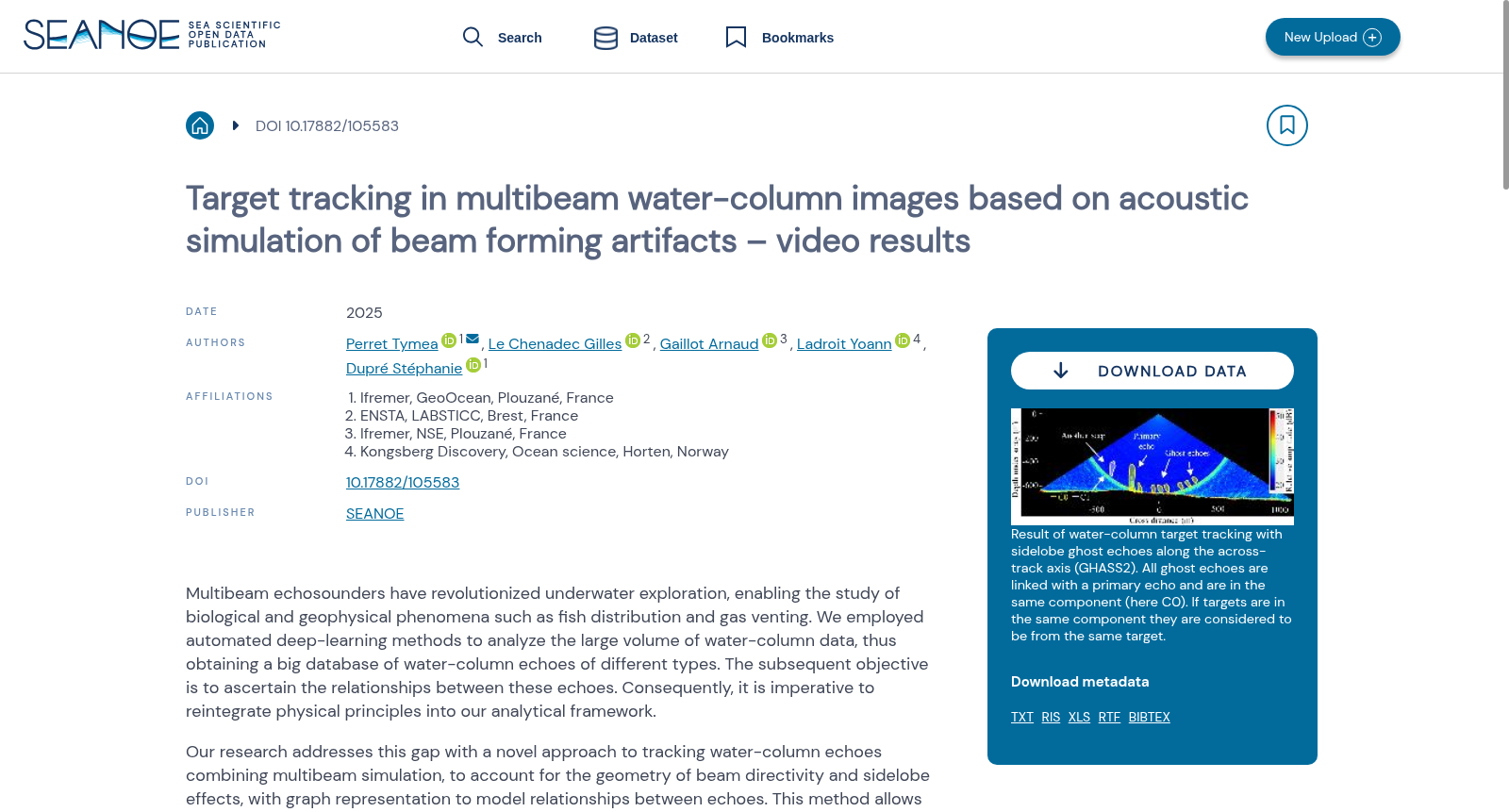
Multibeam echosounders have revolutionized underwater exploration, enabling the study of biological and geophysical phenomena such as fish distribution and gas venting. We employed automated deep-learning methods to analyze the large volume of water-column data, thus obtaining a big database of water-column echoes of different types. The subsequent objective is to ascertain the relationships between these echoes. Consequently, it is imperative to reintegrate physical principles into our analytical framework. Our research addresses this gap with a novel approach to tracking water-column echoes combining multibeam simulation, to account for the geometry of beam directivity and sidelobe effects, with graph representation to model relationships between echoes. This method allows to track and cluster water-column echoes by bridging simulation, graph representation, and acoustic physics. This method identifies whether an echo is a ghost or other echo by (i) approximating the mean sidelobe levels under a simplified hypothesis (ii) simulating the along/across-track positions and levels from an echo detected with an automatic detector and a multibeam survey toolbox and (iii) analyzing geometric and level relationships between echoes from simulated acoustic point clouds. The method then (iv) represents these relationships in the form of a graph that respects multibeam sounder directivity. Importantly, this approach bypasses the need to accurately reproduce sidelobe positions in the directivity pattern, focusing instead on relative acoustic levels and geometric relationships between echoes. We tested this approach on different multibeam surveys to ensure the generalizability of this method. Results demonstrate that our method works effectively in a range of contexts, including echoes of a single target from successive WCIs, ghost echoes in the across and along axes, and multiple distinct target echoes within the same water-column image. This dataset contains videos for the results of the conference article [Target tracking in multibeam water-column images based on acoustic simulation of beam forming artifacts T. Perret, G. Le Chenadec, A. Gaillot, Y. Ladroit and S. Dupré (2025) IEEE OCEANS 2025 Brest]. These videos show the water-column echoes used and the related components of the final graph. The speed of the videos is set to 1 ping (one frame) per second except for the frame in the GHASS2 dataset where we can see the ghost echoes in the across-track axis.
多波束测深仪(multibeam echosounder)彻底革新了水下勘探领域,助力科研人员开展鱼类分布、气体喷溢等生物与地球物理现象的研究。本研究采用自动化深度学习方法对海量水柱数据进行分析,由此构建了涵盖不同类型水柱回波的大型数据库。后续研究目标为明确各类回波间的关联关系,因此有必要将物理原理重新融入分析框架之中。 针对这一研究空白,本研究提出一种全新的水柱回波追踪方法:该方法结合多波束仿真以考量波束指向性几何特性与旁瓣效应,并通过图表征(graph representation)对回波间的关联关系进行建模。该方法通过打通仿真、图表征与声学物理的链路,实现水柱回波的追踪与聚类。本方法通过以下三步识别回波为假回波(ghost echo)还是其他类型回波:(i) 在简化假设下近似平均旁瓣级;(ii) 利用自动检测器与多波束勘探工具箱对检测到的回波,模拟其沿轨/跨轨位置与幅值;(iii) 分析模拟声学点云内回波间的几何关系与幅值关联。随后,该方法(iv)以符合多波束测深仪指向性的图结构形式表征上述关联关系。值得注意的是,该方法无需精准复现指向性图案中的旁瓣位置,而是聚焦于回波间的相对声学幅值与几何关系。 我们在多组不同的多波束勘探数据上测试了该方法,以验证其泛化能力。实验结果表明,本方法在多种场景下均能有效运行:包括连续水柱图像(water-column image, WCI)中单目标的回波、跨轨与沿轨方向的假回波,以及同一张水柱图像内的多个不同目标回波。 本数据集包含对应会议论文《基于波束形成伪影声学仿真的多波束水柱图像目标追踪》(T. Perret、G. Le Chenadec、A. Gaillot、Y. Ladroit与S. Dupré,2025年IEEE OCEANS 2025 Brest会议)研究成果的演示视频。这些视频展示了所使用的水柱回波,以及最终图结构的相关组成部分。视频播放速率设置为每秒1个声脉冲(ping),即1帧;GHASS2数据集的相关片段除外,该片段可展示跨轨方向的假回波。