Blue to black: Hypotheses on plant use complexity in traditional dyeing processes in Southeast Asia and China
收藏资源简介:
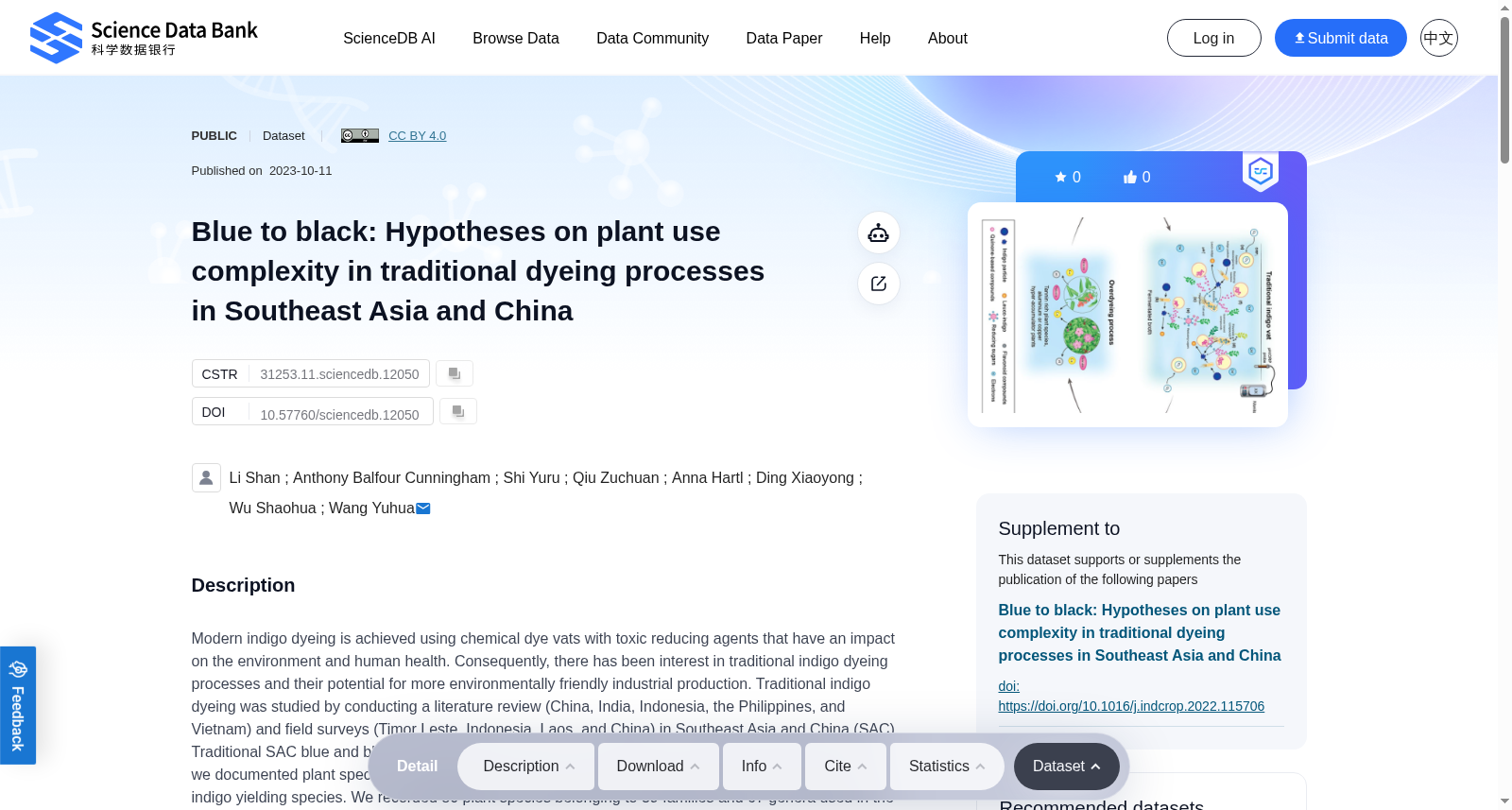
Modern indigo dyeing is achieved using chemical dye vats with toxic reducing agents that have an impact on the environment and human health. Consequently, there has been interest in traditional indigo dyeing processes and their potential for more environmentally friendly industrial production. Traditional indigo dyeing was studied by conducting a literature review (China, India, Indonesia, the Philippines, and Vietnam) and field surveys (Timor Leste, Indonesia, Laos, and China) in Southeast Asia and China (SAC). Traditional SAC blue and black dyeing processes can be a combination of separate dyeing steps. Here, we documented plant species and ingredients in the blue to black dyeing processes used in addition to indigo yielding species. We recorded 80 plant species belonging to 39 families and 67 genera used in the “blue to black” dye processes in SAC. Owing to local use and phytochemicals or microbial substances of these species and their function in the dyeing processes, eight hypotheses for added species, including lime or ash water, microorganisms, food for microorganisms, electron donors, electron mediators, reducing sugars, metallic mordants, and tannins were suggested herein. The combination of hypotheses was supported by the findings and theories of previous studies and clarifies why these particular plant species are likely added to dye vats. The hypotheses and theories derived from this study pave the way for insights into indigo dyeing processes that reduce inorganic chemical additives using additional plant products, which consequently may provide a green route for cleaner production strategies. This research identifies gaps in knowledge and highlights where further work is needed to verify the hypotheses proposed for adding products to dye vats in the future.
现代靛蓝染色工艺多采用含有有毒还原剂的化学染缸,此类工艺会对环境与人体健康造成负面影响。因此,传统靛蓝染色工艺及其在更环保工业生产中的应用潜力受到了学界关注。本研究针对传统靛蓝染色工艺展开研究:针对东南亚及中国(SAC)地区开展文献调研(覆盖中国、印度、印度尼西亚、菲律宾与越南)与实地考察(覆盖东帝汶、印度尼西亚、老挝与中国)。SAC地区传统蓝黑染色工艺可由多步独立染色工序组合而成。本研究记录了该地区蓝黑染色工艺中,除产靛蓝物种外所使用的植物物种与辅料成分。本次调研共记录到SAC地区蓝黑染色工艺中使用的80种植物,隶属于39科67属。基于这些物种的本土应用场景、植物化学物质或微生物组分,及其在染色工艺中的作用,本研究针对辅助添加物种提出了八项假说,涵盖石灰/草木灰水、微生物、微生物营养底物、电子供体、电子介体、还原糖、金属媒染剂与单宁。上述假说组合得到了既往研究成果与理论的支持,阐明了为何此类特定植物物种会被添加至染缸中。本研究提出的假说与理论,为探索通过添加植物基辅料以减少无机化学添加剂的靛蓝染色工艺提供了研究思路,进而可为清洁生产战略提供绿色可行路径。本研究同时明确了现有认知缺口,并指出未来需开展相关研究以验证染缸辅料添加相关假说的具体方向。