
juliensimon/celestrak-space-weather
收藏Hugging Face2026-03-28 更新2026-03-29 收录
下载链接:
https://hf-mirror.com/datasets/juliensimon/celestrak-space-weather
下载链接
链接失效反馈官方服务:
资源简介:
---
license: cc-by-4.0
pretty_name: "CelesTrak Consolidated Space Weather"
language:
- en
description: >-
CelesTrak consolidated space weather data — daily Kp, Ap, F10.7, and solar/geomagnetic
indices used by SGP4/SDP4 propagators, atmospheric models (JB2008, NRLMSISE), and
conjunction screening. 25,245 daily records from 1957-10-01 to 2041-10-01.
size_categories:
- 10K<n<100K
task_categories:
- tabular-regression
- time-series-forecasting
tags:
- space
- space-weather
- celestrak
- sgp4
- atmospheric-drag
- orbit-propagation
- open-data
- tabular-data
- parquet
configs:
- config_name: default
data_files:
- split: train
path: data/celestrak_space_weather.parquet
---
# CelesTrak Consolidated Space Weather
*Part of the [Space Weather Datasets](https://huggingface.co/collections/juliensimon/space-weather-datasets-69c24cae98f1666f2101ca70) collection on Hugging Face.*


CelesTrak consolidated space weather data — **THE** file every orbit propagator needs.
**25,245** daily records from **1957-10-01** to **2041-10-01**, with 31 columns of
solar and geomagnetic indices.
## Dataset description
This dataset contains the consolidated space weather data file maintained by CelesTrak
(Dr. T.S. Kelso). It includes daily values of Kp indices (8 three-hour values per day),
Ap indices, F10.7 solar radio flux, and other solar/geomagnetic parameters essential for:
- **SGP4/SDP4 orbit propagation** — atmospheric drag modeling
- **Atmospheric density models** — JB2008, NRLMSISE-00, DTM
- **Conjunction screening** — collision avoidance maneuver planning
- **Space weather research** — solar cycle analysis, geomagnetic storm studies
## Schema
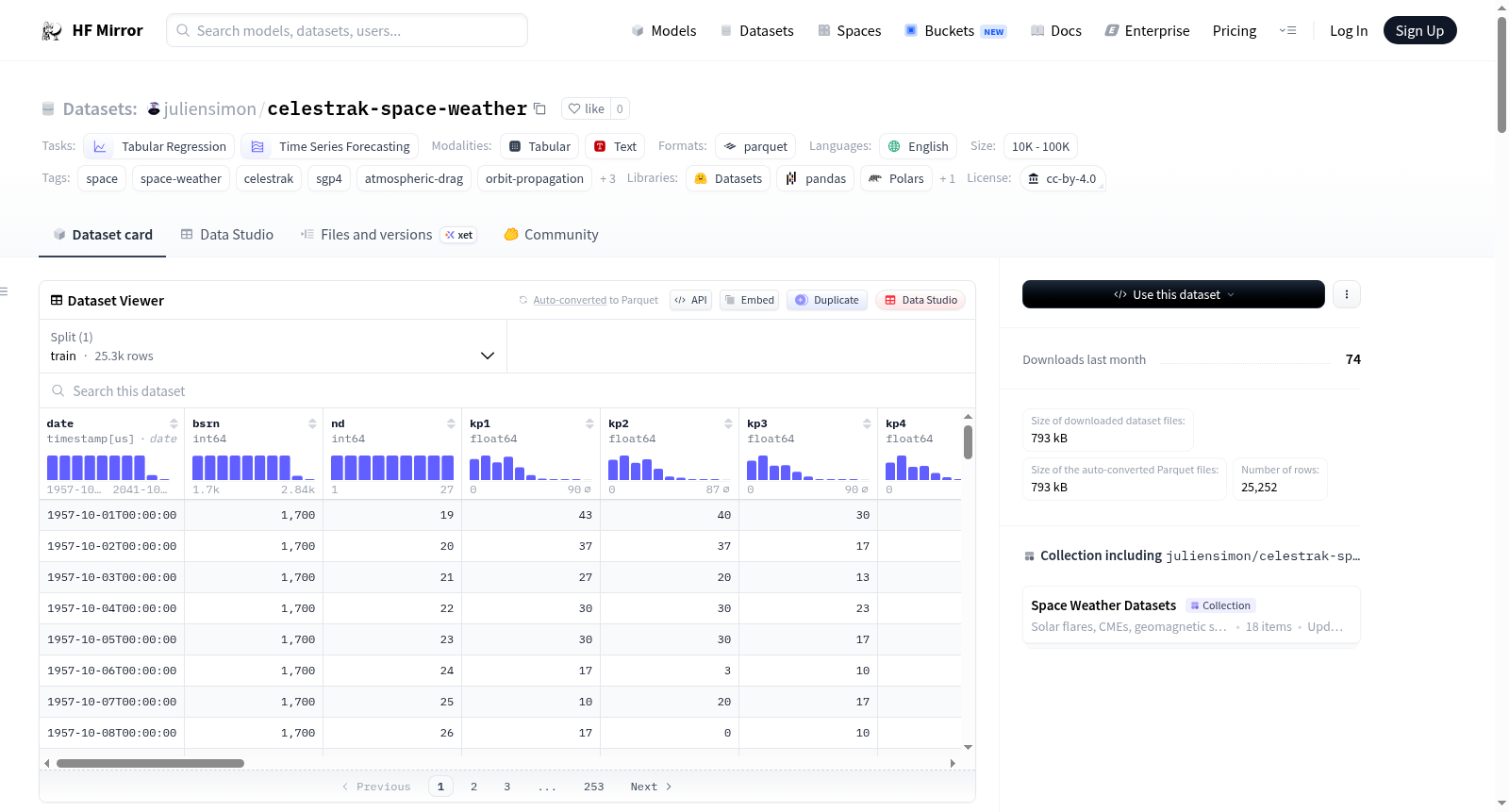
| Column | Type |
|--------|------|
| `date` | datetime64[us] |
| `bsrn` | int64 |
| `nd` | int64 |
| `kp1` | float64 |
| `kp2` | float64 |
| `kp3` | float64 |
| `kp4` | float64 |
| `kp5` | float64 |
| `kp6` | float64 |
| `kp7` | float64 |
| `kp8` | float64 |
| `kp_sum` | float64 |
| `ap1` | float64 |
| `ap2` | float64 |
| `ap3` | float64 |
| `ap4` | float64 |
| `ap5` | float64 |
| `ap6` | float64 |
| `ap7` | float64 |
| `ap8` | float64 |
| `ap_avg` | float64 |
| `cp` | float64 |
| `c9` | float64 |
| `isn` | int64 |
| `f10_7_obs` | float64 |
| `f10_7_adj` | float64 |
| `f10_7_data_type` | str |
| `f10_7_obs_center81` | float64 |
| `f10_7_obs_last81` | float64 |
| `f10_7_adj_center81` | float64 |
| `f10_7_adj_last81` | float64 |
## Quick stats
- **25,245** daily records
- Date range: **1957-10-01** to **2041-10-01**
- **31** columns
## Usage
```python
from datasets import load_dataset
ds = load_dataset("juliensimon/celestrak-space-weather", split="train")
df = ds.to_pandas()
# Recent space weather
print(df.tail(10))
# Plot F10.7 solar flux over time
import matplotlib.pyplot as plt
fig, ax = plt.subplots(figsize=(14, 4))
ax.plot(df["date"], df.get("f10_7_obs", df.iloc[:, -1]), linewidth=0.5)
ax.set_xlabel("Date")
ax.set_ylabel("F10.7 (SFU)")
ax.set_title("Solar Radio Flux (F10.7)")
```
## Update frequency
Updated **daily at 12:00 UTC** via GitHub Actions.
## Data source
[CelesTrak Space Data](https://celestrak.org/SpaceData/) (Dr. T.S. Kelso).
Original data from NOAA SWPC, USAF, and other agencies.
## Related datasets
- [kp-index](https://huggingface.co/datasets/juliensimon/kp-index) -- GFZ Potsdam Kp geomagnetic index
- [dst-index](https://huggingface.co/datasets/juliensimon/dst-index) -- WDC Kyoto Dst geomagnetic index
- [solar-wind](https://huggingface.co/datasets/juliensimon/solar-wind) -- DSCOVR real-time solar wind
- [f107-index](https://huggingface.co/datasets/juliensimon/f107-index) -- NRCan F10.7 solar radio flux
## Pipeline
Source code: [juliensimon/space-datasets](https://github.com/juliensimon/space-datasets)
## Support
If you find this dataset useful, please give it a ❤️ on the [dataset page](https://huggingface.co/datasets/juliensimon/celestrak-space-weather) and share feedback in the Community tab! Also consider giving a ⭐️ to the [space-datasets](https://github.com/juliensimon/space-datasets) repo.
## Citation
```bibtex
@dataset{celestrak_space_weather,
author = {Simon, Julien},
title = {CelesTrak Consolidated Space Weather},
year = {2026},
publisher = {Hugging Face},
url = {https://huggingface.co/datasets/juliensimon/celestrak-space-weather},
note = {Based on CelesTrak Space Data (Dr. T.S. Kelso)}
}
```
## License
[CC-BY-4.0](https://creativecommons.org/licenses/by/4.0/)
提供机构:
juliensimon
搜集汇总
数据集介绍
构建方式
在空间天气监测领域,CelesTrak空间天气数据集通过整合多源观测数据构建而成。该数据集由CelesTrak的T.S. Kelso博士维护,系统性地汇集了来自美国国家海洋和大气管理局空间天气预报中心的地磁Kp与Ap指数、德国地球科学研究中心的确切地磁指数,以及加拿大国家研究委员会赫兹伯格研究所的F10.7太阳射电流量测量值。这些数据经过标准化处理,形成统一格式的每日时间序列,覆盖从1957年10月1日至2041年10月1日的完整记录,共计25,252个日度观测点,并包含未来45天的预测值,以满足实时轨道预报的需求。
特点
该数据集的核心特征在于其作为空间态势感知领域的实际标准输入文件,具备高度的权威性与实用性。数据集包含31个关键参数,涵盖每日八个时段的三小时Kp与Ap指数、F10.7太阳射电流量及其81日滑动平均值,以及太阳黑子数等地磁与太阳活动指标。其时间跨度覆盖了从第19至第25太阳周期的完整太阳活动循环,为研究太阳周期变化对近地轨道环境的影响提供了长期基准。数据格式兼容传统Fortran传播器与现代Python/C++的SGP4实现,确保了在轨道确定、大气密度建模及碰撞规避规划等操作中的直接适用性。
使用方法
在轨道力学与空间环境研究中,该数据集主要服务于卫星轨道传播与空间天气分析。用户可通过Hugging Face的datasets库直接加载数据,转换为Pandas DataFrame进行后续处理。数据集的关键参数如每日Ap指数和三小时Ap序列是NRLMSISE-00等大气密度模型的核心输入,而F10.7流量及其滑动平均值则用于量化太阳极紫外辐射对热层的影响。研究人员可利用该数据执行时间序列预测、太阳活动周期分析,或集成至SGP4/SDP4轨道传播器中,以提升大气阻力建模的精度,支持卫星星座的轨道维持规划与碰撞风险评估。
背景与挑战
背景概述
CelesTrak空间天气数据集由CelesTrak机构维护,其核心工作由T.S. Kelso博士主导,旨在为轨道力学与空间态势感知领域提供标准化的空间天气参数。该数据集整合了自1957年国际地球物理年以来长达数十年的日值观测与预测数据,覆盖了完整的太阳活动周期,为SGP4/SDP4轨道预报模型、大气密度模型(如JB2008、NRLMSISE-00)以及航天器碰撞规避分析提供了不可或缺的输入。作为空间监视领域的实际标准,它深刻影响了卫星轨道确定、空间碎片研究与空间天气预测的发展,推动了高精度航天动力学模型的进步。
当前挑战
该数据集致力于解决空间天气对航天器轨道预报影响的量化难题,其核心挑战在于如何精确建模太阳辐射与地磁活动引起的大气密度变化,以降低轨道预报误差。在构建过程中,挑战体现在多源异构数据的融合上,需协调来自NOAA、GFZ Potsdam等不同机构的观测数据,确保时间序列的一致性与完整性;同时,维持数据的实时更新与长期预测的可靠性,以支持航天任务中紧迫的碰撞风险评估与轨道维持规划,亦是持续面临的考验。
常用场景
经典使用场景
在空间态势感知与轨道动力学领域,CelesTrak空间天气数据集作为标准输入源,其经典应用场景在于支持SGP4/SDP4等轨道预报模型的精确运行。该数据集提供的每日Kp、Ap指数及F10.7太阳射电流量等关键参数,直接驱动大气密度模型(如NRLMSISE-00、JB2008)计算高层大气阻力,从而实现对近地轨道卫星位置的高精度预测与长期演化模拟。
实际应用
在实际操作层面,该数据集是卫星碰撞预警与规避机动规划的关键支撑。航天机构利用其实时与预报数据,评估在轨卫星所受的大气阻力差异,精确计算近距离交会风险,并优化轨道维持策略。此外,商业卫星星座运营商依赖该数据预测燃料消耗与轨道寿命,从而提升星座管理的经济性与安全性。
衍生相关工作
围绕该数据集衍生的经典工作主要包括高精度轨道确定与预报算法的持续优化,例如结合机器学习方法改进大气阻力系数估计的研究。同时,基于其长期序列的太阳活动与地磁暴关联性分析,催生了多项空间天气气候学的前沿研究。数据集也常被集成于开源轨道力学库(如Python的sgp4)和空间态势感知平台,成为学术界与工业界标准工具链的核心组成部分。
以上内容由遇见数据集搜集并总结生成



