贵州苗、侗、布依族人群生活行为因素与疾病关联数据集
收藏资源简介:
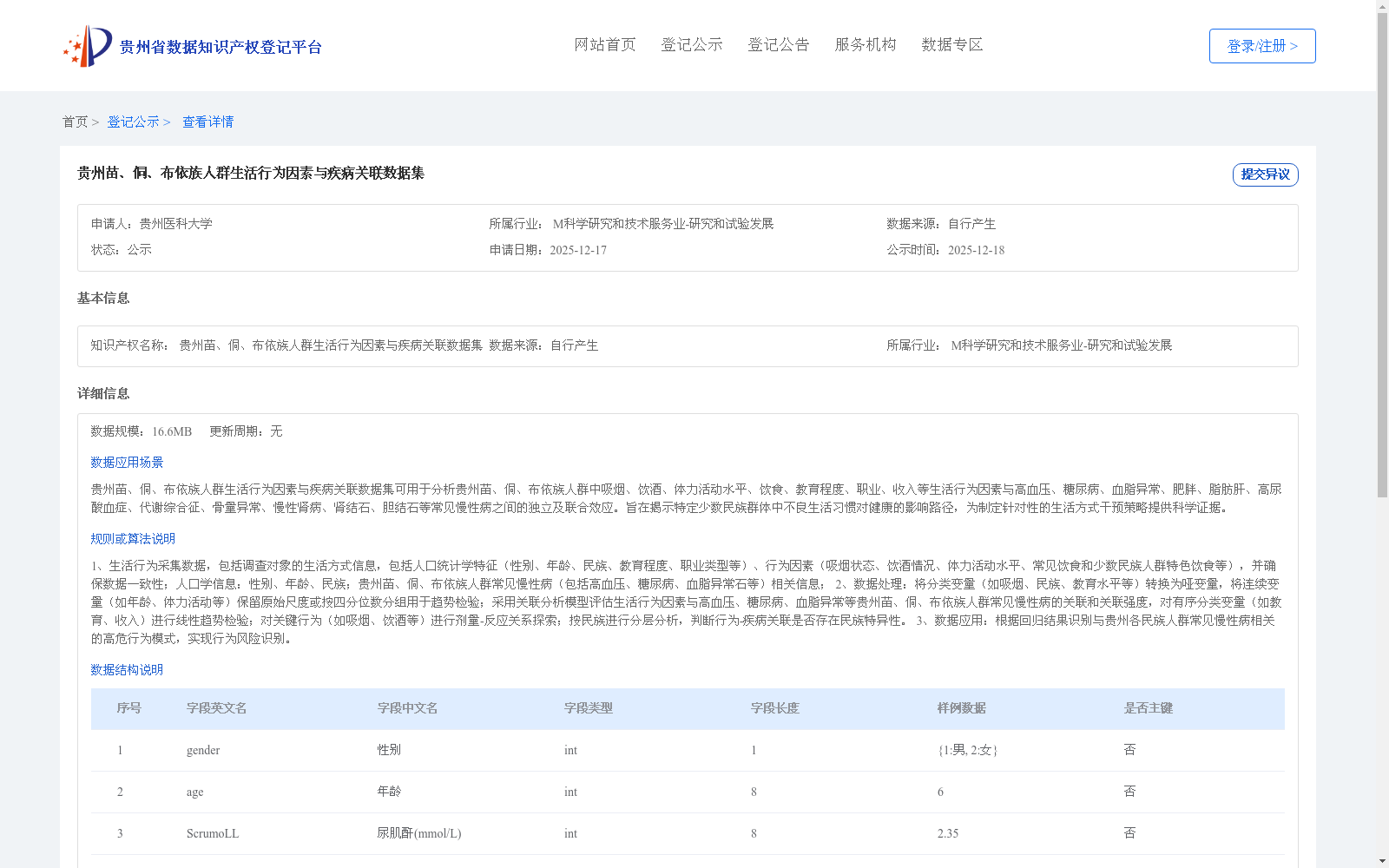
1、生活行为采集数据,包括调查对象的生活方式信息,包括人口统计学特征(性别、年龄、民族、教育程度、职业类型等)、行为因素(吸烟状态、饮酒情况、体力活动水平、常见饮食和少数民族人群特色饮食等),并确保数据一致性;人口学信息:性别、年龄、民族;贵州苗、侗、布依族人群常见慢性病(包括高血压、糖尿病、血脂异常石等)相关信息; 2、数据处理:将分类变量(如吸烟、民族、教育水平等)转换为哑变量,将连续变量(如年龄、体力活动等)保留原始尺度或按四分位数分组用于趋势检验;采用关联分析模型评估生活行为因素与高血压、糖尿病、血脂异常等贵州苗、侗、布依族人群常见慢性病的关联和关联强度,对有序分类变量(如教育、收入)进行线性趋势检验;对关键行为(如吸烟、饮酒等)进行剂量-反应关系探索;按民族进行分层分析,判断行为-疾病关联是否存在民族特异性。 3、数据应用:根据回归结果识别与贵州各民族人群常见慢性病相关的高危行为模式,实现行为风险识别。
1. Lifestyle behavior collection data: This dataset collects lifestyle information of survey respondents, including demographic characteristics (gender, age, ethnicity, educational level, occupation type, etc.) and behavioral factors (smoking status, alcohol consumption, physical activity level, common diets and characteristic diets of ethnic minority groups, etc.), with data consistency guaranteed. It also includes demographic information of gender, age and ethnicity, as well as relevant data on common chronic diseases (including hypertension, diabetes, dyslipidemia, etc.) among the Miao, Dong and Bouyei ethnic groups in Guizhou Province. 2. Data processing: Convert categorical variables (e.g., "smoking status", "ethnicity", "educational level", etc.) into dummy variables; retain continuous variables (e.g., "age", "physical activity", etc.) in their original scale or group them by quartiles for trend testing. Adopt association analysis models to evaluate the associations and their strengths between lifestyle behavioral factors and common chronic diseases (hypertension, diabetes, dyslipidemia, etc.) among the Miao, Dong and Bouyei ethnic groups in Guizhou. Conduct linear trend tests for ordinal categorical variables (e.g., "education", "income", etc.); explore dose-response relationships for key behaviors (e.g., "smoking", "alcohol consumption", etc.); perform stratified analyses by ethnicity to determine whether behavioral-disease associations have ethnic specificity. 3. Data application: Identify high-risk behavioral patterns associated with common chronic diseases among ethnic groups in Guizhou based on regression results, so as to realize behavioral risk identification.