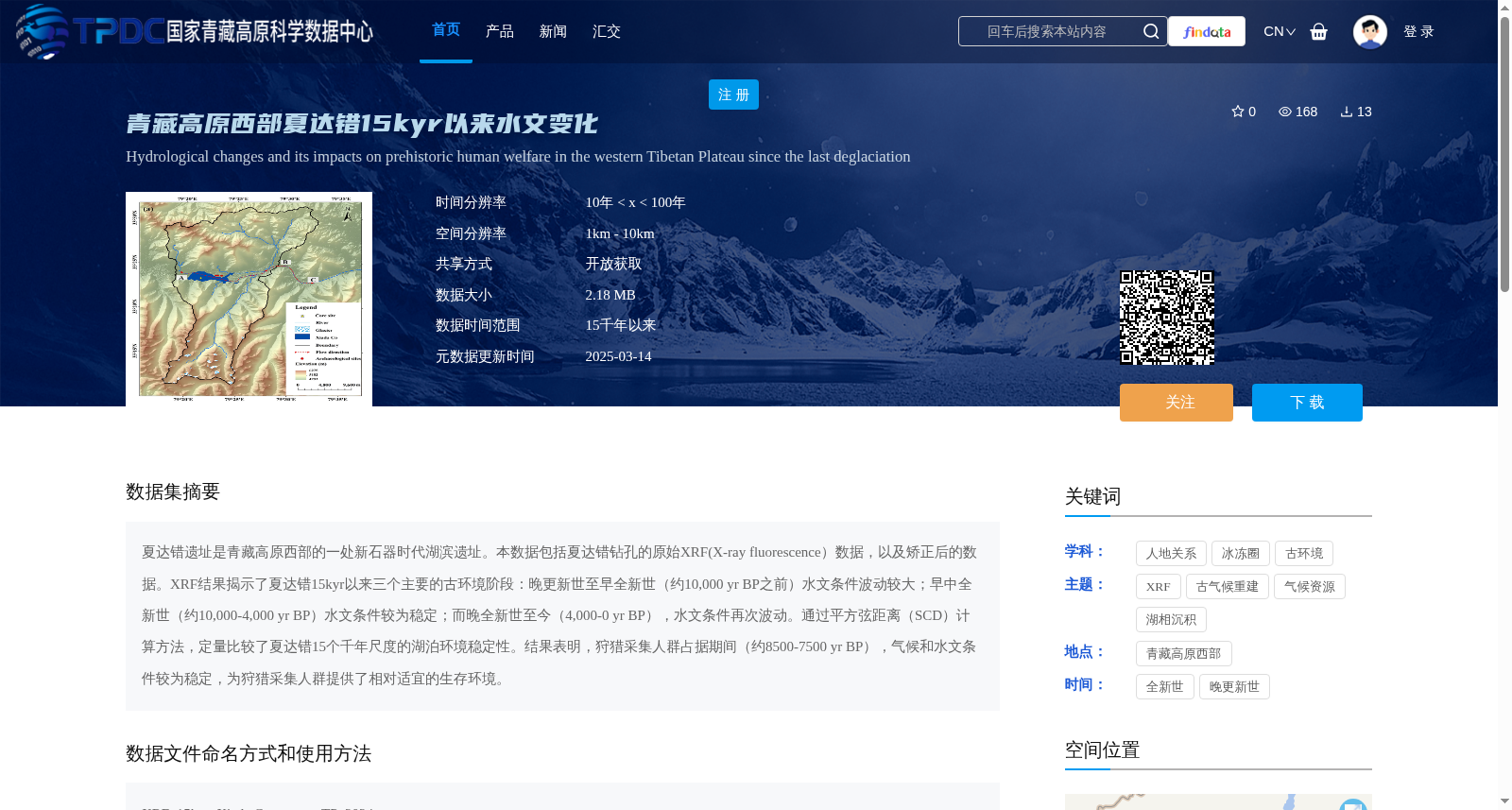
青藏高原西部夏达错15kyr以来水文变化
收藏资源简介:
夏达错遗址是青藏高原西部的一处新石器时代湖滨遗址。本数据包括夏达错钻孔的原始XRF(X-ray fluorescence)数据,以及矫正后的数据。XRF结果揭示了夏达错15kyr以来三个主要的古环境阶段:晚更新世至早全新世(约10,000 yr BP之前)水文条件波动较大;早中全新世(约10,000-4,000 yr BP)水文条件较为稳定;而晚全新世至今(4,000-0 yr BP),水文条件再次波动。通过平方弦距离(SCD)计算方法,定量比较了夏达错15个千年尺度的湖泊环境稳定性。结果表明,狩猎采集人群占据期间(约8500-7500 yr BP),气候和水文条件较为稳定,为狩猎采集人群提供了相对适宜的生存环境。
The Xiadacuo Site is a Neolithic lakeshore site situated in the western Qinghai-Tibet Plateau. This dataset contains the original X-ray fluorescence (XRF) data and the corrected data from the Xiadacuo drill core. The XRF results identify three major paleoenvironmental phases for the Xiadacuo Lake over the past 15 kyr: the Late Pleistocene to Early Holocene (before ~10,000 yr BP), which experienced highly fluctuating hydrological conditions; the Early to Middle Holocene (~10,000–4,000 yr BP), which had relatively stable hydrological conditions; and the Late Holocene to present (4,000–0 yr BP), when hydrological conditions resumed fluctuating. Using the squared chord distance (SCD) calculation method, we quantitatively compared the lake environmental stability at Xiadacuo across the 15-kyr timescale. The results indicate that during the period when hunter-gatherer groups inhabited the area (~8,500–7,500 yr BP), the climatic and hydrological conditions were relatively stable, providing a comparatively favorable living environment for these hunter-gatherer populations.