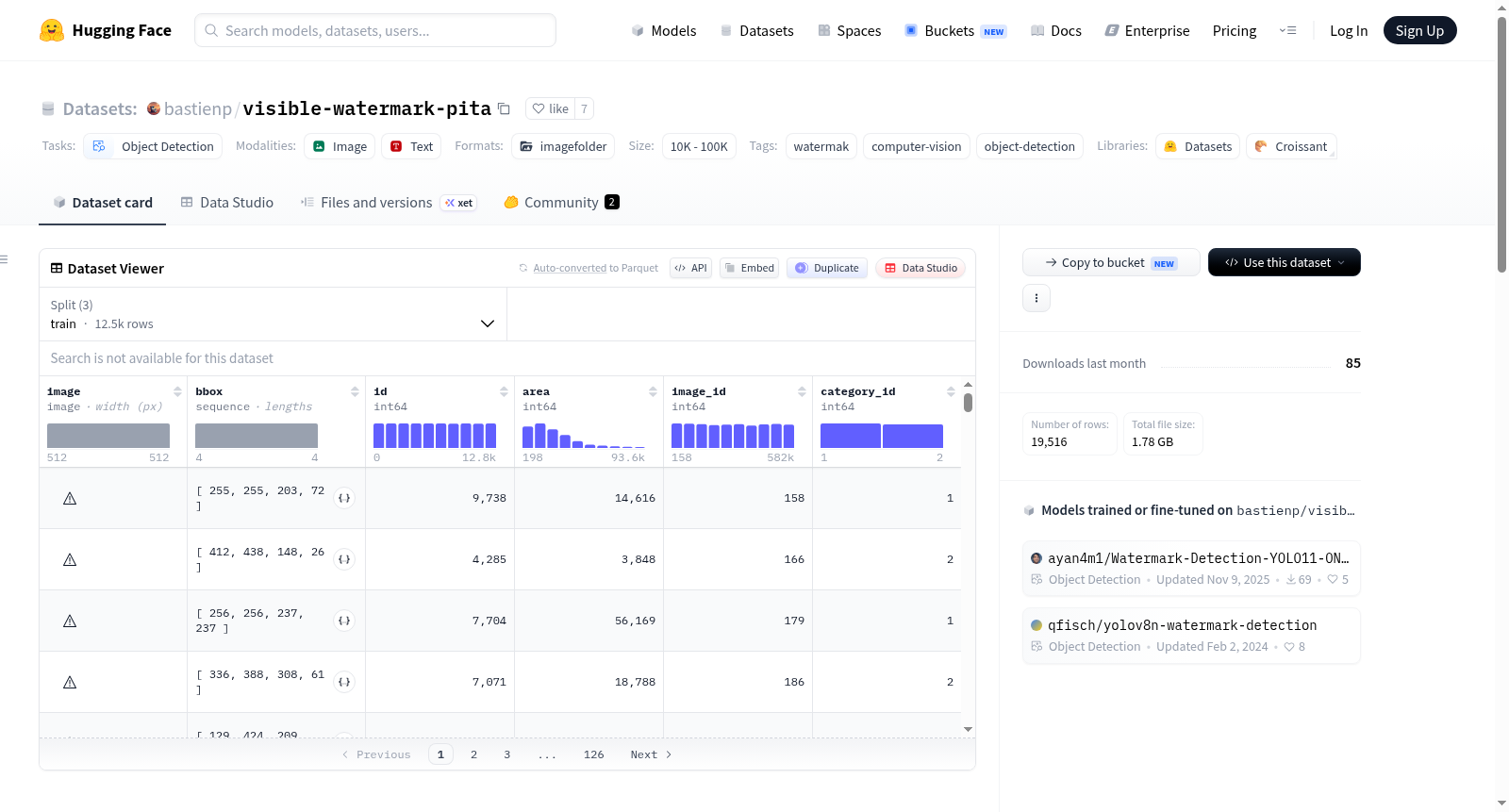
bastienp/visible-watermark-pita
收藏资源简介:
--- task_categories: - object-detection tags: - watermak - computer-vision - object-detection configs: - config_name: default data_files: - split: train path: "data/train.zip" - split: test path: "data/test.zip" - split: val path: "data/val.zip" --- # Dataset Card for Dataset Name <!-- Provide a quick summary of the dataset. --> This dataset card aims to be a base template for new datasets. It has been generated using [this raw template](https://github.com/huggingface/huggingface_hub/blob/main/src/huggingface_hub/templates/datasetcard_template.md?plain=1). ## Dataset Details ### Dataset Description <!-- Provide a longer summary of what this dataset is. --> - **Curated by:** [More Information Needed] - **Funded by [optional]:** [More Information Needed] - **Shared by [optional]:** [More Information Needed] - **Language(s) (NLP):** [More Information Needed] - **License:** [More Information Needed] ### Dataset Sources [optional] <!-- Provide the basic links for the dataset. --> - **Repository:** [More Information Needed] - **Paper [optional]:** [More Information Needed] - **Demo [optional]:** [More Information Needed] ## Uses <!-- Address questions around how the dataset is intended to be used. --> ### Direct Use <!-- This section describes suitable use cases for the dataset. --> [More Information Needed] ### Out-of-Scope Use <!-- This section addresses misuse, malicious use, and uses that the dataset will not work well for. --> [More Information Needed] ## Dataset Structure <!-- This section provides a description of the dataset fields, and additional information about the dataset structure such as criteria used to create the splits, relationships between data points, etc. --> [More Information Needed] ## Dataset Creation ### Curation Rationale <!-- Motivation for the creation of this dataset. --> [More Information Needed] ### Source Data <!-- This section describes the source data (e.g. news text and headlines, social media posts, translated sentences, ...). --> #### Data Collection and Processing <!-- This section describes the data collection and processing process such as data selection criteria, filtering and normalization methods, tools and libraries used, etc. --> [More Information Needed] #### Who are the source data producers? <!-- This section describes the people or systems who originally created the data. It should also include self-reported demographic or identity information for the source data creators if this information is available. --> [More Information Needed] ### Annotations [optional] <!-- If the dataset contains annotations which are not part of the initial data collection, use this section to describe them. --> #### Annotation process <!-- This section describes the annotation process such as annotation tools used in the process, the amount of data annotated, annotation guidelines provided to the annotators, interannotator statistics, annotation validation, etc. --> [More Information Needed] #### Who are the annotators? <!-- This section describes the people or systems who created the annotations. --> [More Information Needed] #### Personal and Sensitive Information <!-- State whether the dataset contains data that might be considered personal, sensitive, or private (e.g., data that reveals addresses, uniquely identifiable names or aliases, racial or ethnic origins, sexual orientations, religious beliefs, political opinions, financial or health data, etc.). If efforts were made to anonymize the data, describe the anonymization process. --> [More Information Needed] ## Bias, Risks, and Limitations <!-- This section is meant to convey both technical and sociotechnical limitations. --> [More Information Needed] ### Recommendations <!-- This section is meant to convey recommendations with respect to the bias, risk, and technical limitations. --> Users should be made aware of the risks, biases and limitations of the dataset. More information needed for further recommendations. ## Citation [optional] <!-- If there is a paper or blog post introducing the dataset, the APA and Bibtex information for that should go in this section. --> **BibTeX:** [More Information Needed] **APA:** [More Information Needed] ## Licence: Annotations & Website The annotations in this dataset along with this website belong to the COCO Consortium and are licensed under a Creative Commons Attribution 4.0 License. Images The COCO Consortium does not own the copyright of the images. Use of the images must abide by the Flickr Terms of Use. The users of the images accept full responsibility for the use of the dataset, including but not limited to the use of any copies of copyrighted images that they may create from the dataset. ## Glossary [optional] <!-- If relevant, include terms and calculations in this section that can help readers understand the dataset or dataset card. --> [More Information Needed] ## More Information [optional] [More Information Needed] ## Dataset Card Authors [optional] [More Information Needed] ## Dataset Card Contact [More Information Needed]
任务类别: - 目标检测(object-detection) 标签: - 水印(watermak) - 计算机视觉(computer-vision) - 目标检测(object-detection) 配置项: - 配置名称:default 数据文件: - 拆分集:训练集(train) 路径:"data/train.zip" - 拆分集:测试集(test) 路径:"data/test.zip" - 拆分集:验证集(val) 路径:"data/val.zip" # 数据集名称 数据集卡片 <!-- 提供该数据集的简要概述。 --> 本数据集卡片旨在作为新建数据集的基础模板,其基于[原始模板](https://github.com/huggingface/huggingface_hub/blob/main/src/huggingface_hub/templates/datasetcard_template.md?plain=1)生成。 ## 数据集详情 ### 数据集描述 <!-- 提供该数据集的详细概述。 --> - **整理方:** [需补充更多信息] - **资助方(可选):** [需补充更多信息] - **共享方(可选):** [需补充更多信息] - **自然语言处理所用语言:** [需补充更多信息] - **许可证:** [需补充更多信息] ### 数据集来源(可选) <!-- 提供该数据集的基础链接信息。 --> - **代码仓库:** [需补充更多信息] - **相关论文(可选):** [需补充更多信息] - **演示示例(可选):** [需补充更多信息] ## 使用场景 ### 直接使用 <!-- 本节描述该数据集的适用场景。 --> [需补充更多信息] ### 超出适用范围的使用场景 <!-- 本节说明该数据集不适用于的场景、恶意使用场景,以及无法良好适配的使用情况。 --> [需补充更多信息] ## 数据集结构 <!-- 本节描述数据集的字段信息,以及数据集拆分依据、数据点间关联关系等额外结构信息。 --> [需补充更多信息] ## 数据集构建 ### 构建依据 <!-- 说明创建该数据集的动机。 --> [需补充更多信息] ### 源数据 <!-- 本节描述源数据的相关信息,例如新闻文本与标题、社交媒体帖文、译句等。 --> #### 数据收集与处理 <!-- 本节说明数据收集与处理流程,包括数据筛选标准、过滤与归一化方法、所用工具与库等。 --> [需补充更多信息] #### 源数据生产者 <!-- 本节说明最初创建该数据的个人或系统。若可获取源数据创作者的自我报告人口统计或身份信息,也应在此处说明。 --> [需补充更多信息] ### 标注信息(可选) <!-- 若数据集包含初始数据收集之外的标注内容,请在本节说明相关信息。 --> #### 标注流程 <!-- 本节说明标注流程,包括所用标注工具、已标注数据量、向标注人员提供的标注指南、标注者间一致性统计、标注验证方式等。 --> [需补充更多信息] #### 标注人员 <!-- 本节说明创建标注内容的个人或系统。 --> [需补充更多信息] #### 个人与敏感信息说明 <!-- 说明本数据集是否包含可被视为个人、敏感或隐私的数据(例如:显示地址、唯一可识别的姓名或别名、种族或族裔起源、性取向、宗教信仰、政治观点、财务或健康数据等)。若已对数据进行匿名化处理,请说明匿名化流程。 --> [需补充更多信息] ## 偏差、风险与局限性 <!-- 本节旨在说明技术与社会技术层面的局限性。 --> ### 建议 <!-- 本节针对数据集的偏差、风险与技术局限性给出相关建议。 --> 用户应充分知晓本数据集存在的各类风险、偏差与局限性,相关推荐建议仍需补充更多信息后方可完善。 ## 引用信息(可选) <!-- 若有介绍该数据集的论文或博客文章,请在此处提供其APA与BibTeX格式的引用信息。 --> **BibTeX 格式:** [需补充更多信息] **APA 格式:** [需补充更多信息] ## 许可证说明: ### 标注内容与本网站 本数据集内的标注内容及本网站内容归属于COCO联盟,并采用知识共享署名4.0国际许可协议(Creative Commons Attribution 4.0 License)进行授权。 ### 图片资源 COCO联盟不享有图片的版权。使用图片需遵守Flickr服务条款。图片使用者需对本数据集的使用承担全部责任,包括但不限于对从本数据集生成的任何受版权保护的图片副本的使用。 ## 术语表(可选) <!-- 若有需要,可在此处添加帮助读者理解数据集或数据集卡片的术语与计算公式。 --> [需补充更多信息] ## 更多信息(可选) [需补充更多信息] ## 数据集卡片撰写者(可选) [需补充更多信息] ## 数据集卡片联系方式 [需补充更多信息]
数据集详情
数据集描述
- 任务类别: 目标检测
- 标签:
- 水印
- 计算机视觉
- 目标检测
数据集结构
- 配置名称: default
- 数据文件:
- 训练集:
data/train.zip - 测试集:
data/test.zip - 验证集:
data/val.zip
- 训练集:
许可证
- 标注 & 网站:
- 属于COCO Consortium,遵循Creative Commons Attribution 4.0 License。
- 图像:
- COCO Consortium不拥有图像版权,使用图像需遵守Flickr服务条款。用户需自行承担使用数据集的风险。