俄罗斯新生代玄武岩全岩主微量元素数据
收藏资源简介:
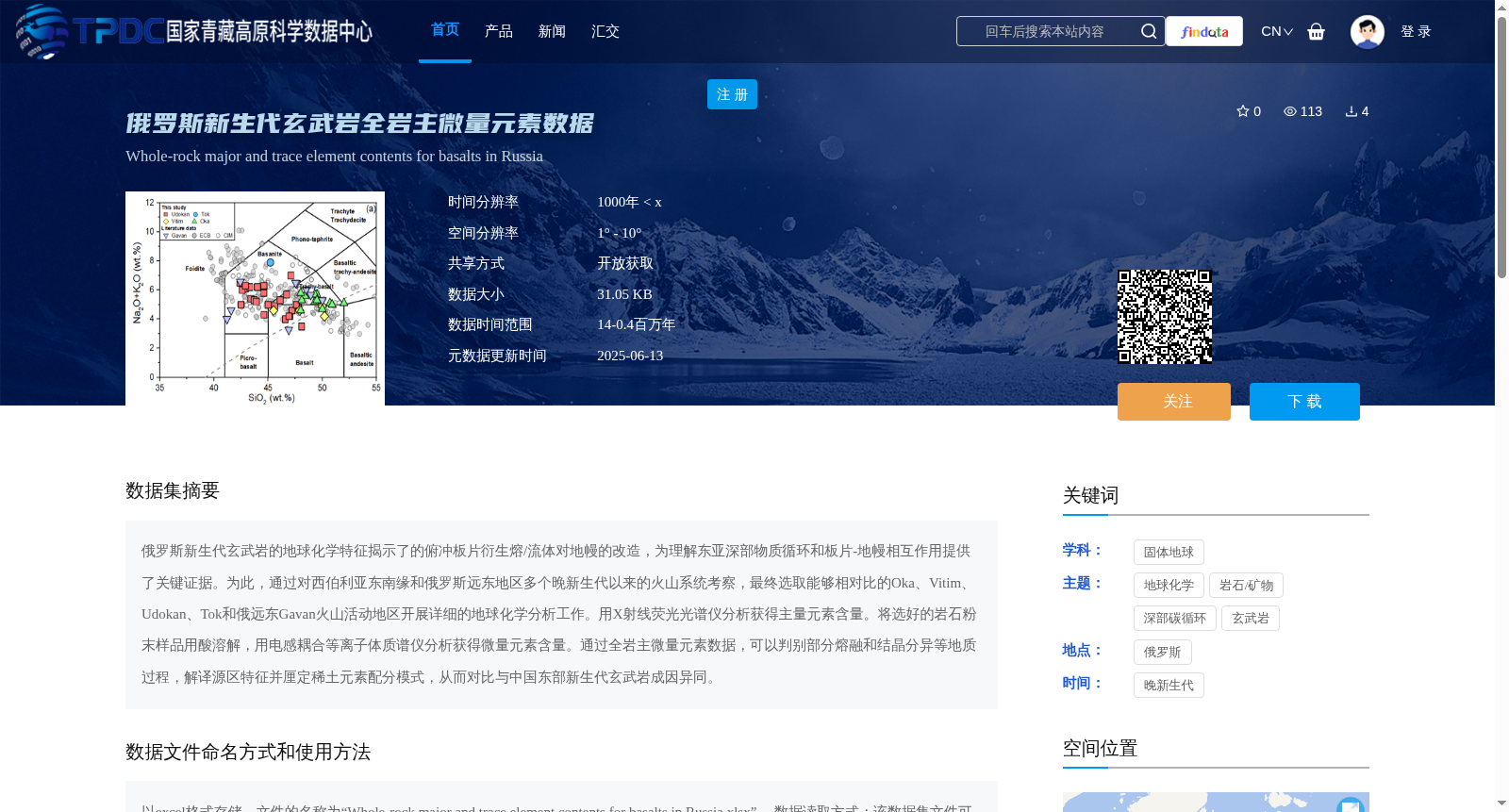
俄罗斯新生代玄武岩的地球化学特征揭示了的俯冲板片衍生熔/流体对地幔的改造,为理解东亚深部物质循环和板片-地幔相互作用提供了关键证据。为此,通过对西伯利亚东南缘和俄罗斯远东地区多个晚新生代以来的火山系统考察,最终选取能够相对比的Oka、Vitim、Udokan、Tok和俄远东Gavan火山活动地区开展详细的地球化学分析工作。用X射线荧光光谱仪分析获得主量元素含量。将选好的岩石粉末样品用酸溶解,用电感耦合等离子体质谱仪分析获得微量元素含量。通过全岩主微量元素数据,可以判别部分熔融和结晶分异等地质过程,解译源区特征并厘定稀土元素配分模式,从而对比与中国东部新生代玄武岩成因异同。
Geochemical characteristics of Cenozoic basalts in Russia reveal the modification of the mantle by melts/fluids derived from subducted slabs, providing critical evidence for understanding deep material cycling and slab-mantle interaction in East Asia. To this end, through field investigations of multiple volcanic systems since the Late Cenozoic in the southeastern margin of Siberia and the Russian Far East, we finally selected well-correlatable volcanic areas including Oka, Vitim, Udokan, Tok, and Gavan in the Russian Far East for detailed geochemical analyses. Major element contents were measured using X-ray fluorescence spectrometry (XRF). The selected rock powder samples were dissolved with acid, and trace element contents were analyzed via inductively coupled plasma mass spectrometry (ICP-MS). Whole-rock major and trace element data can be used to identify geological processes such as partial melting and fractional crystallization, interpret source region characteristics, and determine rare earth element (REE) partition patterns, thereby comparing the genetic similarities and differences between these basalts and Cenozoic basalts in eastern China.