Tourism, transport energy consumption, and the carbon dioxide emission nexus for the USA: Evidence from wavelet coherence and spectral causality approaches
收藏资源简介:
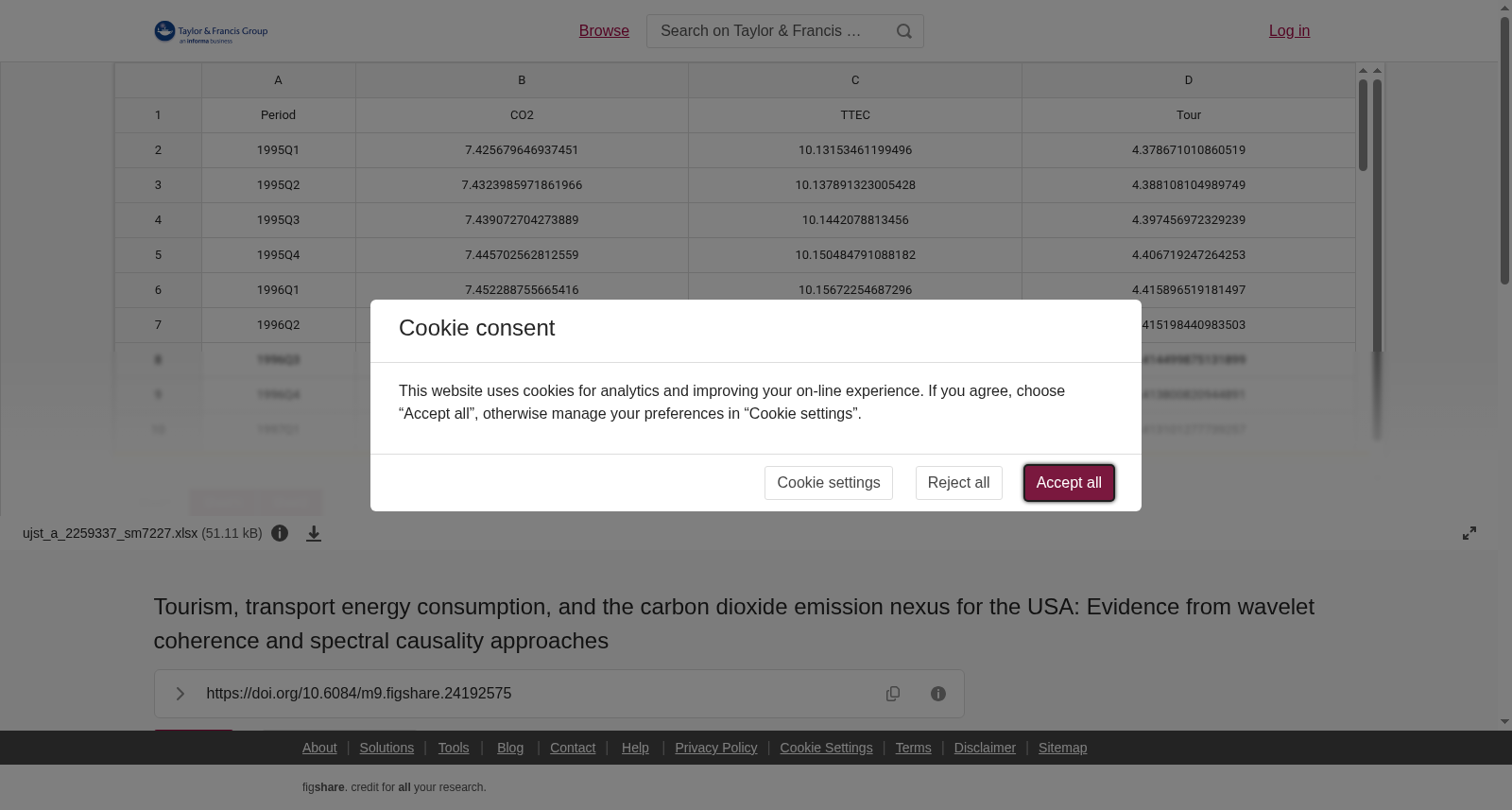
The aim of this study is to analyze the dynamic relationship between tourism, transport energy consumption, and carbon dioxide emissions in the United States from the 1<sup>st</sup> quarter of 1995 to the 4<sup>th</sup> quarter of 2019. To this end, we utilize the autoregressive distributed lag (ARDL), the Wavelet Coherence Approach (WCA), and the Breitung-Candelon spectral granger causality approaches. The empirical outcomes confirm that the variables included in the model exhibit cointegration. The estimations of the wavelet coherence approach confirm that tourism stimulates transport energy consumption, whereas both tourism and energy consumption bolster carbon emissions in the United States. The outcomes for the Breitung-Candelon spectral granger causality approach suggest that our variables exhibit causal associations at various frequencies. These are findings are also robust to alternative econometrics specifications. These empirical outcomes underscore the fact that tourism propel both transport energy consumption and carbon emissions. Our study helps policymakers in regards to revisiting the role of tourism and transport energy consumption concerning emissions in order to cope with environmental challenges in the United States.
本研究旨在分析1995年第一季度至2019年第四季度美国旅游业、交通运输能源消费与二氧化碳排放之间的动态关系。为此,我们采用自回归分布滞后模型(autoregressive distributed lag, ARDL)、小波相干分析法(Wavelet Coherence Approach, WCA)以及Breitung-Candelon频谱格兰杰因果检验方法。实证结果证实,模型纳入的变量间存在协整关系。小波相干分析法的估计结果表明,旅游业对交通运输能源消费具有拉动作用,而美国的旅游业与能源消费均会助推二氧化碳排放。Breitung-Candelon频谱格兰杰因果检验方法的结果显示,各变量在不同频率下均存在因果关联。上述研究结果对于不同的计量经济学设定均具有稳健性。本研究的实证结果凸显,旅游业会同时推动交通运输能源消费与二氧化碳排放。本研究有助于政策制定者重新审视旅游业与交通运输能源消费在碳排放治理中的作用,以应对美国面临的环境挑战。