
<b>Manure improves temperature sensitivity of soil organic carbon by increasing soil alphaproteobacteria, phenols, and pH and decreasing soil esters</b>
收藏DataCite Commons2025-04-01 更新2025-01-06 收录
下载链接:
https://figshare.com/articles/dataset/Ozone_and_crop_yield/14378981/5
下载链接
链接失效反馈官方服务:
资源简介:
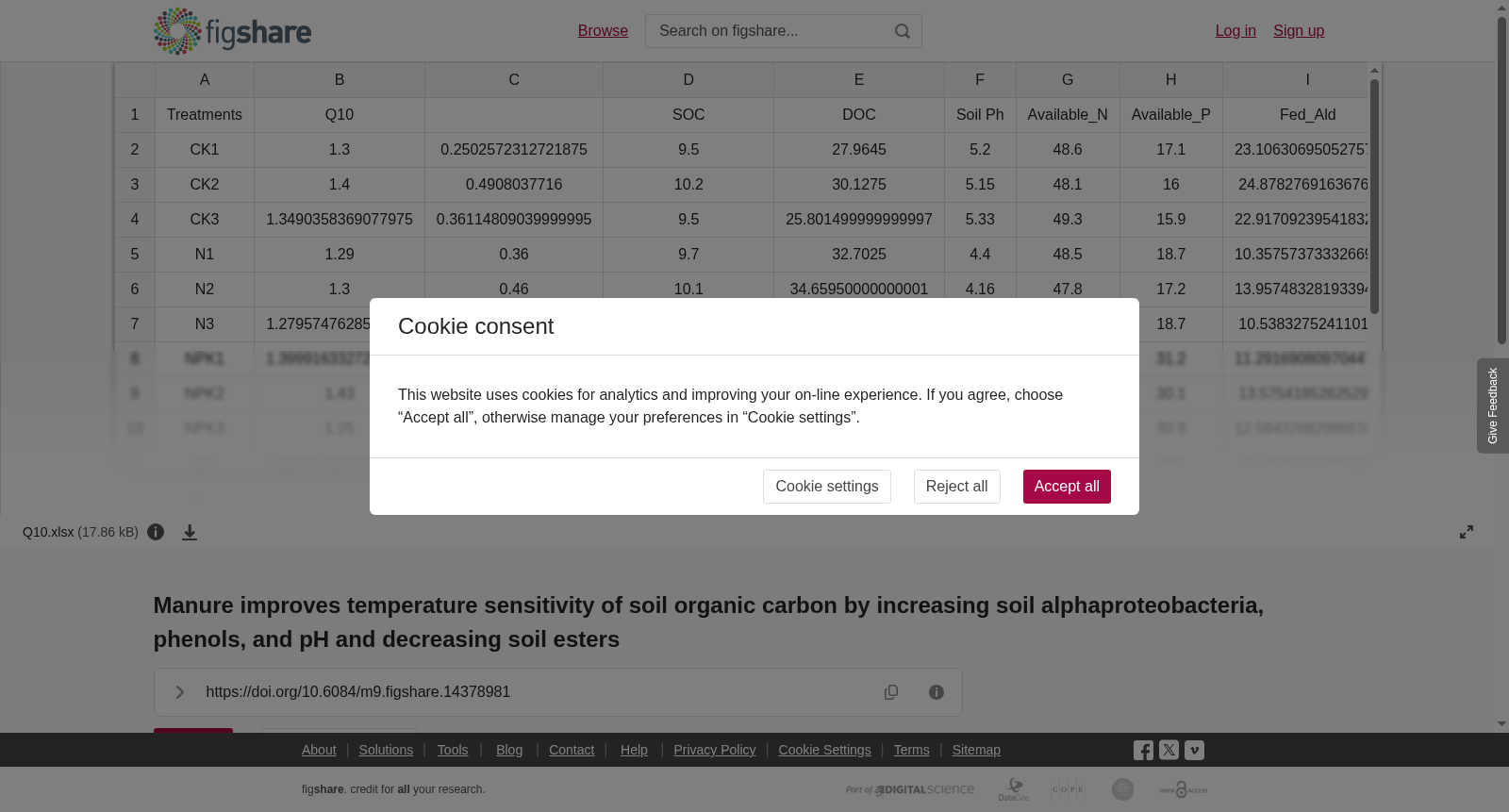
The temperature sensitivity (Q<sub>10</sub>) of soil organic carbon (SOC) is a critical parameter in SOC response models concerning climate warming, which governs both the direction and magnitude of soil carbon-climate feedback. However, the relative importance of soil organic compounds in the regulation of the Q<sub>10</sub> remains unclear, which is attributed to the relative stability of soil organic compounds. Long-term different fertilization could change the quantity and quality of soil organic compounds. Here, a 38-year fertilization experiment combined with pyrolysis gas chromatography-mass spectrometry (Py-GC/MS) was used to identify the effect of key soil organic compounds on the Q<sub>10</sub>. Five treatments were chosen: no fertilization (CK), nitrogen fertilization (N), N combined with phosphorus and potassium fertilization (NPK), manure (M), and NPK combined with manure (NPKM). The results revealed that the Q<sub>10</sub> under M and NPKM were 1.59 and 1.66, respectively, which were significantly higher than those under CK (1.35), N (1.29), and NPK (1.36). There was a positive linear relationship between the Q<sub>10</sub> and SOC, which implied a negative feedback of manure-increased SOC to future warming. Among the soil organic compounds, esters and phenols predominated, representing 30.30% and 18.83% of the composition, respectively. Manure increased soil stable organic compounds relative to CK and chemical fertilizer. The increased stable organic compounds under manure lead to high Q<sub>10</sub>.In addition to the positive effect of soil alphaproteobacteria and pH on the Q<sub>10</sub>, manure increased the Q<sub>10</sub> by increasing phenols and decreasing esters, whereas chemical fertilization did the opposite. These findings first provide substantial evidence that soil organic compounds play an important role in the magnitude and mechanism of SOC response to climate change. Manure-induced SOC, when compared to chemical fertilizers, confers a heightened sensitivity to climate warming within agroecosystems.
土壤有机碳(Soil Organic Carbon, SOC)的温度敏感性系数(Q₁₀)是气候变暖相关SOC响应模型中的关键参数,其调控着土壤碳-气候反馈的方向与幅度。然而,土壤有机化合物对Q₁₀的调控相对重要性仍不明确,这一问题源于土壤有机化合物的相对稳定性。长期差异化施肥可改变土壤有机化合物的数量与质量。本研究依托一项为期38年的施肥定位试验,结合热解气相色谱-质谱联用法(Py-GC/MS),明确了关键土壤有机化合物对Q₁₀的调控效应。试验设置5个处理:不施肥(CK)、单施氮肥(N)、氮磷钾配施(NPK)、单施有机肥(M)以及氮磷钾配施有机肥(NPKM)。结果表明,有机肥(M)与氮磷钾配施有机肥(NPKM)处理下的Q₁₀分别为1.59和1.66,显著高于不施肥(CK,1.35)、单施氮肥(N,1.29)及氮磷钾配施(NPK,1.36)处理。Q₁₀与SOC呈显著正线性相关关系,表明有机肥提升的SOC对未来气候变暖具有负反馈效应。在土壤有机化合物中,酯类与酚类占比最高,分别占总组分的30.30%与18.83%。相较于不施肥与化肥处理,有机肥施用提升了土壤稳定态有机化合物的占比,进而导致Q₁₀升高。除土壤α-变形菌门(Alphaproteobacteria)丰度与pH对Q₁₀具有正向调控作用外,有机肥通过提升酚类占比、降低酯类占比提升Q₁₀,而化肥处理则呈现相反效应。本研究结果首次提供了充分证据,表明土壤有机化合物在SOC响应气候变化的幅度与调控机制中发挥关键作用。与化肥诱导的SOC相比,有机肥驱动的SOC可使农田生态系统对气候变暖表现出更强的温度敏感性。
提供机构:
figshare创建时间:
2024-11-28
搜集汇总
数据集介绍
背景与挑战
背景概述
该数据集基于一个38年的长期施肥实验,探究了粪肥如何通过改变土壤有机化合物和微生物群落来影响土壤有机碳的温度敏感性(Q10)。关键发现显示,粪肥处理显著提高了Q10值,这与土壤有机碳增加、酚类物质增多、酯类减少以及α-变形菌丰度上升和pH值提高相关。这些结果揭示了土壤有机化合物在调节土壤碳-气候反馈中的重要作用,并表明粪肥相比化肥能增强农业生态系统对气候变暖的敏感性。
以上内容由遇见数据集搜集并总结生成

暂无相关数据集


