
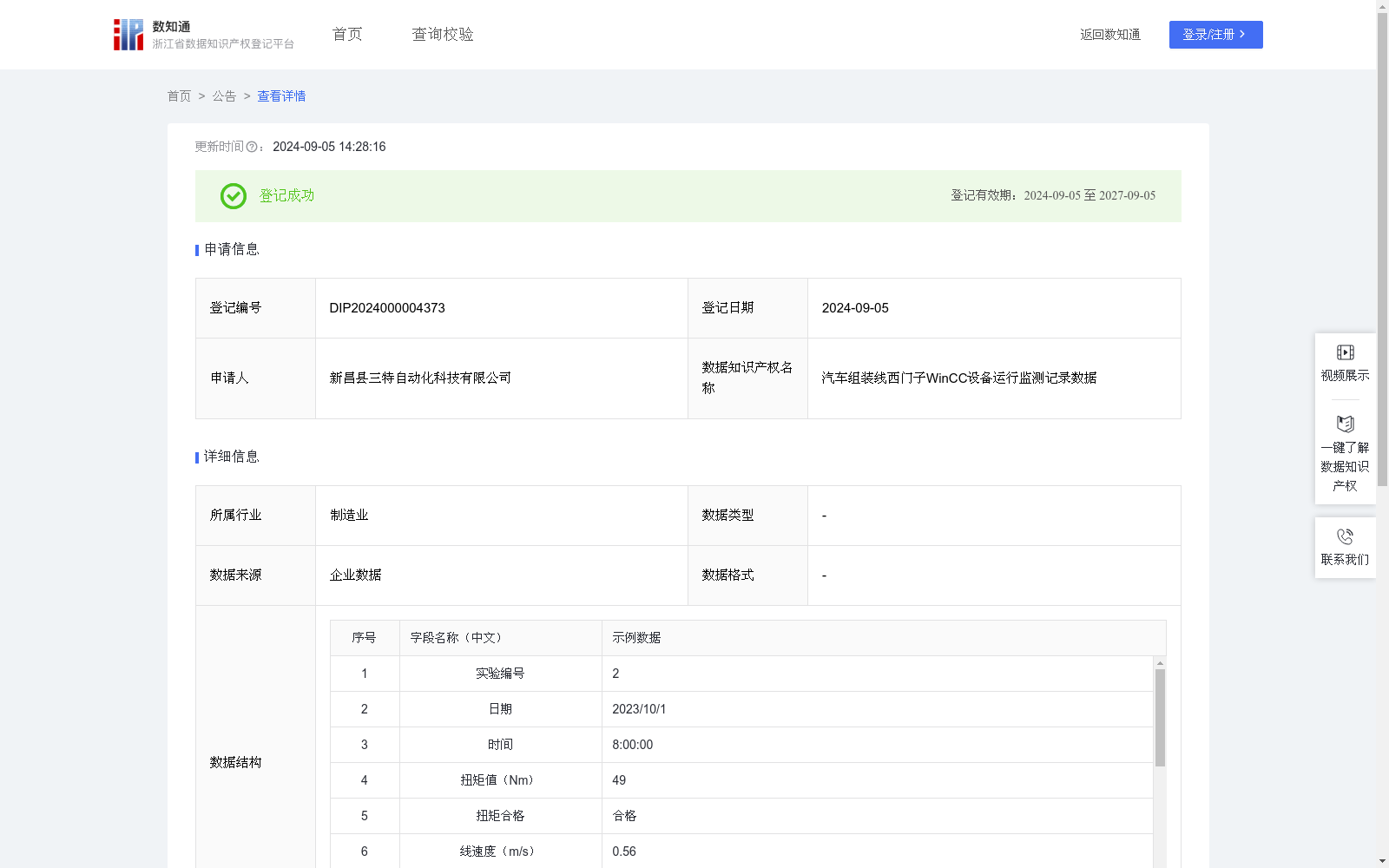
汽车组装线西门子WinCC设备运行监测记录数据
收藏浙江省数据知识产权登记平台2024-09-05 更新2024-09-06 收录
下载链接:
https://www.zjip.org.cn/home/announce/trends/58282
下载链接
链接失效反馈官方服务:
资源简介:
西门子WinCC设备在汽车组装线的监控与记录数据主要适用于高度自动化的生产环境,精密组装需求:汽车组装线需要精确控制和监控装配过程中的各个参数,如扭矩设置和焊接质量。连续生产过程:监控系统必须能够实时处理并记录大量数据,以保持生产流程的连续性和效率。复杂的机器人操作:涉及多个自动化机器人进行精密组装工作,需要监控机器人的操作精度和性能。数据及算法规则解决的具体问题:提高生产质量:通过精确监控和记录扭矩、焊接等关键制造步骤,确保每个部件的装配质量符合标准。优化生产流程:通过监控线速度和机器人操作,分析生产瓶颈,优化资源配置和流程设置,提高生产效率。减少停机时间:通过故障代码分析和预测维护指标,预测设备可能的故障点,提前进行维护,减少意外停机时间。通过这些应用场景和解决的具体问题说明,可以看出西门子WinCC设备在汽车组装线上的监控和记录数据的强大功能和重要性。这不仅提高了生产效率和产品质量,也有助于维护设备性能和操作安全。累计效率指标(根据扭矩合格率和焊接合格率计算):公式:累计效率 = (扭矩合格率 + 焊接合格率) / 2;用于评估整体装配质量的效率。基于质量控制检查结果的百分比,反映了整体装配线的质量水平。动态性能评分(综合考虑线速度和机器人路径偏差):公式:动态性能评分 = 线速度 / (1 + 路径偏差);表示生产线的操作效率和机械精确性。结合线速度和机器人操作的精度,越高表示效率和精度越优越。预测维护指标(基于故障代码频率和严重程度):公式:预测维护指标 = 故障次数 / 观察时间;用于预测可能的设备故障和制定维护计划。用于预测和规划维护活动,减少突发停机。通过分析这些计算数据列,可以更全面地分析和优化生产过程,提高制造效率,减少故障和提前解决潜在问题。这些指标也有助于高级管理决策和持续的过程改进。
Siemens WinCC equipment’s monitoring and logging data for automotive assembly lines is primarily applied in highly automated production scenarios with strict precision assembly demands. Precision assembly requirements: Automotive assembly lines require precise control and monitoring of various parameters during the assembly process, such as torque settings and welding quality. Continuous production process: The monitoring system must be capable of processing and recording large volumes of data in real time to maintain the continuity and efficiency of the production flow. Complex robotic operations: Multiple automated robots are involved in precision assembly tasks, requiring monitoring of their operational accuracy and performance.
Specific problems addressed by the data and algorithmic rules: Improving production quality: By precisely monitoring and recording key manufacturing steps such as torque and welding, the assembly quality of each component can be ensured to meet standards. Optimizing production processes: By monitoring line speed and robotic operations, production bottlenecks can be analyzed, resource allocation and process settings optimized, and production efficiency improved. Reducing downtime: Through fault code analysis and predictive maintenance metrics, potential equipment failure points can be predicted, and maintenance conducted in advance to reduce unplanned downtime.
As illustrated by these application scenarios and specific solved problems, the monitoring and logging data of Siemens WinCC equipment on automotive assembly lines demonstrates its powerful functions and importance. It not only improves production efficiency and product quality, but also helps maintain equipment performance and operational safety.
Cumulative efficiency metric (calculated based on torque pass rate and welding pass rate): Formula: Cumulative Efficiency = (Torque Pass Rate + Welding Pass Rate) / 2; Used to evaluate the efficiency of overall assembly quality. It is a percentage based on quality control inspection results, reflecting the quality level of the entire assembly line.
Dynamic performance score (comprehensively considering line speed and robotic path deviation): Formula: Dynamic Performance Score = Line Speed / (1 + Path Deviation); Represents the operational efficiency and mechanical precision of the production line. Combining line speed and the accuracy of robotic operations, a higher score indicates superior efficiency and precision.
Predictive maintenance metric (based on fault code frequency and severity): Formula: Predictive Maintenance Metric = Number of Faults / Observation Time; Used to predict potential equipment failures and develop maintenance plans. It supports the prediction and planning of maintenance activities to reduce unplanned downtime.
By analyzing these calculated data columns, production processes can be analyzed and optimized more comprehensively, manufacturing efficiency improved, faults reduced, and potential problems addressed in advance. These metrics also support senior management decision-making and continuous process improvement.
提供机构:
新昌县三特自动化科技有限公司
创建时间:
2024-07-29
搜集汇总
数据集介绍
以上内容由遇见数据集搜集并总结生成


