KRAFTON/KOpenAudioBench
收藏资源简介:
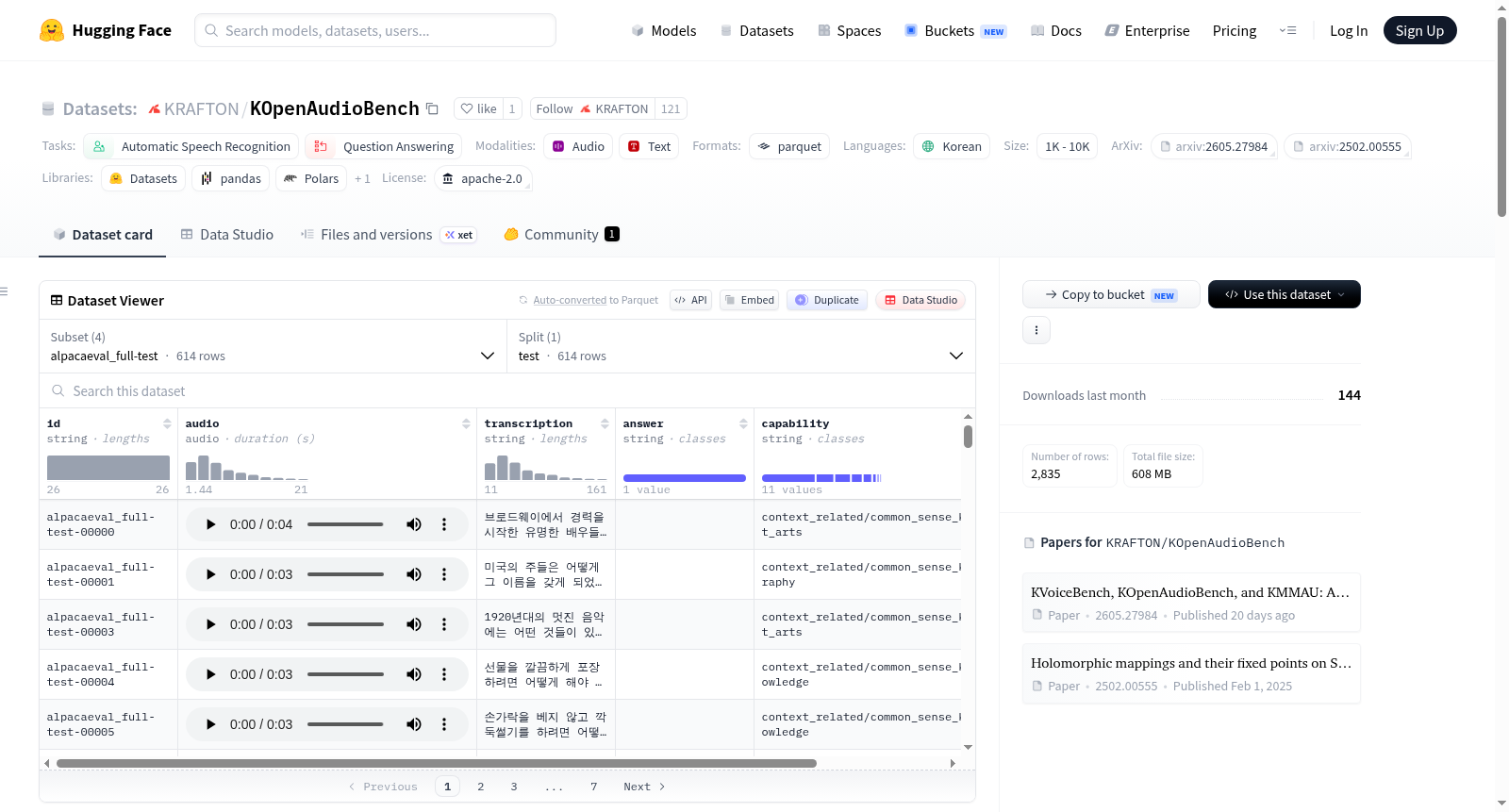
KOpenAudioBench是一个用于评估语音模型的韩语口语问答基准数据集,基于OpenAudioBench构建。由于缺乏现有的韩语口语问答评估基准,该数据集通过将OpenAudioBench转换为韩语来填补这一空白。构建过程遵循SpokenQA转移框架:首先通过LLM审核源样本,纠正标签错误并排除无效案例;然后使用超翻译和人类代理规则书进行韩语转换;接着通过人类代理规范化循环审核超翻译文件,组织可能的TTS失败案例,并生成适合语音的韩语文本;最后使用Qwen3-TTS合成韩语参考语音,并进行基于WER的重合成检查。数据集包含四个子集:KAlpacaEval(614个样本,开放型任务)、KLlamaQ(284个样本,短答案问答)、KTriviaQA(967个样本,短答案问答)和KWebQ(970个样本,短答案问答),总计2,835个样本。每个样本具有以下特征:id(唯一标识符)、audio(合成的韩语语音音频)、transcription(音频的韩语文本转录)、answer(参考答案,开放型子集为空字符串)和capability(评估的能力类别)。数据集用于自动语音识别和问答任务,支持韩语语言模型评估。
KOpenAudioBench is a Korean spoken question answering benchmark for evaluating speech models, built upon OpenAudioBench. As there is no existing benchmark for evaluating Korean spoken question answering capabilities, it is constructed by transferring OpenAudioBench into Korean. The construction process follows the SpokenQA transfer framework: source samples with deterministic answers are audited through an LLM reviewer/meta-reviewer process to correct label errors and exclude invalid cases; retained items are hypertranslated with a human-agent rulebook; a separate human-agent normalization loop audits the hypertranslated files, organizes likely TTS failure cases into a normalization rulebook, and produces speech-friendly Korean text; finally, Qwen3-TTS synthesis with Korean reference voices and WER-based resynthesis checks are applied. The dataset consists of 2,835 samples across four subsets: KAlpacaEval (614 samples, open-ended tasks), KLlamaQ (284 samples, short-answer QA), KTriviaQA (967 samples, short-answer QA), and KWebQ (970 samples, short-answer QA). Each sample includes features such as id (unique identifier), audio (synthesized Korean speech audio), transcription (Korean text transcription of the audio), answer (reference answer, empty string for open-ended subsets), and capability (evaluated capability category). It is used for automatic speech recognition and question-answering tasks, supporting Korean language model evaluation.