QCRI/M2CQA
收藏资源简介:
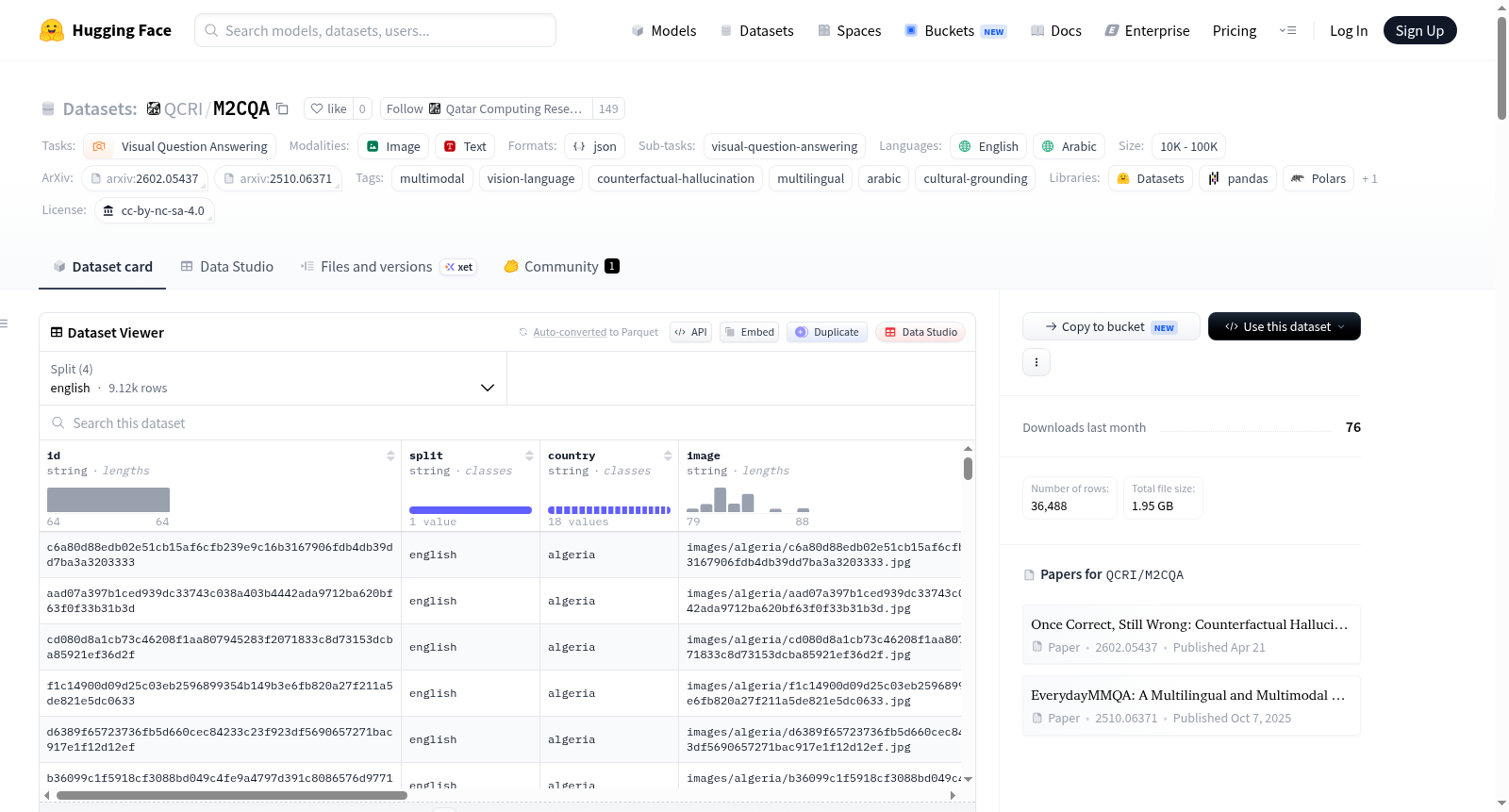
M2CQA是一个多语言多模态基准数据集,用于评估视觉语言模型中的反事实幻觉。每个数据示例将一张图片与三个基于文化的陈述配对:其中一个陈述由图片视觉支持,而另外两个陈述是文化上合理但视觉不支持的反事实。任务是接受真实的基于图片的陈述并拒绝反事实陈述。该版本包含英语、现代标准阿拉伯语、黎凡特阿拉伯语和埃及阿拉伯语的陈述,共享同一组图片。数据集旨在评估多模态系统是否依赖视觉证据,而不是接受合理的文化先验。数据集结构包括JSON文件和图片文件,每个JSON分割包含9,122个唯一的图片ID,图片在语言分割间共享。数据字段包括id(图片文件名无扩展名)、split(语言分割名称)、country(图片关联的国家)、image(图片文件的相对路径)、image_filename(带扩展名的图片文件名)、source_shard(原始数据集生成管道的源parquet分片)、Q1/Q2/Q3(三个候选陈述)、A1/A2/A3(对应陈述的布尔标签,其中只有一个为true)。数据集创建过程涉及图像收集、手动筛选、去重、问题生成和翻译,并经过人工验证。数据集适用于多语言和多文化视觉语言模型评估、反事实幻觉测量、跨语言鲁棒性研究以及跨模态模型行为比较。
M2CQA is a multilingual and multimodal benchmark for evaluating counterfactual hallucination in vision-language models. Each example pairs an image with three culturally grounded statements. One statement is visually supported by the image, while two statements are culturally plausible but visually unsupported counterfactuals. The task is to accept the true image-grounded statement and reject the counterfactual statements. This release contains English, Modern Standard Arabic, Levantine Arabic, and Egyptian Arabic statements over a shared set of images. It is intended for evaluating whether multimodal systems rely on visual evidence rather than accepting plausible cultural priors. The dataset is organized as JSON files and image files, with each JSON split containing 9,122 unique image IDs, and the images are shared across language splits. Data fields include id (image filename without extension), split (language split name), country (country associated with the image), image (relative path to the image file), image_filename (image filename with extension), source_shard (source parquet shard from the original dataset generation pipeline), Q1/Q2/Q3 (three candidate statements), and A1/A2/A3 (boolean labels for the corresponding statements, with exactly one true). The dataset creation involves image collection, manual screening, deduplication, question generation, translation, and human verification. It is intended for evaluating multilingual and multicultural vision-language models, measuring counterfactual hallucination, studying robustness across languages, and comparing cross-modal model behavior.