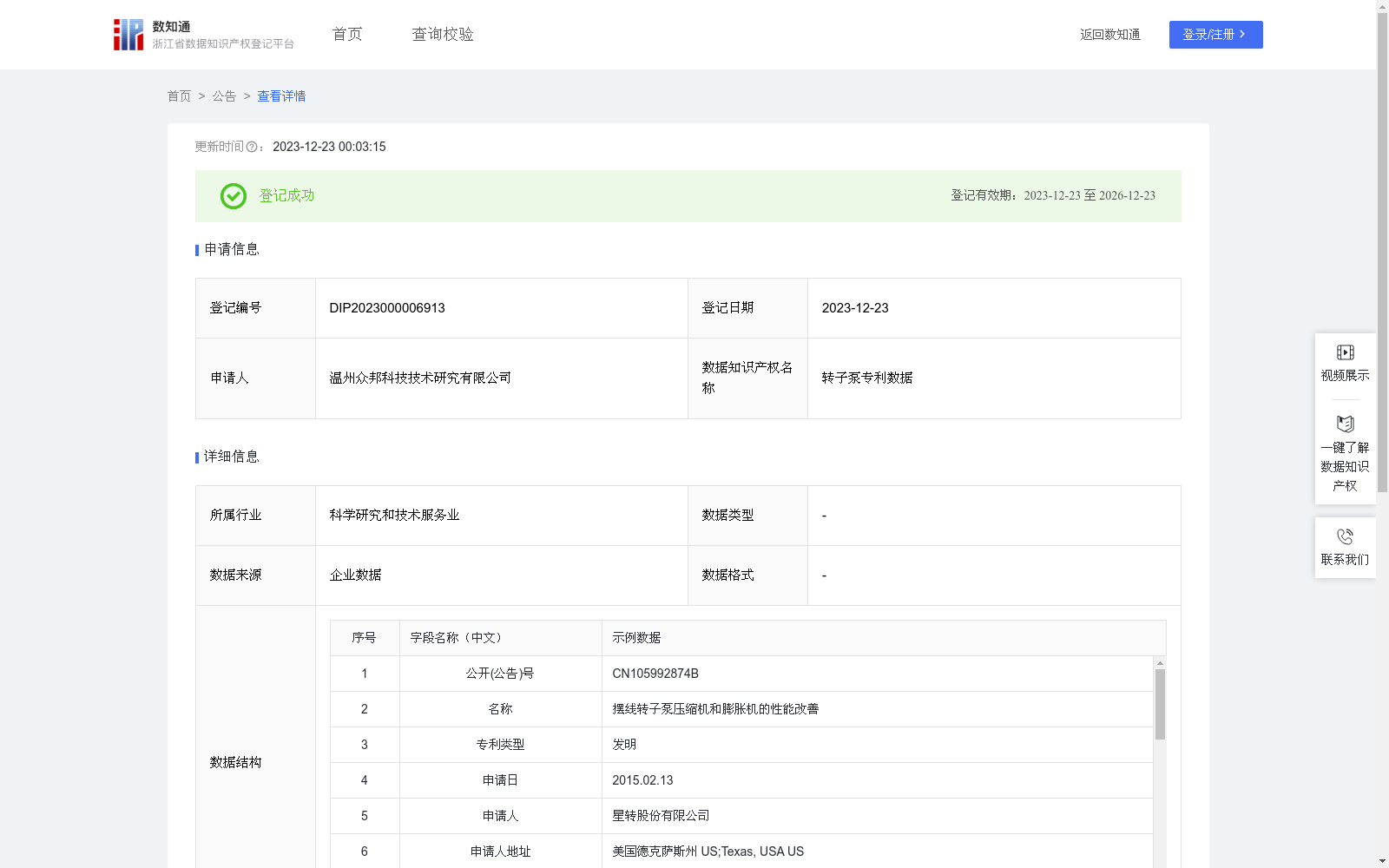
转子泵专利数据
收藏资源简介:
数据包中主要包括了全球专利数据库中有关转子泵专利数据的发明和实用新型专利数据,并根据自有算法对专利数据进行了评价和分类,可用于横向、纵向了解转子泵专利数据的专利数据变化情况,有助于了解转子泵专利数据的知识产权工作成果: 通过对各企业/个人转子泵专利数据专利数据的对比,可了解各企业/个人的技术创新能力、创新水平差异,了解转子泵专利数据的技术发展超势,有助于企业避免重研发,避免企业开发的技术侵犯他人的知识产权。本数据基于熵权法的 AHP 模型,目标层为综合价值,指标层将综合价值指标体系分为技术、战略、经济三大价值维度,指标层向下分准则层,包括: 技术价值:被引证数、IPC小类数、权项数、存活期;经济价值:剩余有效期、转让次数、许可次数、质押次数;战略价值:同族数、布局国家/地域数。根据维度和指标建立三个维度的原始矩阵和专利评价准则求得相应权重,计算各个维度的单项值,将各个维度的值相加后获得综合价值,用lookup函数判断单个专利的综合价值所在数值区间,用于区分高价值专利、一般价值专利和低价值专利(综合价值≥25的为高价值专利;14>综合价值的为低价值专利;25>综合价值≥14的为一般价值专利),为本领域技术人员提供研发决策依据和技术规避作优先参考。 数据来源:全球专利数据库,通过关键字和ipc分类筛选目标专利。 高价值专利评定参考依据:《高价值专利评价方法》T/ISC 0030-2023。
This data package mainly includes invention and utility model patent data related to rotary pump patents from the Global Patent Database. Proprietary algorithms are used to evaluate and classify the patent data, enabling horizontal and vertical analysis of the changes in rotary pump patent data, and facilitating understanding of the intellectual property (IP) achievements in this field. By comparing the patent data of various enterprises and individuals in the rotary pump sector, one can grasp their technological innovation capabilities and differences in innovation levels, as well as the technological development trends of rotary pump patents. This helps enterprises avoid redundant R&D and prevent their developed technologies from infringing others' intellectual property rights. This dataset is constructed based on the AHP model integrated with the entropy weight method. The target layer is set as comprehensive value, while the indicator layer divides the comprehensive value index system into three value dimensions: technological, economic and strategic. The indicator layer further breaks down into the following criterion layers: - Technological value: number of citations, number of IPC subclasses, number of claims, and survival period; - Economic value: remaining validity period, number of transfers, number of licenses, and number of pledges; - Strategic value: number of patent families, and number of countries/regions covered for patent layout. Original matrices of the three dimensions and patent evaluation criteria are established to derive corresponding weights, and calculate the single dimension value of each dimension. The comprehensive value is obtained by summing up the values of all dimensions. The LOOKUP function is used to determine the value interval of the comprehensive value of a single patent, so as to distinguish high-value patents, medium-value patents and low-value patents (specifically, patents with comprehensive value ≥25 are high-value patents; those with comprehensive value <14 are low-value patents; and those with 14 ≤ comprehensive value <25 are medium-value patents). This provides a basis for R&D decision-making and priority references for technology avoidance for technical personnel in this field. Data source: Global Patent Database, where target patents are screened via keywords and IPC classification. Reference basis for high-value patent evaluation: T/ISC 0030-2023 *Method for Evaluating High-Value Patents*.