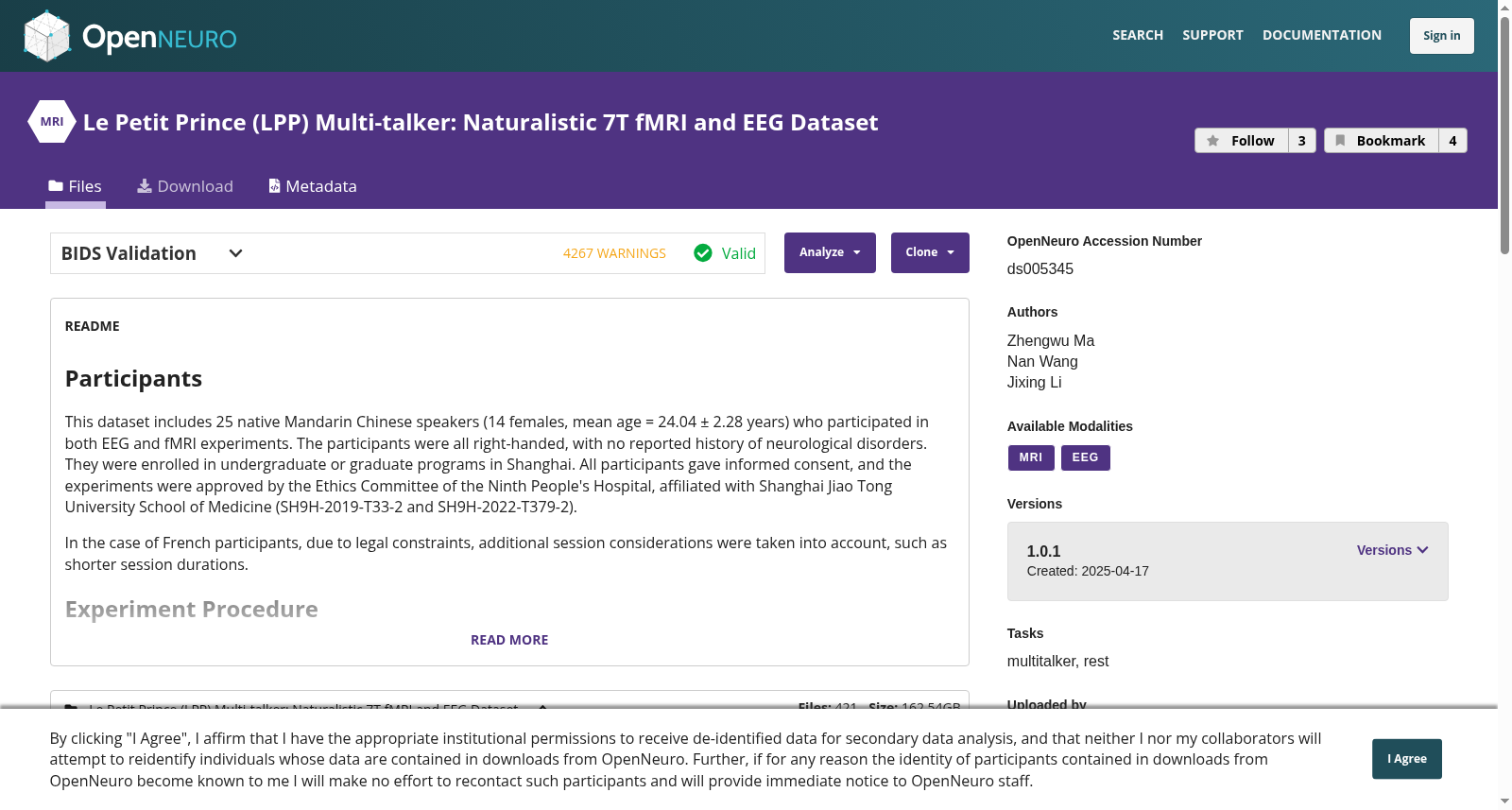
Le Petit Prince (LPP) Multi-talker: Naturalistic 7T fMRI and EEG Dataset
收藏资源简介:
## Participants This dataset includes 25 native Mandarin Chinese speakers (14 females, mean age = 24.04 ± 2.28 years) who participated in both EEG and fMRI experiments. The participants were all right-handed, with no reported history of neurological disorders. They were enrolled in undergraduate or graduate programs in Shanghai. All participants gave informed consent, and the experiments were approved by the Ethics Committee of the Ninth People's Hospital, affiliated with Shanghai Jiao Tong University School of Medicine (SH9H-2019-T33-2 and SH9H-2022-T379-2). In the case of French participants, due to legal constraints, additional session considerations were taken into account, such as shorter session durations. ## Experiment Procedure MRI Scanning Sessions Participants underwent both EEG and fMRI experiments while listening to the Chinese version of *Le Petit Prince*. During the MRI session, participants were instructed to maintain fixation on a crosshair on the screen and minimize eye movements and head motions. The task involved attending to different talkers in the multitalker condition (single male, single female, mixed male, and mixed female talkers). Session Breakdown - The entire session lasted approximately 70 minutes for fMRI participants, including a series of 4 conditions (single-talker, mixed-attended, and mixed-unattended conditions). - Quiz questions were administered after each run to assess participants' comprehension of the narrative. In the French cohort, due to legal time constraints, the experiment durations were adjusted. ## Stimuli The stimuli were selected excerpts from the Chinese version of *Le Petit Prince* (available at [xiaowangzi.org](http://www.xiaowangzi.org/)). These audio clips were previously used in both EEG (Li et al., 2024) and fMRI (Li et al., 2022) studies. The English and Chinese versions were enhanced with visual stimuli (e.g., images of scenes from the book) to align with the storyline. However, visual stimuli were not presented in the French version to comply with legal restrictions. ## Acquisition MRI Hardware & Scanning Parameters - EEG: Data were collected using a 64-channel actiCAP system, sampled at 500 Hz, and filtered between 0.016 and 80 Hz. - fMRI: Scanning was performed on a 7.0 T Terra Siemens MRI scanner at the Zhangjiang International Brain Imaging Centre. The scanning parameters differed slightly between the English/Chinese and French studies due to equipment availability. - Functional MRI: 85 interleaved axial slices (1.6×1.6×1.6 mm voxel size, TR = 1000 ms, TE = 22.2 ms) - Anatomical MRI: MP-RAGE sequence, T1-weighted images (voxel size = 0.7×0.7×0.7 mm). ## Preprocessing MRI Data Processing 1. DICOM to NIfTI Conversion: All raw MRI data were converted to NIfTI format using `dcm2niix` (version 1.0.20220505) and processed using the `fMRIPrep` pipeline (version 20.2.0). 2. Anatomical Preprocessing: - Skull stripping - Segmentation into gray matter (GM), white matter (WM), and cerebrospinal fluid (CSF) - Registration to the Montreal Neurological Institute (MNI) space using MNI152NLin2009cAsym:res-2 template. 3. Functional Preprocessing: - Motion correction - Slice-timing correction - Multi-echo ICA for denoising - Voxel resampling to native and MNI spaces. Note: Visual stimuli processing for the English and Chinese conditions was handled separately to avoid potential biases in the analysis.
参与者 本数据集共纳入25名母语为汉语的参与者(女性14名,平均年龄24.04±2.28岁),所有参与者均完成了脑电图(electroencephalogram, EEG)与功能磁共振成像(functional magnetic resonance imaging, fMRI)实验。所有参与者均为右利手,无神经系统疾病史,就读于上海地区的本科或研究生阶段。所有参与者均签署了知情同意书,本实验经上海交通大学医学院附属第九人民医院伦理委员会批准(批准号:SH9H-2019-T33-2与SH9H-2022-T379-2)。 针对法国籍参与者,因法律限制,实验流程需进行额外调整,例如缩短实验时长。 实验流程 磁共振扫描流程 参与者在聆听中文版《小王子》(*Le Petit Prince*)的过程中完成了脑电图与功能磁共振成像扫描。在磁共振扫描期间,要求参与者注视屏幕上的十字固定点,尽量减少眼球运动与头部晃动。实验任务为在多说话人场景下关注不同说话人(包括单男性说话人、单女性说话人、混合男性说话人与混合女性说话人四种条件)。 实验流程细分 - 针对功能磁共振成像参与者,整个扫描流程时长约70分钟,包含4种实验条件:单说话人条件、混合注意条件与混合非注意条件等。 - 每轮扫描结束后会设置问答环节,以评估参与者对叙事内容的理解程度。 针对法国籍参与者队列,因法定时长限制,实验时长进行了调整。 刺激材料 刺激材料选自中文版《小王子》的节选音频(可于[http://www.xiaowangzi.org/](http://www.xiaowangzi.org/)获取)。此前这些音频片段已被用于脑电图(Li等,2024)与功能磁共振成像(Li等,2022)相关研究。 英语与中文版刺激材料配套了与故事情节匹配的视觉刺激(例如书中场景的相关图片)。但因法律限制,法语版实验未设置视觉刺激。 采集方案 MRI硬件与扫描参数 - 脑电图(EEG):采用64通道actiCAP系统采集数据,采样率为500 Hz,滤波频段为0.016~80 Hz。 - 功能磁共振成像(fMRI):于张江国际脑影像中心使用7.0 T Terra西门子磁共振扫描仪完成扫描。因设备可用性差异,英语/汉语组与法语组的扫描参数略有不同。 - 功能磁共振成像:采用85层轴面交错采集切片,体素大小为1.6×1.6×1.6 mm,重复时间(TR)=1000 ms,回波时间(TE)=22.2 ms。 - 结构磁共振成像:采用MP-RAGE序列采集T1加权图像,体素大小为0.7×0.7×0.7 mm。 预处理流程 MRI数据处理 1. DICOM转NIfTI格式:所有原始MRI数据均使用`dcm2niix`(版本1.0.20220505)转换为NIfTI格式,并通过`fMRIPrep`流程(版本20.2.0)进行处理。 2. 结构像预处理: - 去颅骨(skull stripping) - 分割为灰质(gray matter, GM)、白质(white matter, WM)与脑脊液(cerebrospinal fluid, CSF) - 配准至蒙特利尔神经研究所(Montreal Neurological Institute, MNI)标准空间,使用MNI152NLin2009cAsym:res-2模板。 3. 功能像预处理: - 运动校正(motion correction) - 切片时间校正(slice-timing correction) - 多回波独立成分分析(multi-echo ICA)用于降噪 - 体素重采样至原生空间与MNI标准空间。 注:为避免分析中出现潜在偏倚,英语与汉语组的视觉刺激处理流程单独进行。