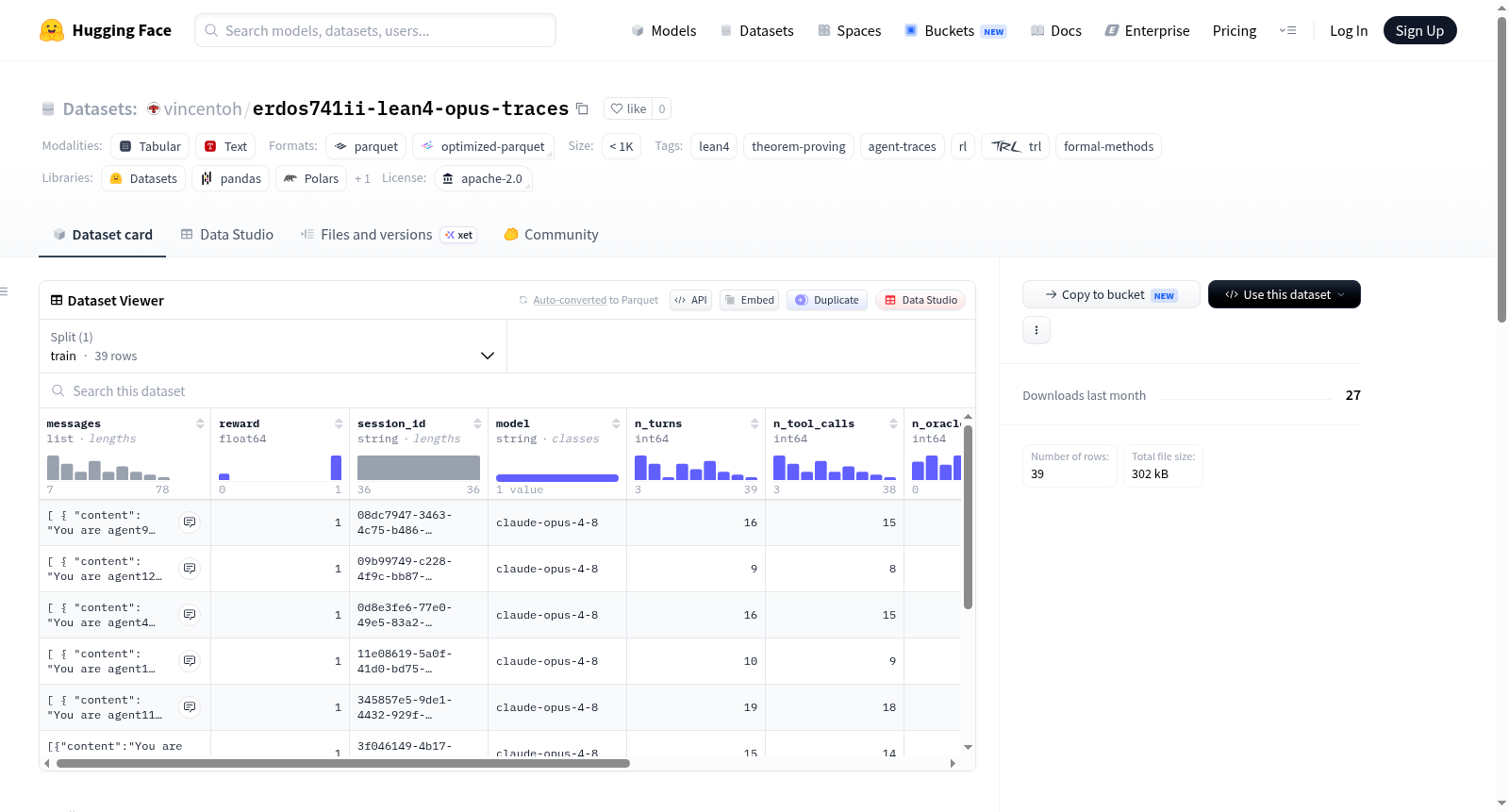
erdos741ii-lean4-opus-traces
收藏资源简介:
该数据集名为“Erdős #741(ii) — Lean 4 Opus Agent Traces”,包含39个由Claude Opus模型生成的智能体会话轨迹,用于在Lean 4定理证明器中解决Erdős问题#741(ii)。这是一个G1级别任务,要求根据自然语言构造描述构建证明,具体目标是证明存在一个整数集,它同时满足加法基性质(每个大于等于4的整数可表示为该集合中两个元素之和)和不可分割性质(该集合的任意划分都有一半是非syndetic的),构造方法基于5的幂的塔。每个数据样本代表一个完整的智能体会话,包含消息列表(如用户提示、工具调用、预言机反馈和修复步骤的交替序列)、奖励标签(1.0表示会话最后一次真实的预言机运行得分为1.0,即Lean编译成功且无未完成证明占位符sorry,否则为0.0;共有31个轨迹奖励为1.0)、预言机审计字段(如运行次数、最后得分、是否曾得1.0)、模型标识(claude-opus-4-8)和会话统计(如回合数和工具调用数)。工具调用以特定标记内联,思考块被保留。数据集的核心信号是硬验证奖励,完全由Lean编译器接受或拒绝决定,无模糊评分,轨迹清晰地展示了智能体在形式化证明中典型的编辑、编译、诊断和修复的迭代循环过程。该数据集适用于定理证明、形式化方法、强化学习(RL)和智能体行为分析等研究场景,尤其可用于分析智能体如何克服形式化语言障碍并完成复杂数学证明。
The dataset is named Erdős #741(ii) — Lean 4 Opus Agent Traces and contains 39 agent session trajectories generated by the Claude Opus model, aimed at solving Erdős problem #741(ii) in the Lean 4 theorem prover. This is a G1-level task that requires constructing proofs based on natural language descriptions, specifically to prove the existence of an integer set that simultaneously satisfies the additive basis property (every integer greater than or equal to 4 can be expressed as the sum of two elements in the set) and the indivisibility property (any partition of the set has a half that is non-syndetic), with a construction method based on towers of powers of 5. Each data sample represents a complete agent session, including a message list (such as alternating sequences of user prompts, tool calls, oracle feedback, and repair steps), a reward label (1.0 indicates that the last real oracle run of the session scored 1.0, meaning Lean compilation succeeded without incomplete proof placeholders sorry, otherwise 0.0; there are 31 trajectories with a reward of 1.0), oracle audit fields (such as run count, final score, and whether it ever scored 1.0), model identifier (claude-opus-4-8), and session statistics (such as turn count and tool call count). Tool calls are inlined with specific markers, and thought blocks are preserved. The core signal of the dataset is hard validation rewards, entirely determined by acceptance or rejection from the Lean compiler, with no ambiguous scoring; the trajectories clearly demonstrate the iterative cycle of editing, compiling, diagnosing, and repairing typical in formal proof processes. This dataset is suitable for research scenarios such as theorem proving, formal methods, reinforcement learning (RL), and agent behavior analysis, particularly for analyzing how agents overcome formal language barriers and complete complex mathematical proofs.
数据集概览
该数据集包含 39 条 Claude Opus 智能体会话轨迹,旨在尝试在 Lean 4 中证明 Erdős 问题 #741(ii)(G1 层级:基于自然语言构造描述构建证明)。
任务描述
证明存在一个整数集合,它同时满足:
- 加法基:每个 n ≥ 4 都可以表示为该集合中两个元素的和。
- 不可分割性:对该集合的任意划分,其中一半集合都不是 syndetic 集。
- 构造方法:基于 5 的幂的塔式构造。
数据内容
每条记录代表一个完整的智能体会话,包含以下字段:
- messages:一系列
{role, content}交互记录(用户提示、工具调用、编译器反馈、修复)。 - reward:1.0 表示会话最终的编译器运行得分为 1.0(Lean 编译通过,0 个未证明目标),否则为 0.0。经修正后,31/39 条轨迹 成功完成证明。
- 其余 8 条中,6 条从未运行编译器(会话容量限制/API 错误),2 条运行但未达到 1.0。
- n_oracle_runs:编译器运行次数。
- last_oracle_score:最后一次编译器运行得分。
- ever_scored_1:是否曾达到 1.0 分。
- model:claude-opus-4-8。
- n_turns、n_tool_calls:会话统计信息。
- 工具调用内联标记为
<tool_call>/<tool_result>。 - 思考过程保留在
<thinking>标签中。
奖励信号
使用 硬验证奖励 — Lean 编译器直接接受或拒绝,无模糊评分。轨迹展示了编辑→编译→诊断→修复的循环过程,用于消除形式化语言中的摩擦。
许可证
Apache-2.0
使用示例
python from datasets import load_dataset ds = load_dataset("vincentoh/erdos741ii-lean4-opus-traces", split="train") proved = ds.filter(lambda x: x["reward"] == 1.0) # 31 traces