Microendemism can be the rule in the Brazilian Caatinga: evidence from flat lizards of the <i>Tropidurus semitaeniatus</i> group (Squamata: Tropiduridae)
收藏资源简介:
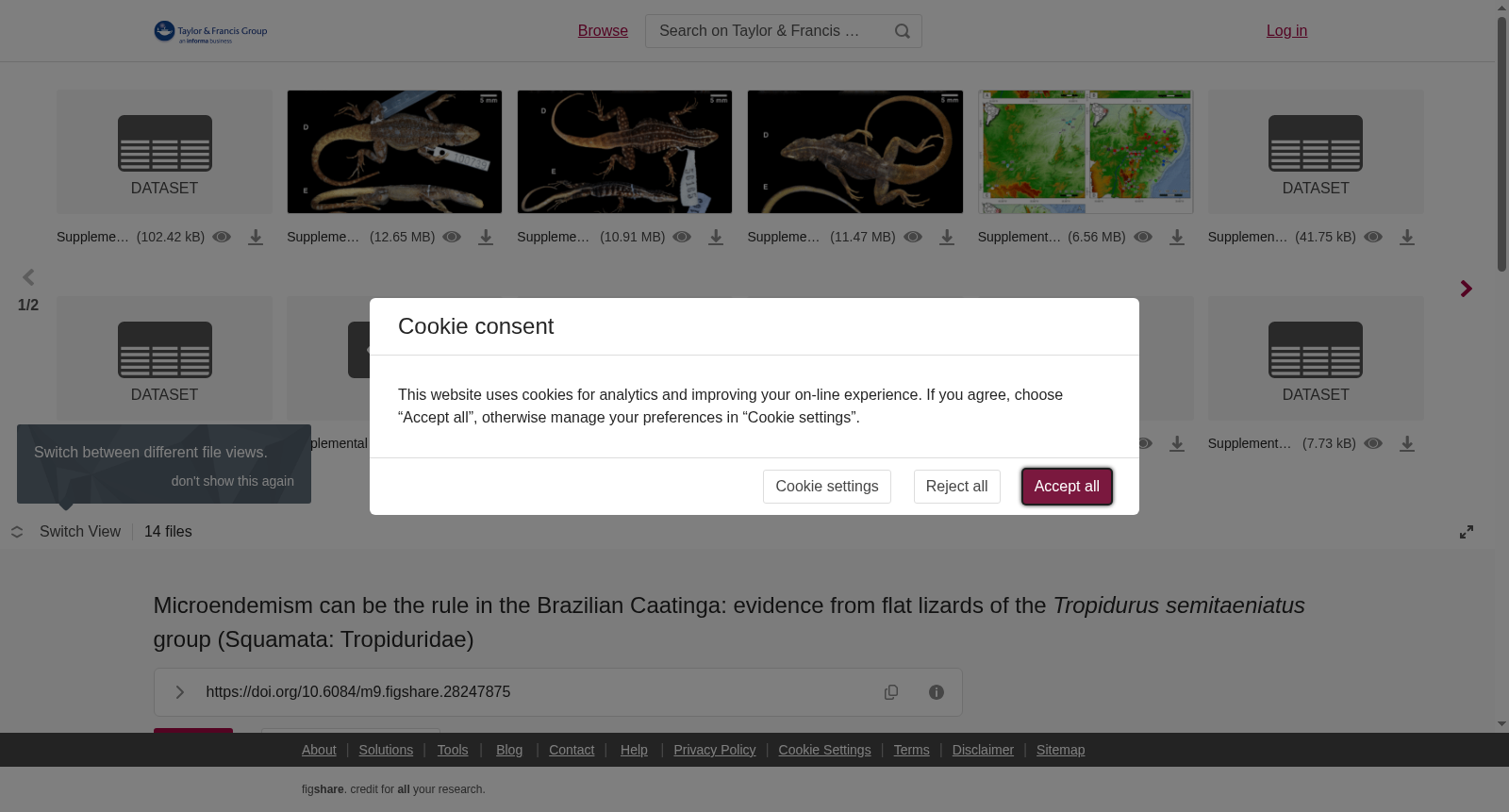
Microendemism remains a poorly studied phenomenon within Brazil’s Caatinga biome, yet recent research has revealed a number of species complexes with diverging lineages confined to narrow geographic ranges. These lineages often inhabit remote and undersampled regions lacking conservation efforts. Notable examples include the flat lizards from the <i>Tropidurus semitaeniatus</i> group, which comprises the broadly distributed <i>T. semitaeniatus</i> species complex plus <i>T. helenae</i>, <i>T. jaguaribanus</i>, and <i>T. pinima</i>, all endemic to the Caatinga biome. Incomplete knowledge of their taxonomic boundaries, phylogenetic relationships, and geographic distribution hinders both the formal description of new microendemic taxa and their conservation assessment. To address these gaps, we conducted a phylogenomic analysis of the <i>T. semitaeniatus</i> group employing ultra-conserved elements (UCEs) and investigated its microendemic diversity. Our analysis revealed that <i>T. semitaeniatus</i> is paraphyletic, with <i>T. helenae</i> emerging as sister to a clade formed by microendemic lineages of <i>T. semitaeniatus</i> (<i>sensu lato</i>), within which <i>T. jaguaribanus</i> is embedded. Additionally, the discovery of a new microendemic species, <i>Tropidurus galileii</i> sp. nov., from calcareous formations of Itaguaçu da Bahia, Brazil, exposed <i>T. pinima</i> as paraphyletic, revealing a novel species complex composed of multiple microendemic lineages. This finding led us to produce the first illustrated morphological guide for the <i>T. semitaeniatus</i> group, aimed at facilitating future comparative studies. Most species requiring taxonomic treatment in the <i>T. semitaeniatus</i> group exhibit morphological distinctiveness, and the number of microendemic taxa is significantly higher than previously estimated. Our findings suggest that range expansion followed by allopatric speciation is unlikely to be the sole driver of microendemism in this group. However, the specific biogeographic processes underlying the origin of microendemic lineages remain elusive. This study sheds light on the microendemic lizard diversity of the Caatinga, emphasizing the urgent need for enhanced systematic and conservation efforts. http://zoobank.org/urn:lsid:zoobank.org:pub:062DCEAA-67D9-41B9-B155-EC538BFE8182
微特有性(microendemism)在巴西卡廷加生物群区(Caatinga biome)中仍是研究不足的科学现象,但近期研究已发现多个支系分化的物种复合体,其分布范围极为狭窄。这些支系多栖息于缺乏保护投入的偏远且采样不足的区域。典型案例包括嵴尾蜥属(Tropidurus)半纹嵴尾蜥类群(<i>Tropidurus semitaeniatus</i> group)的扁体蜥,该类群包含分布广泛的半纹嵴尾蜥物种复合体,以及仅分布于卡廷加生物群区的<i>T. helenae</i>、<i>T. jaguaribanus</i>与<i>T. pinima</i>。目前对该类群的分类界限、系统发育关系及地理分布的认知缺口,既阻碍了新微特有类群的正式描述,也制约了其保护评估工作。为填补上述研究空白,本研究利用超保守元件(ultra-conserved elements, UCEs)对半纹嵴尾蜥类群开展系统基因组学分析,并探究其微特有多样性。研究结果显示,半纹嵴尾蜥为并系群,<i>T. helenae</i>作为姊妹群与广义半纹嵴尾蜥(<i>sensu lato</i>)的微特有支系构成的演化支形成姊妹关系,而<i>T. jaguaribanus</i>嵌套于该演化支内部。此外,研究团队在巴西巴伊亚州伊塔瓜苏(Itaguaçu da Bahia)的钙质地层中发现了新微特有物种——<i>Tropidurus galileii</i> sp. nov.,该发现证实<i>T. pinima</i>为并系群,同时揭示了由多个微特有支系构成的全新物种复合体。基于该发现,本研究编制了半纹嵴尾蜥类群的首个图文并茂的形态学指南,旨在为后续比较研究提供支撑。半纹嵴尾蜥类群中多数需开展分类学修订的物种均具备形态特异性,且微特有类群的数量远高于此前预估。本研究结果表明,先分布范围扩张再发生异域成种(allopatric speciation)并非该类群微特有性的唯一驱动因素,但微特有支系起源背后的具体生物地理过程仍不明晰。本研究阐明了卡廷加生物群区的微特有蜥蜴多样性,强调了加强系统学研究与保护工作的迫切需求。http://zoobank.org/urn:lsid:zoobank.org:pub:062DCEAA-67D9-41B9-B155-EC538BFE8182