Simulation studies of divertor power exhaust with neon seeding for CFETR with GW-level fusion power
收藏资源简介:
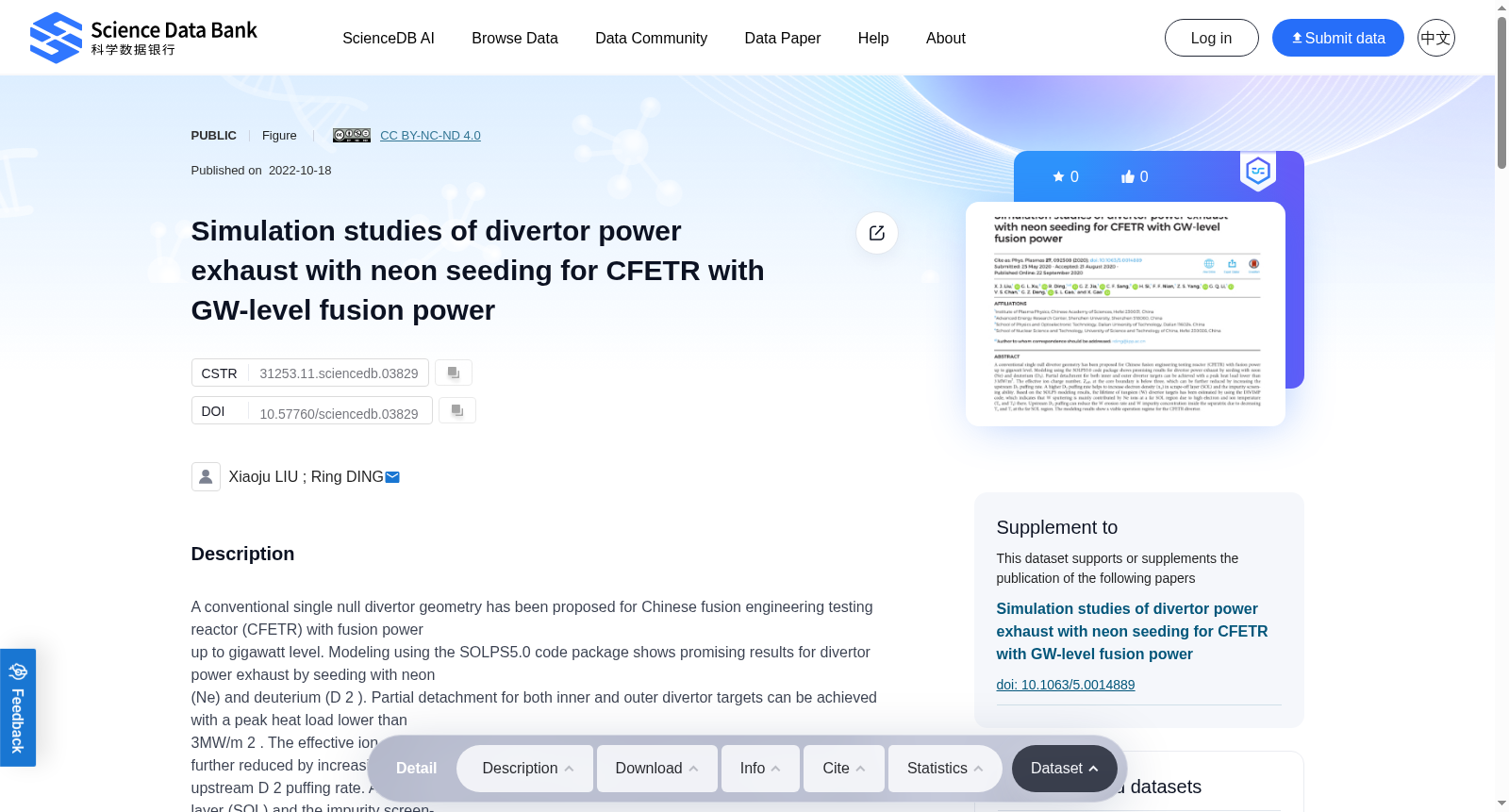
A conventional single null divertor geometry has been proposed for Chinese fusion engineering testing reactor (CFETR) with fusion powerup to gigawatt level. Modeling using the SOLPS5.0 code package shows promising results for divertor power exhaust by seeding with neon(Ne) and deuterium (D 2 ). Partial detachment for both inner and outer divertor targets can be achieved with a peak heat load lower than3MW/m 2 . The effective ion charge number, Z eff , at the core boundary is below three, which can be further reduced by increasing theupstream D 2 puffing rate. A higher D 2 puffing rate helps to increase electron density (n e ) in scrape-off layer (SOL) and the impurity screen-ing ability. Based on the SOLPS modeling results, the lifetime of tungsten (W) divertor targets has been estimated by using the DIVIMPcode, which indicates that W sputtering is mainly contributed by Ne ions at a far SOL region due to high electron and ion temperature(T e and T i ) there. Upstream D 2 puffing can reduce the W erosion rate and W impurity concentration inside the separatrix due to decreasingT e and T i at the far SOL region. The modeling results show a viable operation regime for the CFETR divertor.
针对聚变功率可达吉瓦级的中国聚变工程实验堆(CFETR),研究人员提出采用传统单零偏滤器构型。借助SOLPS5.0代码包开展的模拟建模显示,通过注入氖(Ne)与氘(D₂)可实现优异的偏滤器排热效果:内、外偏滤器靶板均可实现部分脱靶,且峰值热负荷低于3MW/m²。芯部边界处的有效离子电荷数Z_eff低于3,通过提升上游氘气(D₂)喷注速率可进一步降低该数值。更高的D₂喷注速率有助于提升刮削层(SOL)的电子密度(n_e)与杂质屏蔽能力。基于SOLPS的建模结果,研究人员结合DIVIMP代码估算了钨(W)偏滤器靶板的寿命,结果表明钨溅射主要由远刮削层区域的氖离子贡献——该区域电子与离子温度(T_e、T_i)较高。上游D₂喷注可通过降低远刮削层区域的T_e与T_i,从而减少磁分界面(separatrix)内的钨侵蚀速率与钨杂质浓度。本次建模结果证实,CFETR偏滤器具备可行的运行工况区间。