AITDNA
收藏资源简介:
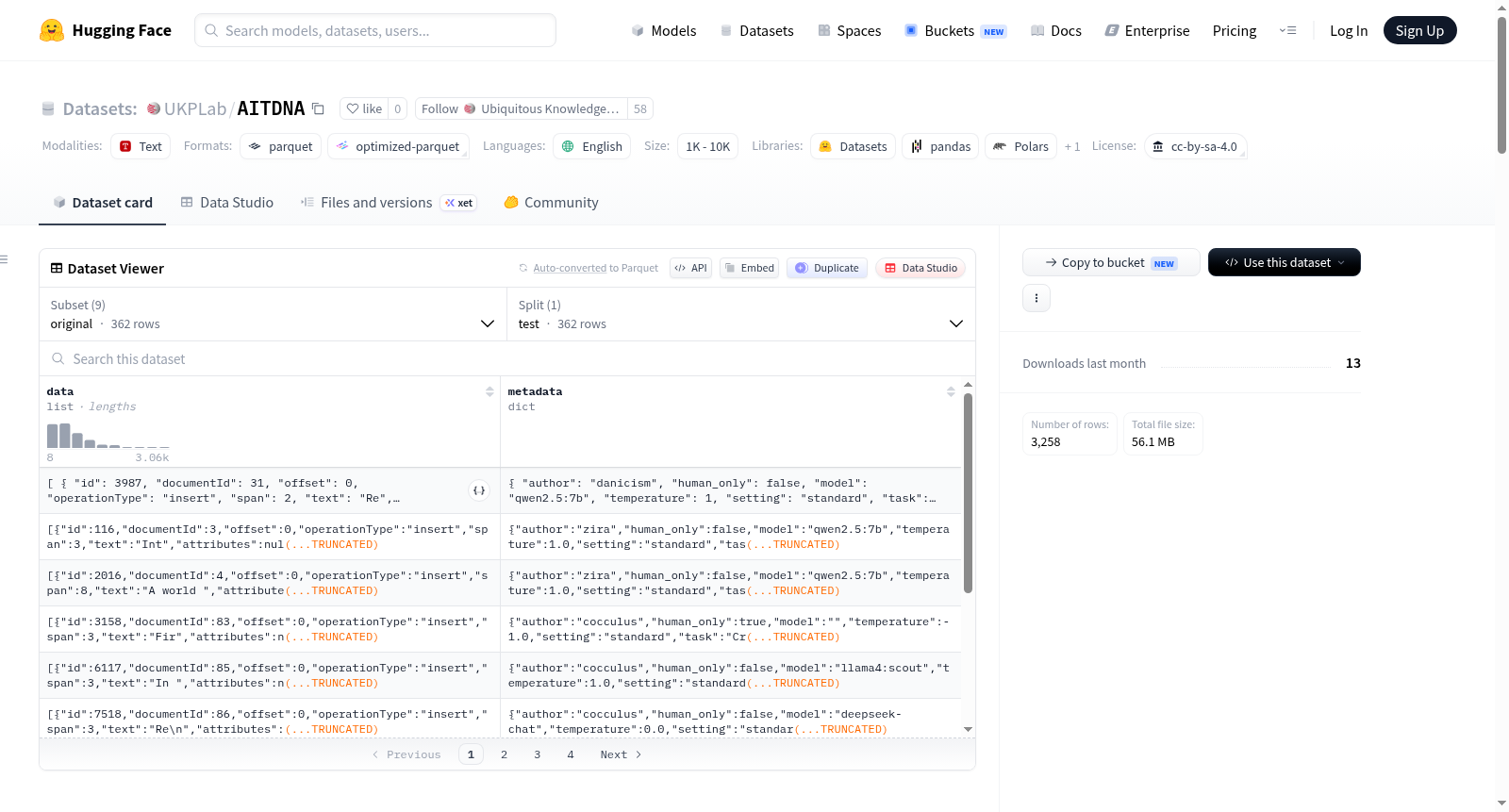
AITDNA(AI-generated Text Detection: Notion-Agnostic)是一个用于AI生成文本检测的数据集,旨在支持论文《Your AI Text is not Mine: Redefining and Evaluating AI-generated Text Detection under Realistic Assumptions》的研究。该数据集收集了来自用户研究的人机交互文本数据,完整记录了每篇文本的创作过程,包括原始用户编辑、模型建议和用户查询等信息。其核心特点是提供了多种基于不同AI生成文本定义(notions)的数据表示,包括文档级(基于词元比例)、句子级、词元级、边界级(最优分割)、片段级(字符级作者归属)、意图基于(基于用户查询规则)、内容基于(基于模型输出规则)和成员基于(基于N-gram在参考语料中的出现)。数据集包含9个配置,每个配置对应一种表示,其中original配置为原始编辑数据,其他配置为处理后的结构化数据。每个样本均以JSON格式存储,包含data(文本片段列表,每个片段有文本内容、作者和查询)和metadata(作者、是否为纯人工文本、模型名称、温度参数、设置和任务类型)两部分。数据集规模为362个样本(测试集),语言为英语,适用于评估和开发在不同现实假设下的AI生成文本检测模型。数据通过用户研究收集,参与者撰写了论证性、创意性和说明性文本,并已进行匿名化处理以保护隐私。
AITDNA (AI-generated Text Detection: Notion-Agnostic) is a dataset for AI-generated text detection, designed to support the research in the paper Your AI Text is not Mine: Redefining and Evaluating AI-generated Text Detection under Realistic Assumptions. It collects human-AI interaction text data from user studies, fully documenting the creation process of each text, including original user edits, model suggestions, and user queries. The datasets core feature is providing multiple data representations based on different notions of AI-generated text, including document-level (based on token proportion), sentence-level, token-level, boundary-level (optimal segmentation), segment-level (character-level author attribution), intention-based (based on user query rules), content-based (based on model output rules), and membership-based (based on N-gram occurrence in reference corpora). The dataset includes 9 configurations, each corresponding to a representation, with the original configuration as raw edit data and others as processed structured data. Each sample is stored in JSON format, containing data (a list of text segments, each with text content, author, and query) and metadata (author, whether it is purely human text, model name, temperature parameter, settings, and task type). The dataset size is 362 samples (test set), the language is English, and it is suitable for evaluating and developing AI-generated text detection models under various realistic assumptions. Data was collected through user studies where participants wrote argumentative, creative, and expository texts, and has been anonymized to protect privacy.
数据集概述:AITDNA(AI生成文本检测:概念无关)
数据集名称: AITDNA (AI-generated Text Detection: Notion-Agnostic)
语言: 英语
许可证: cc-by-sa-4.0(注:README中另标注gpl-2.0,以YAML定义为准)
配置数量: 9个(original、boundary、content、document、intent、membership、sentence、span、token)
默认配置: original
规模: 所有配置的每个split均含362个样本(n<1K)
仓库地址: https://github.com/UKPLab/arxiv2026-aitdna
数据集描述
AITDNA通过一系列用户研究收集人机交互数据,旨在为AI生成文本检测提供多种视角(概念)。数据集包含每个文本的完整创建信息(原始用户编辑、模型建议、用户查询等),并针对不同检测任务提供了多种标注层次。
配置(概念/Notions)
| 配置名称 | 标注粒度 | 说明 | 测试集大小(字节) |
|---|---|---|---|
| original | - | 原始用户编辑数据(JSON格式) | 37,230,508 |
| document | 文档级 | 如果≥50%的token由AI生成,则标记为AI | 980,943 |
| sentence | 句子级 | 如果≥50%的token由AI生成,则标记该句子为AI | 1,227,927 |
| token | token级 | 每个token的归属标签 | 5,688,232 |
| boundary | 片段级 | 将文本分为N个最优分割部分(默认N=5) | 1,028,554 |
| span | 跨度级 | 字符级别的相同作者连续片段 | 1,262,577 |
| intent | 意图级 | 基于用户查询类型规则(允许/禁止)的句子级标签 | 1,181,744 |
| content | 内容级 | 基于模型输出类型规则(允许/禁止)的句子级标签 | 1,206,051 |
| membership | 成员级 | 基于N-gram在人类参考语料库中出现情况的token级标签(默认N=2) | 4,687,493 |
数据结构
通用结构(以sentence配置为例)
每个样本包含两个主要部分:data和metadata。
- data:列表,每个元素包含:
text(字符串):文本片段author(字符串):作者(User或Bot)queries(字符串列表):用户查询(如有)
- metadata:结构体,包含:
author(字符串):参与者化名human_only(布尔):是否纯人类撰写model(字符串):使用的AI模型(如gpt-5.2)temperature(浮点数):生成温度setting(字符串):实验设置(如standard)task(字符串):写作任务类型(如Argumentative Writing)
original配置的数据结构
- data:列表,每个元素为JSON对象,包含:
id、documentId、offset、operationType(字符串,如insert)、span、text、attributes、createdAt、order、user
- metadata:与上述相同
数据来源与创建
- 数据收集:通过用户研究收集,参与者包括学生、博士生和Prolific平台人员。每人撰写四篇文本:三篇借助LLM(论证、创意、说明各一),一篇纯人类撰写(类型重复前述之一)。
- 任务主题:论证类和创意类文本提供两个选题供选择。
- 隐私处理:已匿名化,用户名无对应真实姓名,无个人信息发布。
下载与使用
- 总下载大小(所有配置总和):约254MB(original配置占254,075,203字节,其余配置共约30MB)
- 使用示例(Python): python from datasets import load_dataset ds = load_dataset("UKPLab/AITDNA", name="sentence", split="test")
联系信息
marina.sakharova@stud.tu-darmstadt.de