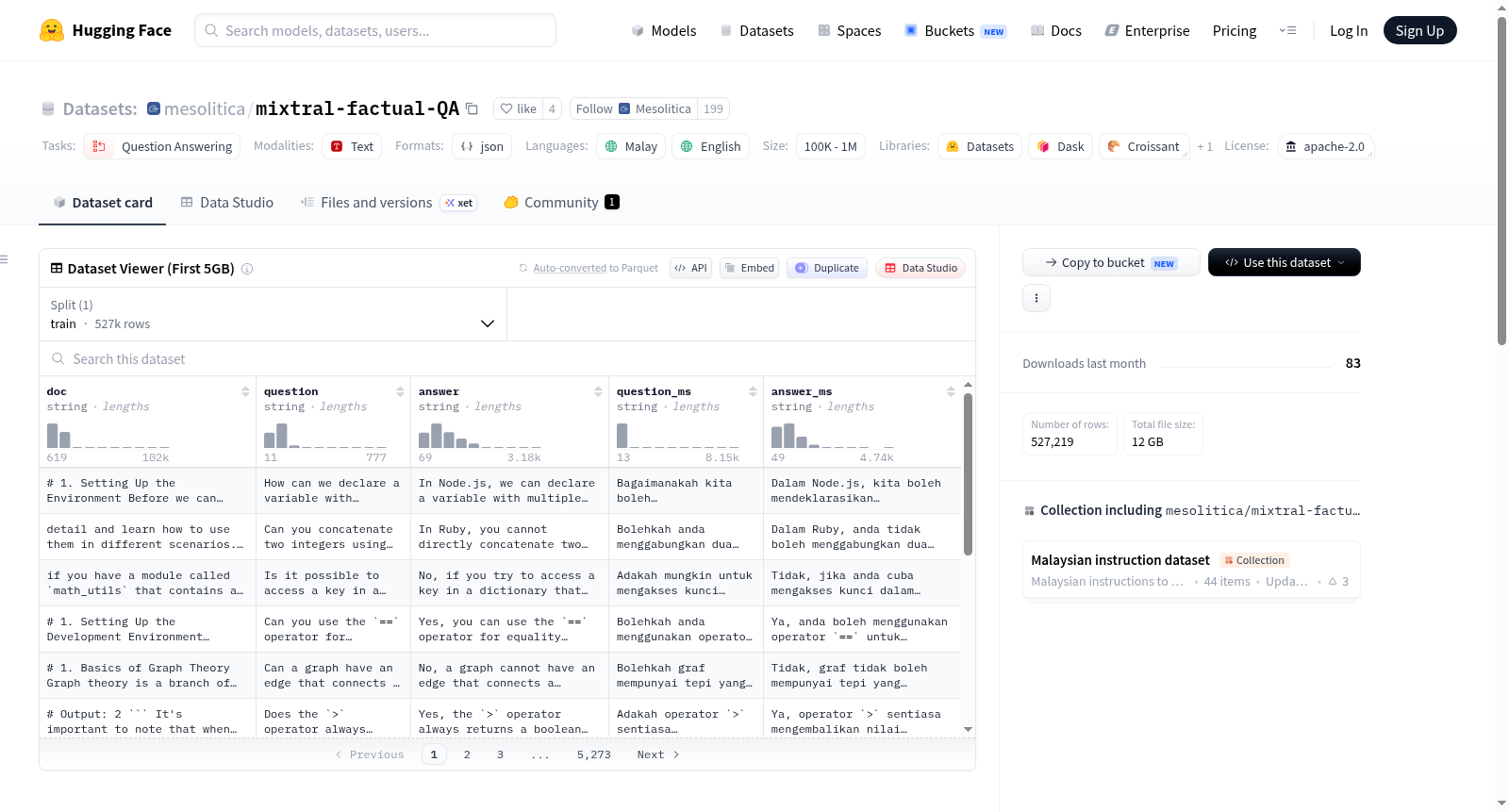
mesolitica/mixtral-factual-QA
收藏Mixtral Factual QA 数据集概述
数据集基本信息
- 许可证:Apache-2.0
- 任务类别:问答(Question-Answering)
- 语言:马来语(ms)、英语(en)
数据来源
数据集包含以下来源的上下文信息:
- maktabahalbakri.com
- muftiwp.gov.my
- asklegal.my
- dewanbahasa-jdbp
- gov.my
- patriots
- rootofscience
- majalahsains
- nasilemaktech
- alhijrahnews
- https://huggingface.co/datasets/open-phi/textbooks
数据文件
factually-wrong-qa-coding.jsonl:包含31253行,大小为425 MBfactually-wrong-qa.jsonl:包含1108037行,大小为10 GB
示例数据
示例数据包含以下字段:
doc:文档内容question:问题answer:答案question_ms:马来语问题answer_ms:马来语答案
示例数据内容如下: python { doc: "shift register, the parallel-in-serial-out (PISO) register, and the serial-in-parallel-out (SIPO) register. These registers are all based on the concept of a sequential circuit, which is a circuit that has a sequence of states and can be switched between them by applying appropriate inputs. - Shift Register: The shift register is a type of register that can shift its stored data by one bit at a time. It has a set of inputs, CLK (clock), SER (serial input), and RST (reset), and a set of outputs, Q0, Q1, Q2, etc. The CLK input controls when the register shifts its data, and the RST input resets the register to its initial state. The SER input allows for the serial input of data into the register. The truth table for a shift register is: | CLK | RST | SER | Q0 | Q1 | Q2 | ... | |-----|-----|-----|----|----|----|-----| | 0 | 0 | 0 | 0 | 0 | 0 | ... | | 0 | 0 | 1 | 0 | 0 | 0 | ... | | 1 | 0 | 0 | 1 | 0 | 0 | ... | | 1 | 0 | 1 | 0 | 1 | 0 | ... | | 0 | 1 | 0 | 0 | 0 | 0 | ... | | 0 | 1 | 1 | 0 | 0 | 0 | ... | | 1 | 1 | 0 | 0 | 0 | 0 | ... | | 1 | 1 | 1 | 0 | 0 | 0 | ... | | ... | ... | ... | ...| ...| ...| ... | - Parallel-In-Serial-Out (PISO) Register: The PISO register is a type of register that can transfer parallel data into a serial output. It has a set of inputs, CLK (clock), D0, D1, D2, etc. (parallel inputs), and RST (reset), and a set of outputs, Q (serial output). The CLK input controls when the register transfers its data, and the RST input resets the register to its initial state. The truth table for a PISO register is: | CLK | RST | D0 | D1 | D2 | ... | Q | |-----|-----|----|----|----|-----|---| | 0 | 0 | 0 | 0 | 0 | ... | 0 | | 0 | 0 | 1 | 0 | 0 | ... | 0 | | 1 | 0 | 0 | 1 | 0 | ... | 0 | | 1 | 0 | 1 | 0 | 1 | ... | 0 | | 0 | 1 | 0 | 0 | 0 | ... | 0 | | 0 | 1 | 1 | 0 | 0 | ... | 0 | | 1 | 1 | 0 | 0 | 0 | ... | 0 | | 1 | 1 | 1 | 0 | 0 | ... | 0 | | ... | ... | ...| ...| ...| ... |...| - Serial-In-Parallel-Out (SIPO) Register: The SIPO register is a type of register that can transfer serial data into parallel outputs. It has a set of inputs, CLK (clock), SER (serial input), and RST (reset), and a set of outputs, Q0, Q1, Q2, etc. (parallel outputs). The CLK input controls when the register transfers its data, and the RST input resets the register to its initial state. The SER input allows for the serial input of data into the register. The truth table for a SIPO register is: | CLK | RST | SER | Q0 | Q1 | Q2 | ... | |-----|-----|-----|----|----|----|-----| | 0 | 0 | 0 | 0 | 0 | 0 | ... | | 0 | 0 | 1 | 0 | 0 | 0 | ... | | 1 | 0 | 0 | 1 | 0 | 0 | ... | | 1 | 0 | 1 | 0 | 1 | 0 | ... | | 0 | 1 | 0 | 0 | 0 | 0 | ... | | 0 | 1 | 1 | 0 | 0 | 0 | ... | | 1 | 1 | 0 | 0 | 0 | 0 | ... | | 1 | 1 | 1 | 0 | 0 | 0 | ... | | ... | ... | ... | ...| ...| ...| ... | ### Conclusion In this chapter, we have explored the fundamentals of digital electronics. We have learned about the basic building blocks of digital circuits, such as logic gates, flip-flops, and registers. We have also discussed the importance of binary numbers and how they are used to represent and manipulate data in digital systems. Additionally, we have examined the design and implementation of combinational and sequential logic circuits, and how they can be used to perform various operations and tasks. Digital electronics is a rapidly evolving field, with new technologies and advancements being made every day. As such, it is important to continue learning and staying updated on the latest developments in this area. By understanding the fundamentals of digital electronics, you will be better equipped to design and analyze complex digital systems, and contribute to the advancement of this field. ### Exercises #### Exercise 1 Design a combinational logic circuit that takes in two 4-bit binary numbers and outputs their sum in binary form. #### Exercise 2 Implement a sequential logic circuit that counts from 0 to 7 and then repeats the sequence. #### Exercise 3 Research and compare the different types of flip-flops, including D, JK, T, and SR flip-flops. Explain their differences and when each type would be used. #### Exercise 4 Using Boolean algebra, simplify the following expression: $$(A + B)(A + \overline{B})(\overline{A} + B)$$ #### Exercise 5 Design a circuit that takes in a 3-bit binary number and outputs its equivalent in Gray code. ### Conclusion In this chapter, we have explored the fundamentals of digital electronics. We have learned about the basic building blocks of digital circuits, such as logic gates, flip-flops, and registers. We have also discussed the importance of binary numbers and how they are used to represent and manipulate data in digital systems. Additionally, we have examined the design and implementation of combinational and sequential logic circuits, and how they can be used to perform various operations and tasks. Digital electronics is a rapidly evolving field, with new technologies and advancements being made every day. As such, it is important to continue learning and staying updated on the latest developments in this area. By understanding the fundamentals of digital electronics, you will be better equipped to design and analyze complex digital systems, and contribute to the advancement of this field. ### Exercises #### Exercise 1 Design a combinational logic circuit that takes in two 4-bit binary numbers and outputs their sum in binary form. #### Exercise 2 Implement a sequential logic circuit that counts from 0 to 7 and then repeats the sequence. #### Exercise 3 Research and compare the different types of flip-flops, including D, JK, T, and SR flip-flops. Explain their differences and when each type would be used. #### Exercise 4 Using Boolean algebra, simplify the following expression: $$(A + B)(A + \overline{B})(\overline{A} + B)$$ #### Exercise 5 Design a circuit that takes in a 3-bit binary number and outputs its equivalent in Gray code. ## Chapter: Fundamentals of Circuits and Electronics ### Introduction In this chapter, we will explore the fundamentals of communication systems. Communication systems are an integral part of our daily lives, allowing us to connect with others and access information from around the world. These systems rely on the principles of circuits and electronics to transmit and receive signals, making them an essential topic to understand in the field of electrical engineering. We will begin by discussing the basic components of a communication system, including transmitters, receivers, and channels. We will then delve into the principles of modulation, which is the process of encoding information onto a carrier signal for transmission. This will include an in-depth look at amplitude modulation (AM), frequency modulation (FM), and phase modulation (PM). Next, we will explore the concept of noise and its impact on communication systems. We will discuss various techniques for reducing noise and improving the quality of transmitted signals. This will include error correction codes, equalization, and diversity techniques. Finally, we will examine different types of communication systems, such as analog and digital systems, and their applications in various industries. We will also touch on emerging technologies, such as wireless communication and satellite communication, and their impact on modern communication systems. By the end of this chapter, you will have a solid understanding of the fundamentals of communication systems and how they are used in our daily lives. This knowledge will serve as a foundation for further exploration into more advanced topics in the field of circuits and electronics. So lets dive in and discover the exciting world of communication systems! ## Chapter 19: Communication Systems: ### Section 19.1: Modulation Techniques Modulation is the process of encoding information onto a carrier signal for transmission. This is a crucial step in communication systems, as it allows for the efficient and reliable transfer of information over long distances. In this section, we will explore the different types of modulation techniques and their applications in communication systems. #### Amplitude Modulation (AM) Amplitude modulation is a type of modulation where the amplitude of the carrier signal is varied in accordance with the information being transmitted. This is achieved by multiplying the carrier signal with the information signal, resulting in a modulated signal that contains both the carrier and information signals. The modulated signal is then transmitted through a channel to the receiver, where it is demodulated to extract the original information signal. AM is commonly used in radio broadcasting, where the carrier signal is a high-frequency electromagnetic wave and the information signal is an audio signal. The amplitude of the carrier wave is varied to match the amplitude of the audio signal, resulting in a modulated signal that can be transmitted over long distances without significant loss of quality. #### Frequency Modulation (FM) Frequency modulation is a type of modulation where the frequency of the carrier signal is varied in accordance with the information being transmitted. This is achieved by changing the frequency of the carrier signal in proportion to the amplitude of the information signal. The modulated signal is then transmitted through a channel to the receiver, where it is demodulated to extract the original information signal. FM is commonly used in radio broadcasting, particularly for high-fidelity music transmission. Unlike AM, FM is less susceptible to noise and interference, making it a preferred choice for high-quality audio transmission. #### Phase Modulation (PM) Phase modulation is a type of modulation where the phase of the carrier signal is varied in accordance with the information being transmitted. This is achieved by changing the phase of the carrier signal in proportion to the amplitude of the information signal. The modulated signal is then transmitted through a channel to the receiver, where it is demodulated to extract the original information signal. PM is commonly used in digital communication systems, such as satellite communication and wireless communication. It is also used in some analog systems, particularly in high-frequency applications. ### Noise in Communication Systems Noise is an unwanted disturbance that can affect the quality of a transmitted signal. It can be caused by various factors, such as electromagnetic interference, thermal noise, and channel distortion. In communication systems, noise can cause errors in the received signal, leading to a loss of information. To combat noise, various techniques are used, such as error correction codes, equalization, and diversity techniques. Error correction codes add redundancy to the transmitted signal, allowing for the detection and correction of errors at the receiver. Equalization techniques are used to compensate for channel distortion, while diversity techniques use multiple channels to transmit the same information, reducing the impact", question: Why is amplitude modulation more susceptible to noise and interference compared to frequency modulation?, answer: Amplitude modulation (AM) is more susceptible to noise and interference compared to frequency modulation (FM) because the amplitude of the carrier wave in AM is varied to match the amplitude of the audio signal. This means that any noise or interference present in the channel will also be amplified, leading to a loss of quality in the received signal.
In contrast, FM varies the frequency of the carrier signal in proportion to the amplitude of the information signal. This means that any noise or interference present in the channel will result in a slight shift in the frequency of the carrier signal, but the overall amplitude of the signal will remain relatively constant. This makes FM less susceptible to noise and interference compared to AM, particularly in high-fidelity music transmission.
Furthermore, FM modulation has a higher signal-to-noise ratio compared to AM modulation. The signal-to-noise ratio is the ratio of the power of the signal to the power of the noise. A higher signal-to-noise ratio means that the signal is stronger compared to the noise, resulting in a clearer and more reliable transmission. FM has a wider bandwidth compared to AM, allowing it to transmit a stronger signal and reducing the impact of noise and interference.
Overall, FM is a more robust modulation technique compared to AM, particularly in high-fidelity music transmission. However, AM is still commonly used in radio broadcasting due to its simplicity and lower bandwidth requirements., question_ms: Mengapa modulasi amplitud lebih terdedah kepada hingar dan gangguan berbanding dengan modulasi frekuensi?, answer_ms: Modulasi amplitud (AM) lebih mudah terdedah kepada hingar dan gangguan berbanding dengan modulasi frekuensi (FM) kerana amplitud gelombang pembawa dalam AM diubah untuk sepadan dengan amplitud isyarat audio. Ini bermakna bahawa sebarang bunyi atau gangguan yang terdapat dalam saluran juga akan dikuatkan, yang membawa kepada kehilangan kualiti dalam isyarat yang diterima.
Sebaliknya, FM mengubah kekerapan isyarat pembawa mengikut kadar amplitud isyarat maklumat. Ini bermakna bahawa sebarang bunyi atau gangguan yang terdapat dalam saluran akan mengakibatkan perubahan sedikit dalam kekerapan isyarat pembawa, tetapi amplitud keseluruhan isyarat akan kekal secara relatifnya. Ini menjadikan FM kurang terdedah kepada hingar dan gangguan berbanding AM, terutamanya dalam penghantaran muzik kesetiaan tinggi.
Tambahan pula, modulasi FM mempunyai nisbah isyarat-ke-bunyi yang lebih tinggi berbanding modulasi AM. Nisbah isyarat kepada hingar ialah nisbah kuasa isyarat kepada kuasa bunyi. Nisbah isyarat-ke-bunyi yang lebih tinggi bermakna isyarat itu lebih kuat berbanding dengan hingar, menghasilkan penghantaran yang lebih jelas dan lebih dipercayai. FM mempunyai lebar jalur yang lebih luas berbanding AM, membolehkannya menghantar isyarat yang lebih kuat dan mengurangkan kesan hingar dan gangguan.
Secara keseluruhan, FM ialah teknik modulasi yang lebih mantap berbanding AM, terutamanya dalam penghantaran muzik kesetiaan tinggi. Walau bagaimanapun, AM masih biasa digunakan dalam penyiaran radio kerana kesederhanaan dan keperluan jalur lebar yang lebih rendah. }
数据集用途
该数据集用于生成基于提供的上下文的问答对,适用于问答系统的训练和评估。