印度洋-第三极经向断面区域大气和海洋热源数据集(2000-2019)
收藏资源简介:
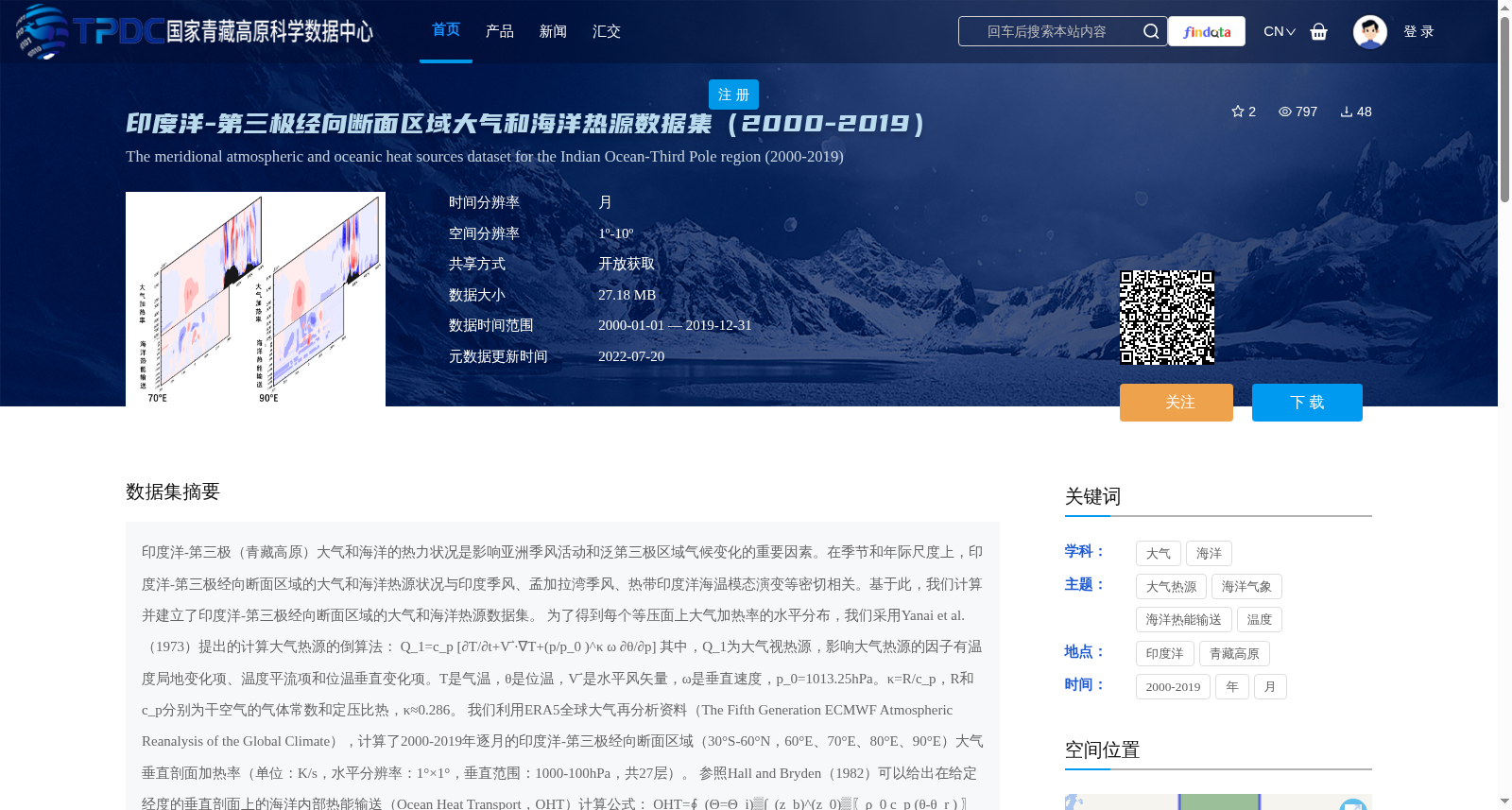
印度洋-第三极(青藏高原)大气和海洋的热力状况是影响亚洲季风活动和泛第三极区域气候变化的重要因素。在季节和年际尺度上,印度洋-第三极经向断面区域的大气和海洋热源状况与印度季风、孟加拉湾季风、热带印度洋海温模态演变等密切相关。基于此,我们计算并建立了印度洋-第三极经向断面区域的大气和海洋热源数据集。 为了得到每个等压面上大气加热率的水平分布,我们采用Yanai et al.(1973)提出的计算大气热源的倒算法: Q_1=c_p [∂T/∂t+V ⃑∙∇T+(p/p_0 )^κ ω ∂θ/∂p] 其中,Q_1为大气视热源,影响大气热源的因子有温度局地变化项、温度平流项和位温垂直变化项。T是气温,θ是位温,V ⃑是水平风矢量,ω是垂直速度,p_0=1013.25hPa。κ=R/c_p,R和c_p分别为干空气的气体常数和定压比热,κ≈0.286。 我们利用ERA5全球大气再分析资料(The Fifth Generation ECMWF Atmospheric Reanalysis of the Global Climate),计算了2000-2019年逐月的印度洋-第三极经向断面区域(30°S-60°N,60°E、70°E、80°E、90°E)大气垂直剖面加热率(单位:K/s,水平分辨率:1°×1°,垂直范围:1000-100hPa,共27层)。 参照Hall and Bryden(1982)可以给出在给定经度的垂直剖面上的海洋内部热能输送(Ocean Heat Transport,OHT)计算公式: OHT=∮_(Θ=Θ_i)▒∫_(z_b)^(z_0)▒〖ρ_0 c_p (θ-θ_r ) 〗∙udz 其中,ρ_0是海水密度,c_p是海水的比热容,θ是海水位温,基准温度θ_r可取0℃,u是纬向海水流速。z_0、z_b分别表示海表和海底深度。 我们利用CMEMS(Copernicus Marine Service)全球海洋集合再分析数据,计算了2000-2019年逐月的印度洋-第三极经向断面区域(30°S-30°N,60°E、70°E、80°E、90°E)海洋内部垂直剖面的热能输送(以向东为正,单位:PW(1015W),水平分辨率:1°×1°,垂直范围:从海表到海底约5900m深度,共75层)。 该数据集可以反映出印度洋-青藏高原地区经向剖面的大气和海洋热力状况与印度季风、孟加拉湾季风、热带印度洋海温模态演变的密切关联。比如,从印度洋-第三极70°E经向断面区域大气垂直剖面加热率的逐月演变(图1)能够看到,从3月至5月,大气热源区从热带南印度洋上空逐渐向北推进,特别是从5月到6月,大气热源区从赤道印度洋上空移向热带北印度洋上空,且强度显著加强、范围明显扩大,与此同时印度夏季风爆发。比如,从印度洋-第三极90°E经向断面区域大气垂直剖面加热率的逐月演变(图2)可以看到,4月到6月,大气热源区从热带印度洋上空向青藏高原南侧扩张并明显增强,与孟加拉湾季风的爆发和向北推进相一致。再比如,根据印度洋-第三极60°E和90°E经向断面区域海洋内部热能输送的逐月演变(图3和4)可知,赤道印度洋次表层有自西向东的海洋热能输送,它与印度洋赤道潜流的位置非常接近,且在西部的强度明显高于东部,这与风-温跃层-海温之间的反馈机制有关;另外值得注意的是,该次表层热能输送在春季(3-5月)较强,夏季减弱,秋末冬初(10-12月)再次显著加强,与印度洋偶极子的发展和形成存在相互作用。
The thermal conditions of the atmosphere and ocean over the Indian Ocean-Third Pole (Tibetan Plateau) region are critical factors influencing Asian monsoon activities and climate change in the Pan-Third Pole region. On seasonal and interannual scales, the atmospheric and oceanic heat source conditions in the meridional transect region of the Indian Ocean-Third Pole are closely correlated with the Indian monsoon, Bay of Bengal monsoon, and the evolution of sea temperature modes in the tropical Indian Ocean, among other factors. Based on this, we calculated and established an atmospheric and oceanic heat source dataset for the meridional transect region of the Indian Ocean-Third Pole. To obtain the horizontal distribution of atmospheric heating rates on each isobaric surface, we adopted the backward calculation method for atmospheric heat sources proposed by Yanai et al. (1973): $$Q_1 = c_p left[ frac{partial T}{partial t} + vec{V} cdot abla T + left( frac{p}{p_0} ight)^kappa omega frac{partial heta}{partial p} ight]$$ Here, $Q_1$ is the apparent atmospheric heat source. The factors affecting the atmospheric heat source include the local temperature change term, temperature advection term, and vertical variation term of potential temperature. $T$ denotes air temperature, $ heta$ is potential temperature, $vec{V}$ is the horizontal wind vector, $omega$ is the vertical velocity, and $p_0 = 1013.25$ hPa. $kappa = R/c_p$, where $R$ and $c_p$ are the gas constant and specific heat at constant pressure for dry air, respectively, with $kappa approx 0.286$. We used the ERA5 global atmospheric reanalysis dataset ("The Fifth Generation ECMWF Atmospheric Reanalysis of the Global Climate") to calculate the monthly atmospheric vertical cross-section heating rates over the meridional transect region of the Indian Ocean-Third Pole (30°S–60°N, 60°E, 70°E, 80°E, 90°E) from 2000 to 2019. The unit is K/s, with a horizontal resolution of 1°×1°, vertical range of 1000–100 hPa, and a total of 27 layers. Referring to Hall and Bryden (1982), the calculation formula for Ocean Heat Transport (OHT) in the vertical section at a given longitude is as follows: $$OHT = oint_{Theta=Theta_i} int_{z_b}^{z_0} ho_0 c_p ( heta - heta_r) u , dz$$ Here, $ ho_0$ is the seawater density, $c_p$ is the specific heat capacity of seawater, $ heta$ is the potential temperature of seawater, the reference temperature $ heta_r$ can be taken as 0°C, and $u$ is the zonal seawater velocity. $z_0$ and $z_b$ represent the sea surface and seabed depth, respectively. We used the CMEMS (Copernicus Marine Service) global ocean ensemble reanalysis dataset to calculate the monthly ocean internal heat transport in vertical sections over the meridional transect region of the Indian Ocean-Third Pole (30°S–30°N, 60°E, 70°E, 80°E, 90°E) from 2000 to 2019. The direction is positive eastward, with the unit of PW (10^15 W), horizontal resolution of 1°×1°, vertical range from sea surface to approximately 5900 m seabed depth, and a total of 75 layers. This dataset can reflect the close correlation between the atmospheric and oceanic thermal conditions in the meridional cross-sections of the Indian Ocean-Tibetan Plateau region and the Indian monsoon, Bay of Bengal monsoon, and the evolution of sea temperature modes in the tropical Indian Ocean. For example, from the monthly evolution of atmospheric vertical cross-section heating rates in the 70°E meridional transect region of the Indian Ocean-Third Pole (Figure 1), it can be seen that from March to May, the atmospheric heat source region gradually advances northward over the tropical southern Indian Ocean. Specifically, from May to June, the atmospheric heat source region shifts from over the equatorial Indian Ocean to over the tropical northern Indian Ocean, with significantly enhanced intensity and expanded scope, coinciding with the onset of the Indian summer monsoon. For another example, from the monthly evolution of atmospheric vertical cross-section heating rates in the 90°E meridional transect region of the Indian Ocean-Third Pole (Figure 2), it can be observed that from April to June, the atmospheric heat source region expands toward the southern side of the Tibetan Plateau from over the tropical Indian Ocean and is significantly enhanced, which is consistent with the onset and northward advance of the Bay of Bengal monsoon. Furthermore, based on the monthly evolution of ocean internal heat transport in the 60°E and 90°E meridional transect regions of the Indian Ocean-Third Pole (Figures 3 and 4), it is known that there is a west-to-east ocean heat transport in the subsurface layer of the equatorial Indian Ocean, which is very close to the location of the Equatorial Undercurrent of the Indian Ocean, with higher intensity in the western region than in the eastern region. This is related to the feedback mechanism between wind, thermocline and sea surface temperature. It is also worth noting that this subsurface heat transport is strong in spring (March–May), weakens in summer, and strengthens significantly again in late autumn and early winter (October–December), interacting with the development and formation of the Indian Ocean Dipole.