
Data for: Endogenous Retinoic Acid Theory and Retinoic Acid Depletion Syndrome
收藏Mendeley Data2024-06-25 更新2024-06-26 收录
下载链接:
https://data.mendeley.com/datasets/yc26zg925z
下载链接
链接失效反馈官方服务:
资源简介:
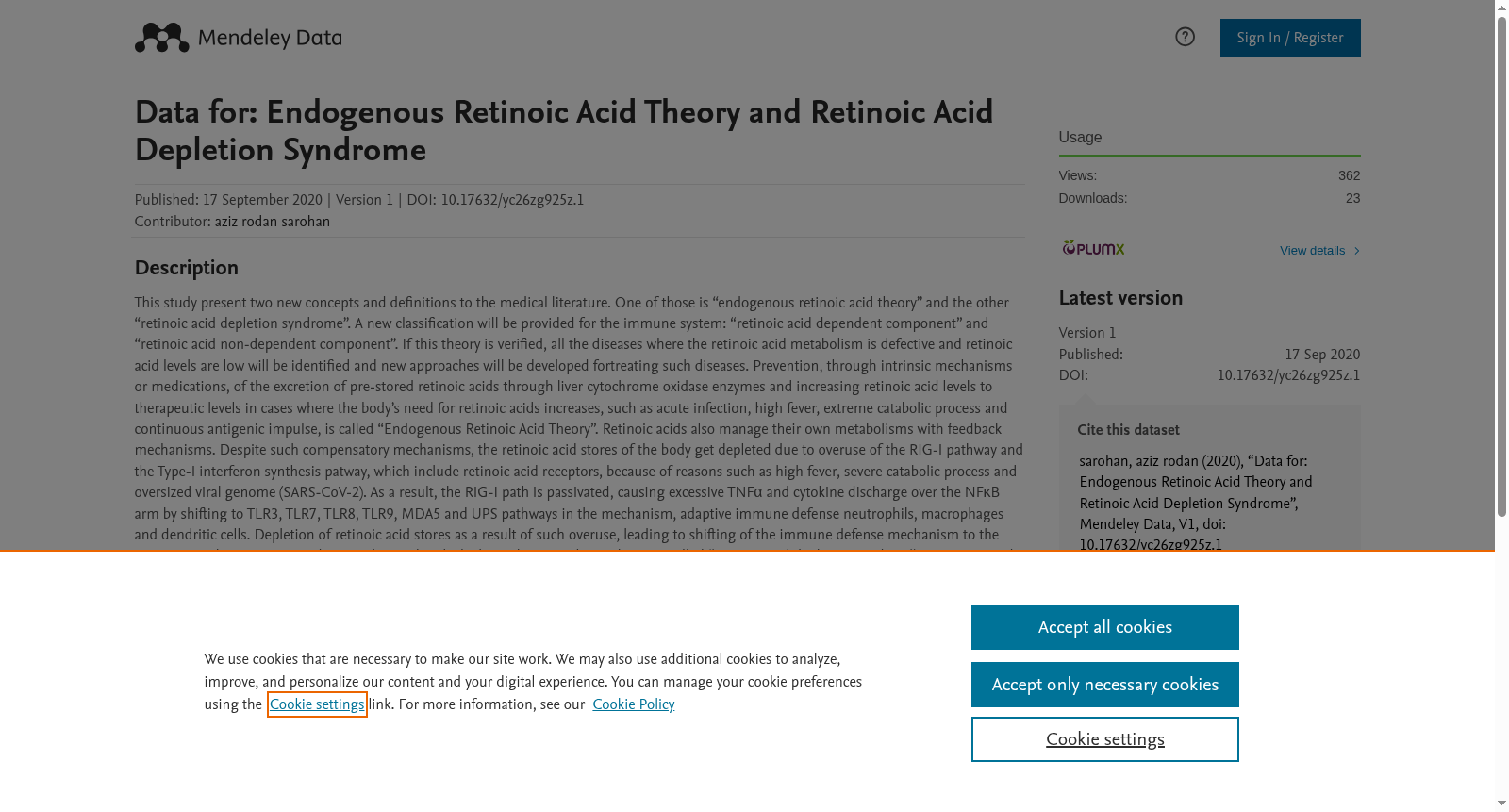
This study present two new concepts and definitions to the medical literature. One of those is “endogenous retinoic acid theory” and the other “retinoic acid depletion syndrome”. A new classification will be provided for the immune system: “retinoic acid dependent component” and “retinoic acid non-dependent component”. If this theory is verified, all the diseases where the retinoic acid metabolism is defective and retinoic acid levels are low will be identified and new approaches will be developed fortreating such diseases. Prevention, through intrinsic mechanisms or medications, of the excretion of pre-stored retinoic acids through liver cytochrome oxidase enzymes and increasing retinoic acid levels to therapeutic levels in cases where the body’s need for retinoic acids increases, such as acute infection, high fever, extreme catabolic process and continuous antigenic impulse, is called “Endogenous Retinoic Acid Theory”. Retinoic acids also manage their own metabolisms with feedback mechanisms. Despite such compensatory mechanisms, the retinoic acid stores of the body get depleted due to overuse of the RIG-I pathway and the Type-I interferon synthesis patway, which include retinoic acid receptors, because of reasons such as high fever, severe catabolic process and oversized viral genome (SARS-CoV-2). As a result, the RIG-I path is passivated, causing excessive TNFα and cytokine discharge over the NFκB arm by shifting to TLR3, TLR7, TLR8, TLR9, MDA5 and UPS pathways in the mechanism, adaptive immune defense neutrophils, macrophages and dendritic cells. Depletion of retinoic acid stores as a result of such overuse, leading to shifting of the immune defense mechanism to the NFκB arm, where retinoic acid cannot be used and which results in cytokine release, is called ‘’retinoic acid depletion syndrom’’. COVID-19 and each of the previously defined sepsis, SIRS and ARDS are essential a retinoic acid depletion syndrome. We claim that retinoic acid metabolism is defective especially in COVID-19 (cytokine storm) most inflammatory diseases such as sepsis, SIRS and ARDS. Finding a solution to this mechanism will require a new perspective and treatment approach to such diseases.
本研究为医学领域引入了两项全新的概念与定义:其一为**内源性视黄酸理论(endogenous retinoic acid theory)**,其二为**视黄酸耗竭综合征(retinoic acid depletion syndrome)**。本研究还将提出免疫系统的全新分类标准,即「视黄酸依赖性组分」与「视黄酸非依赖性组分」。若该理论得到验证,所有存在视黄酸代谢缺陷且视黄酸水平低下的疾病都将被精准识别,并为这类疾病开发全新的治疗方案。通过内源性机制或药物手段,抑制肝脏细胞色素氧化酶介导的预储存视黄酸排泄,并在机体视黄酸需求增加的场景(如急性感染、高热、极端分解代谢过程及持续抗原刺激)中将视黄酸水平提升至治疗靶标浓度,这一策略即被称为「内源性视黄酸理论」。视黄酸亦可通过反馈调控机制自主管理自身代谢。尽管存在此类代偿机制,但在高热、重度分解代谢以及超大病毒基因组(如新型冠状病毒SARS-CoV-2)等因素作用下,机体因过度激活包含视黄酸受体的视黄酸诱导基因I(RIG-I)通路与I型干扰素合成通路,导致体内视黄酸储备被耗竭。随后,RIG-I通路被钝化,机体免疫防御机制转而激活Toll样受体3(TLR3)、TLR7、TLR8、TLR9、黑色素瘤分化相关基因5(MDA5)及泛素-蛋白酶体系统(UPS)通路,通过核因子κB(NFκB)信号轴引发肿瘤坏死因子α(TNFα)与细胞因子的过度释放,涉及中性粒细胞、巨噬细胞及树突状细胞等适应性免疫防御细胞。因上述过度激活导致的视黄酸储备耗竭,会使免疫防御机制转向无法利用视黄酸的NFκB信号轴,进而引发细胞因子释放,这一状态即被称为「视黄酸耗竭综合征」。新型冠状病毒肺炎(COVID-19)以及此前定义的脓毒症(sepsis)、全身炎症反应综合征(SIRS)与急性呼吸窘迫综合征(ARDS),本质上均属于视黄酸耗竭综合征。我们认为,视黄酸代谢缺陷广泛存在于各类炎症性疾病中,尤其在COVID-19(即细胞因子风暴)、脓毒症、SIRS及ARDS中更为显著。阐明这一病理机制,将为这类疾病的研究提供全新视角与治疗思路。
创建时间:
2024-01-23
搜集汇总
数据集介绍
背景与挑战
背景概述
该数据集包含一项医学研究的数据,提出了两个新概念:内源性视黄酸理论和视黄酸耗竭综合征,用于解释视黄酸代谢缺陷与免疫系统疾病(如COVID-19、败血症和ARDS)的关联。数据集包括一份PDF手稿,属于免疫和健康研究领域,旨在为相关疾病提供新的治疗视角。
以上内容由遇见数据集搜集并总结生成


