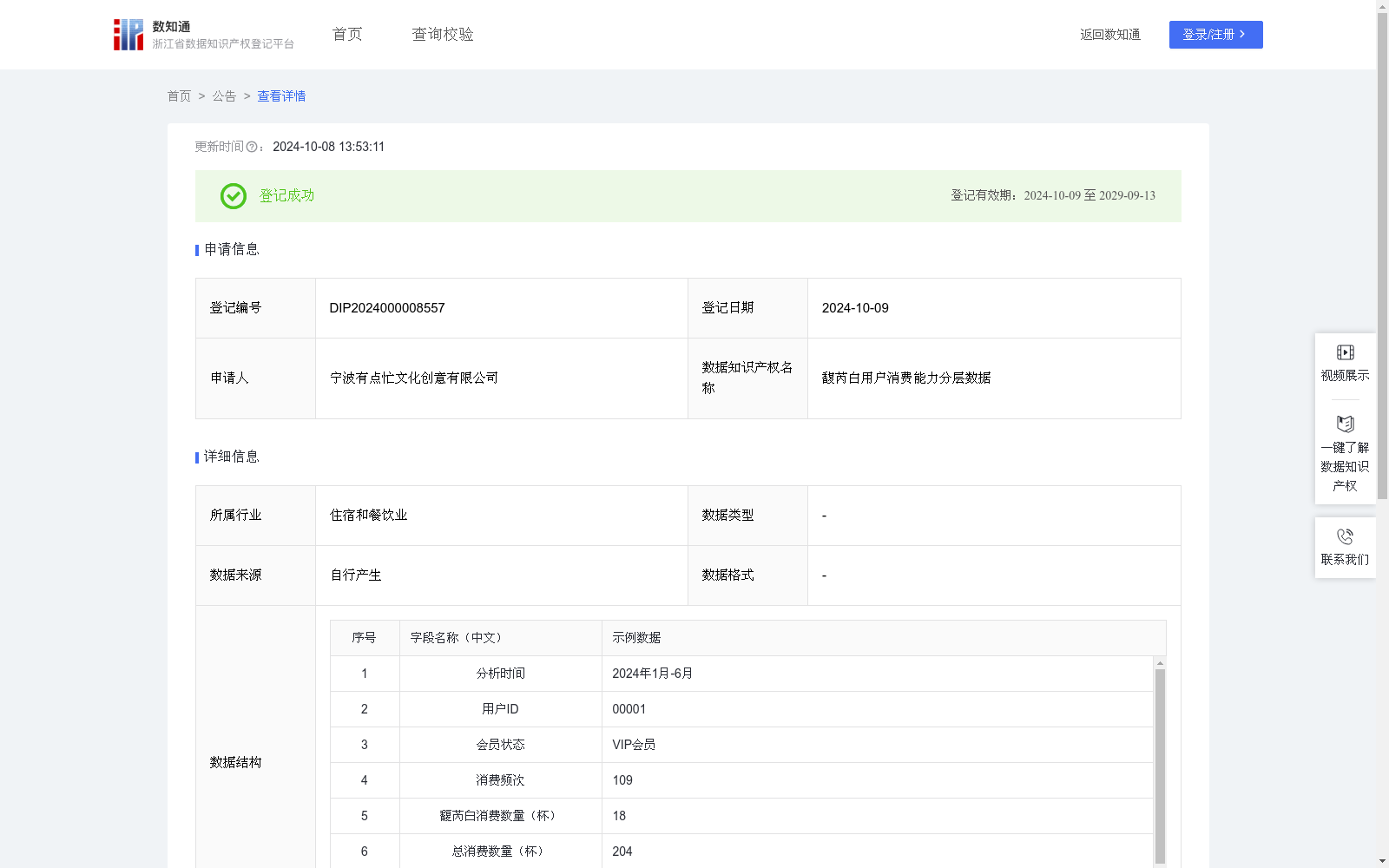
馥芮白用户消费能力分层数据
收藏资源简介:
基于消费能力分层数据,针对不同层次的用户制定个性化的营销策略。对于高消费能力用户,可推出高端咖啡饮品及定制化服务;对于中等和低消费能力用户,则注重性价比和促销活动的吸引力。应用场景广泛,通过充分利用这些数据资源,企业可以更好地理解用户需求,优化产品和服务,提升市场竞争力。1. 数据采集:采集咖啡店管理系统馥芮白用户消费能力分层数据等信息; 2、数据计算:对采集得到的数据先进行整理处理,总消费数量(杯)是一个用户一段时间内容的全部消费杯数,消费数量(杯)是一个用户具体一款咖啡一段时间内容的消费杯数,对整理后的数据按照如下公式进行计算:馥芮白消费占比(%)=馥芮白消费数量(杯)/总消费数量(杯)*100%; 3. 数据分析:用户消费能力运用ABCD分类法,对消费占比≥25%的,给予“A类”用户分级;消费占比≥13%且<25%的,给予“B类”用户分级;消费占比≥5%且<13%区间的,给予“C类”用户分级;消费占比<5%区间的,给予“D类”用户分级; 4. 数据应用: 通过对历史下单用户画像建立,对用户进行标签制定,定位用户消费级别,可以为咖啡店消费者广告营销策略提供数据支持,如推出适合消费层级的咖啡饮品及定制化服务。
This dataset is developed based on consumption capability stratified data to formulate personalized marketing strategies for users at different tiers. For high-consumption-capability users, premium coffee beverages and customized services can be launched; for medium and low-consumption-capability users, focus should be placed on cost-effectiveness and the attractiveness of promotional campaigns. It has a wide range of application scenarios: by making full use of these data resources, enterprises can better understand user needs, optimize products and services, and enhance market competitiveness. 1. Data Collection: Collect information including the consumption capability stratified data of Flat White users from the coffee shop management system; 2. Data Calculation: First sort out and process the collected data. The total number of coffee cups consumed refers to the total number of cups a user has purchased over a certain period of time, while the number of coffee cups consumed refers to the number of cups of a specific type of coffee that a user has purchased over a certain period of time. Calculate the processed data using the following formula: Flat White consumption share (%) = (number of Flat White cups consumed / total number of coffee cups consumed) * 100%; 3. Data Analysis: Use the ABCD classification method to grade users based on their consumption capability. Users with a consumption share ≥25% are classified as "Category A"; those with a consumption share ≥13% and <25% are classified as "Category B"; those with a consumption share ≥5% and <13% are classified as "Category C"; and those with a consumption share <5% are classified as "Category D"; 4. Data Application: By establishing historical order user profiles and formulating user tags to locate their consumption levels, this dataset can provide data support for coffee shop advertising and marketing strategies, such as launching coffee beverages and customized services suitable for different consumption tiers.