
Snow depth and sea ice thickness derived from the measurements of SIMBA buoy 2019T68
收藏Mendeley Data2023-12-19 更新2024-06-30 收录
下载链接:
https://doi.pangaea.de/10.1594/PANGAEA.938234
下载链接
链接失效反馈官方服务:
资源简介:
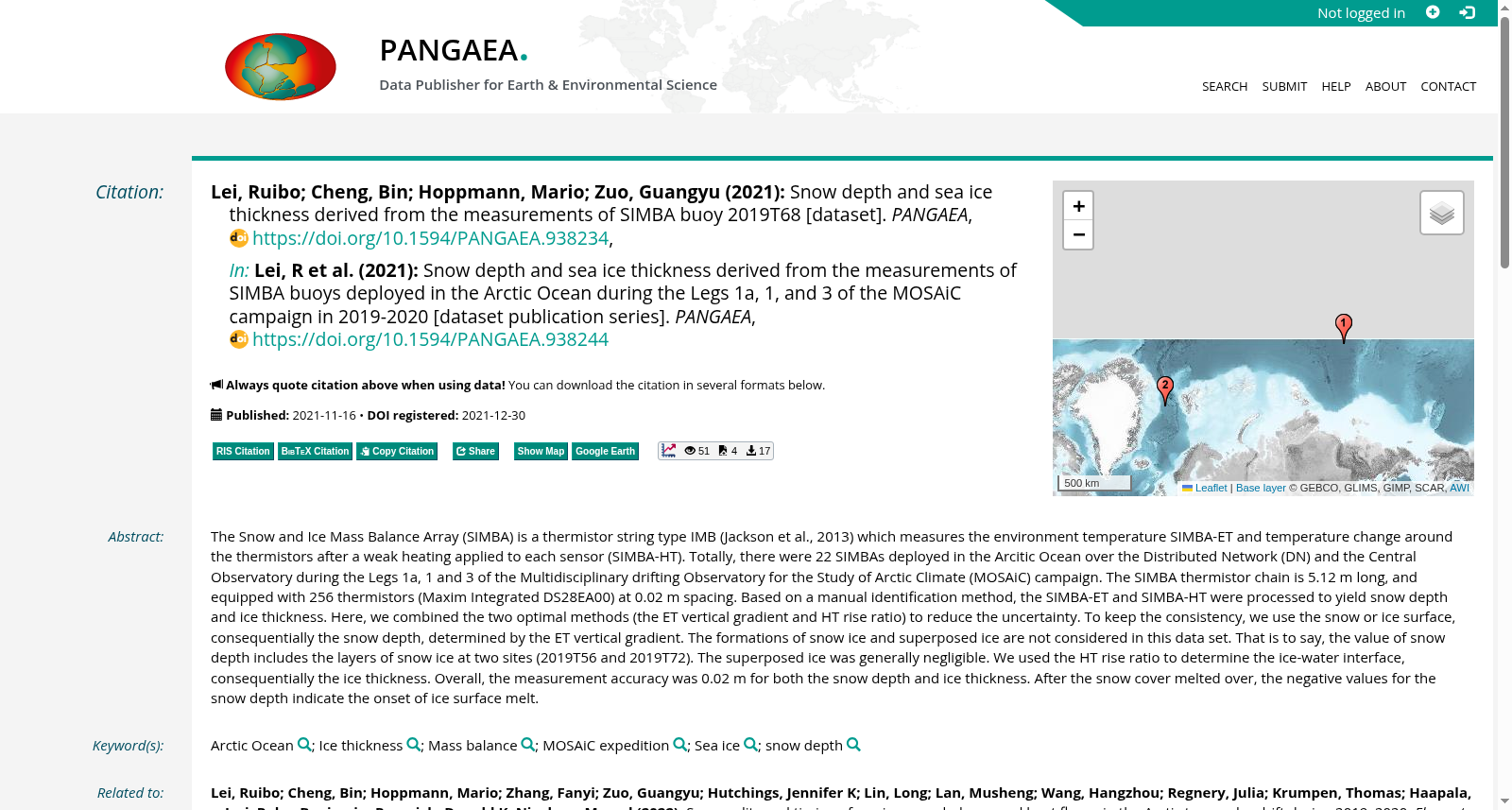
The Snow and Ice Mass Balance Array (SIMBA) is a thermistor string type IMB (Jackson et al., 2013) which measures the environment temperature SIMBA-ET and temperature change around the thermistors after a weak heating applied to each sensor (SIMBA-HT). Totally, there were 22 SIMBAs deployed in the Arcitic Ocean over the Distributed Network (DN) and the Central Observatory during the Legs 1a, 1 and 3 of the Multidisciplinary drifting Observatory for the Study of Arctic Climate (MOSAiC) campaign. The SIMBA thermistor chain is 5.12 m long, and equipped with 256 thermistors (Maxim Integrated DS28EA00) at 0.02 m spacing. Based on a manual identification method, the SIMBA-ET and SIMBA-HT were processed to yield snow depth and ice thickness. Here, we combined the two optimal methods (the ET vertical gradient and HT rise ratio) to reduce the uncertainty. To keep the consistency, we use the snow or ice surface, consequentially the snow depth, determined by the ET vertical gradient. The formations of snow ice and superposed ice are not considered in this data set. That is to say, the value of snow depth includes the layers of snow ice at two sites (2019T56 and 2019T72). The superposed ice was generally negligible. We used the HT rise ratio to determine the ice-water interface, consequentially the ice thickness. Overall, the measurement accuracy was 0.02 m for both the snow depth and ice thickness. After the snow cover melted over, the negative values for the snow depth indicate the onset of ice surface melt.
雪冰质量平衡阵列(Snow and Ice Mass Balance Array, SIMBA)是一款热敏电阻串式冰质量平衡监测仪(Ice Mass Balance, IMB,Jackson等,2013),可测量环境温度(SIMBA-ET),以及对每个传感器施加弱加热后热敏电阻周围的温度变化(SIMBA-HT)。在北极气候多学科漂流观测计划(Multidisciplinary drifting Observatory for the Study of Arctic Climate, MOSAiC)的第1a、1和3航段中,共计22台SIMBA设备被部署于北冰洋的分布式网络(Distributed Network, DN)与中央观测站区域。该SIMBA热敏电阻串总长5.12 m,以0.02 m的间距布设了256个美信集成(Maxim Integrated)DS28EA00型号热敏电阻。本研究采用人工识别方法对SIMBA-ET与SIMBA-HT数据进行处理以反演雪深与冰厚;为降低反演不确定性,我们结合了两种最优方法——环境温度垂直梯度法与加热后温度上升比率法。为保证数据一致性,我们采用环境温度垂直梯度法确定的雪/冰表面来计算雪深。本数据集未考虑雪冰与叠置冰的形成过程,即雪深数值包含了两个测站(2019T56与2019T72)处的雪冰层;由于叠置冰占比通常可忽略不计,我们采用加热后温度上升比率法确定冰水界面,进而计算冰厚。总体而言,雪深与冰厚的测量精度均为0.02 m。当积雪完全消融后,雪深的负值代表冰面融化过程的起始。
创建时间:
2023-12-19
搜集汇总
数据集介绍
背景与挑战
背景概述
该数据集基于2019-2020年MOSAiC活动期间在北冰洋部署的SIMBA浮标2019T68的测量数据,通过热敏电阻链(5.12米长,256个传感器)采用ET垂直梯度和HT上升比方法,精确测量雪深和海冰厚度,测量精度为0.02米。数据集覆盖2019年10月至2020年6月的时间范围和北冰洋特定地理区域,包含486个数据点,提供日期/时间、经纬度、冰厚和雪厚等参数,用于研究北极海冰质量平衡和气候变化。
以上内容由遇见数据集搜集并总结生成


