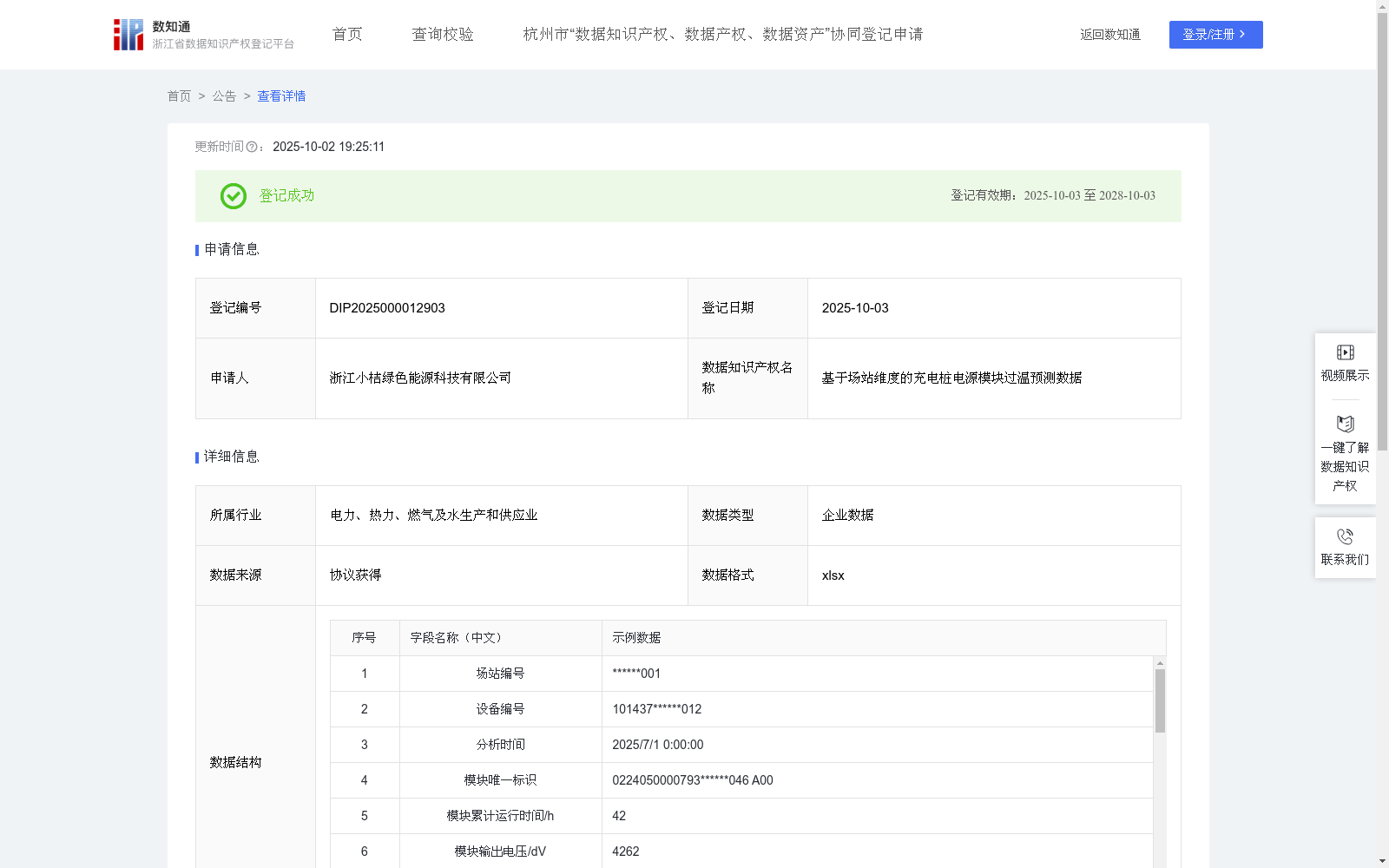
基于场站维度的充电桩电源模块过温预测数据
收藏资源简介:
本数据集以充电场站为分析单元,通过历史运行数据训练多点温度预测模型,结合当前输入参数判定模块温度是否异常,实现对充电桩电源模块过温风险的早期识别。具体应用场景如下: 1.对平台(即申请人)而言:可基于预测结果构建电源模块多点温度健康画像,识别存在热失控隐患的设备区域,支撑平台在大规模设备层面推进预警机制部署和远程动态风险管控; 2.对场站商家而言:可据此开展模块级精准诊断,提前干预可能出现热损伤的部件,延长电源模块使用寿命、减少高温引发的非计划停机,提高设备可用率和服务连续性; 3.对政府而言:可将该模型纳入对充电基础设施的安全运行监管工具箱,动态监测重点区域场站的电源模块运行温控状况,为制定设备技术标准与完善充电站安全管理政策提供数据支撑。1.数据采集:原始数据经授权合法获取,按场站维度实时采集电源模块运行过程中的关键参数字段,包括:场站编号、设备编号、分析时间、模块唯一标识、模块累计运行时间、模块输出电压、模块输出电流、模块PFC_U温度、模块PFC_V温度、模块PFC_W温度、模块环境温度、模块DCDC正MOS管温度、模块DCDC负MOS管温度、模块DCDC输出二极管温度、模块整流二极管温度。 2.模型训练:采用Scikit-learn多项式回归模型,分别建立模块PFC_U温度、PFC_V温度、PFC_W温度、DCDC正MOS管温度、DCDC负MOS管温度、DCDC输出二极管温度、整流二极管温度的预测模型,基于长期积累的历史数据拟合模块累计运行时间、输出电压、电流、环境温度等参数与各温度点位之间的变化关系,获得各点位的温度预测能力。 3.温度预测结果输出:对当前模块输入运行参数(即步骤1采集的数据),调用对应预测模型(即步骤2训练的模型),分别输出各点位的温度预测值,包括预测模块PFC_U温度、预测模块PFC_V温度、预测模块PFC_W温度、预测模块DCDC正MOS管温度、预测模块DCDC负MOS管温度、预测模块DCDC输出二极管温度、预测模块整流二极管温度。 4.异常判定与结论输出:对每个温度点,计算其预测温度与实际温度的差值。若某点位温差≥6℃,则判定该点位温度异常,并输出对应结论。若所有点位温差均<6℃,则输出结论为“温度正常”。
This dataset takes charging stations as the analytical unit. It trains a multi-point temperature prediction model using historical operational data, and combines current input parameters to determine whether the module temperature is abnormal, thereby enabling early identification of over-temperature risks for charging pile power modules. The specific application scenarios are as follows: 1. For the platform (i.e., the applicant): A multi-point temperature health profile of the power modules can be constructed based on the prediction results, identifying equipment areas with potential thermal runaway risks, and supporting the platform to deploy early warning mechanisms and implement remote dynamic risk management for large-scale equipment; 2. For station operators: Accurate module-level diagnosis can be performed, intervening in components that may suffer thermal damage in advance, extending the service life of power modules, reducing unplanned downtime caused by high temperatures, and improving equipment availability and service continuity; 3. For government agencies: This model can be incorporated into the safe operation supervision toolbox for charging infrastructure, dynamically monitoring the temperature control status of power modules in key regional charging stations, and providing data support for formulating equipment technical standards and improving charging station safety management policies. 1. Data Collection: Original data is legally obtained with proper authorization. Key parameter fields during the operation of power modules are collected in real time per station, including: station ID, equipment ID, analysis time, module unique identifier, module cumulative operating time, module output voltage, module output current, module PFC_U temperature, module PFC_V temperature, module PFC_W temperature, module ambient temperature, module DCDC positive MOS tube temperature, module DCDC negative MOS tube temperature, module DCDC output diode temperature, and module rectifier diode temperature. 2. Model Training: The Scikit-learn polynomial regression model is utilized. Prediction models are established separately for the module PFC_U temperature, PFC_V temperature, PFC_W temperature, DCDC positive MOS tube temperature, DCDC negative MOS tube temperature, DCDC output diode temperature, and rectifier diode temperature. Based on long-term accumulated historical data, the correlation between parameters such as module cumulative operating time, output voltage, current, and ambient temperature and each temperature point is fitted to acquire the temperature prediction capability for each point. 3. Temperature Prediction Result Output: For the current input operating parameters of the module (i.e., the data collected in Step 1), call the corresponding prediction model (i.e., the model trained in Step 2) to output the temperature prediction values of each point separately, including predicted module PFC_U temperature, predicted module PFC_V temperature, predicted module PFC_W temperature, predicted module DCDC positive MOS tube temperature, predicted module DCDC negative MOS tube temperature, predicted module DCDC output diode temperature, and predicted module rectifier diode temperature. 4. Abnormality Judgment and Conclusion Output: For each temperature point, calculate the difference between its predicted temperature and actual temperature. If the temperature difference of a certain point is ≥6°C, the temperature of this point is judged to be abnormal, and the corresponding conclusion is output. If the temperature difference of all points is <6°C, the conclusion "Temperature Normal" is output.