
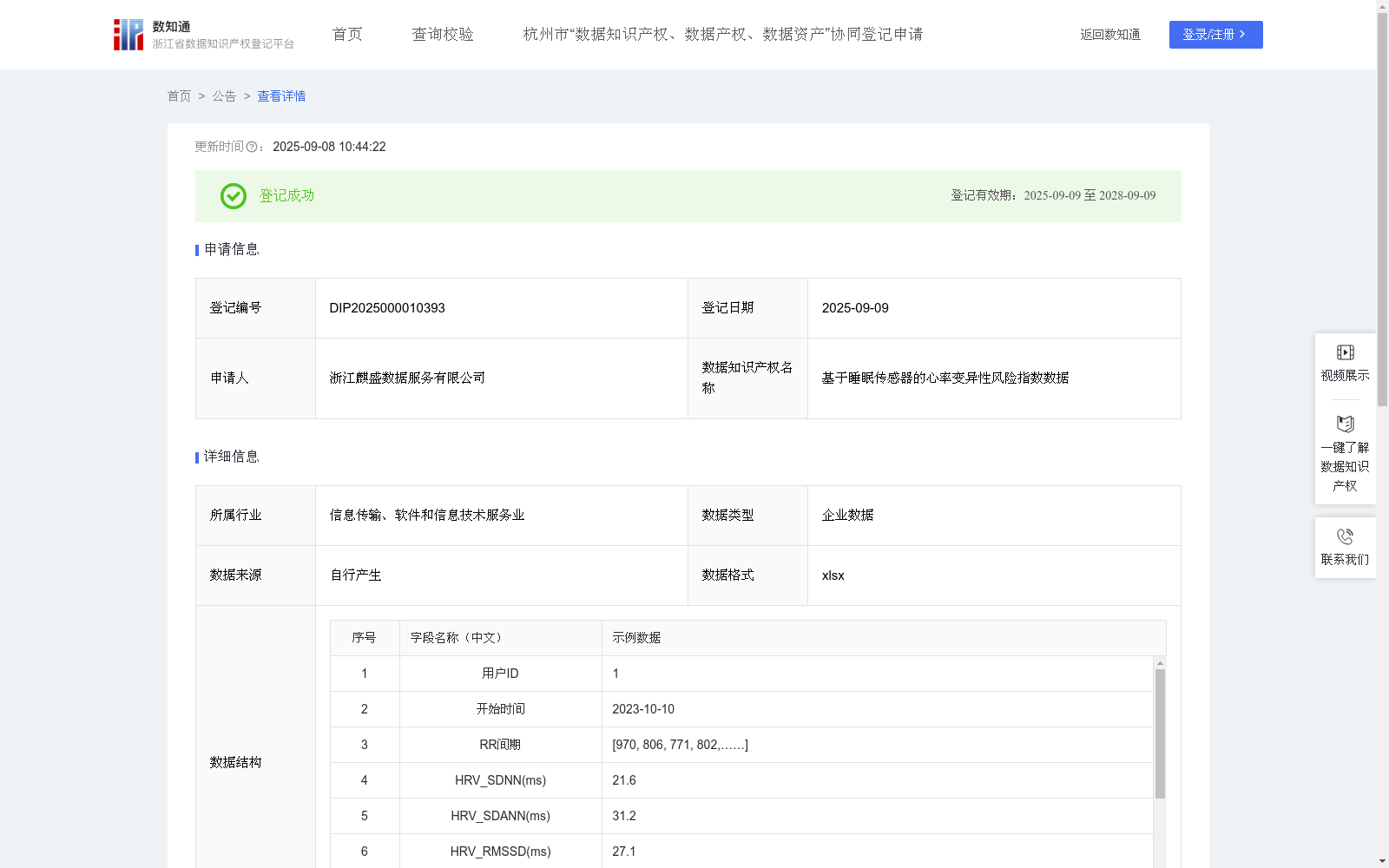
基于睡眠传感器的心率变异性风险指数数据
收藏浙江省数据知识产权登记平台2025-09-08 更新2025-09-09 收录
下载链接:
https://www.zjip.org.cn/home/announce/trends/176429
下载链接
链接失效反馈官方服务:
资源简介:
基于睡眠传感器的心率变异性数据在健康监测领域具有重要应用价值。在健康管理方面,心率变异性数据能够实时反映自主神经系统状态,通过长期监测可有效评估个体的压力水平和疲劳程度,并对高血压、糖尿病等慢性疾病提供早期风险预警。在睡眠领域,心率变异性数据可量化睡眠分期、觉醒次数,辅助诊断失眠、睡眠呼吸暂停等睡眠障碍问题。在心理健康监测方面,心率变异性的异常波动模式与焦虑、抑郁等心理状态具有显著相关性,这使得心率变异性成为心理状态筛查的有效工具,并能为呼吸训练、冥想等干预手段提供数据支持。本系统基于睡眠传感器数据,提取心率变异性相关指标,计算个体的心率变异性风险指数。算法依赖于睡眠监测设备连续记录的RR间期数据。原始心率数据按5分钟为滑动窗口进行分段,逐段提取心率变异性特征。共提取8项心率变异性指标,包括:HRV_SDNN(RR间期的标准差)、HRV_SDANN(每5分钟平均RR间期的标准差)、HRV_RMSSD(相邻RR间期差值的均方根)、HRV_SDSD(相邻间期差值的标准差)、HRV_TP(总功率)、HRV_LF(低频功率)、HRV_HF(高频功率)、HRV_LF_HF(低频与高频的比值)。首先,对每个心率变异性指标设定风险阈值,根据其数值将每项指标分别打分(0–3分),其中正常为0分,轻度异常为1分,中度异常为2分,重度异常为3分。各指标的划分标准如下:HRV_SDNN>50为正常,35–50为轻度异常,20–35为中度异常,<20为重度异常;HRV_SDANN>40为正常,30-39为轻度异常,15-29为中度异常,<15为重度异常;HRV_RMSSD >40为正常,30-39为轻度异常,15-29为中度异常,<15则为重度异常;HRV_SDSD>30为正常,20-30为轻度异常,10-20为中度异常,<10为重度异常; HRV_TP>1000为正常,600-1000为轻度异常,300-600为中度异常,<200为重度异常;HRV_LF>600为正常,400-600为轻度异常,200-400为中度异常,<200为重度异常;HRV_HF>500为正常,300-500为轻度异常,150-300为中度异常,<150为重度异常;LF/HF在0.5–2.0为正常,>4或<0.2为重度异常。其次,将各指标得分按预设权重加权汇总,不同指标的重要性在风险计算中略有差异,HRV_SDNN、HRV_RMSSD、HRV_HF和HRV_TP核心指标权重较高(权重为0.15),HRV_SDANN、HRV_SDSD、HRV_LF和LF/HF权重相对较低(权重为0.10),权重总和为1。通过加权求和后得到的风险分值范围为0–3。最后,对加权总分进行线性标准化,将其转换为1–99之间的心率变异性风险指数,公式为:风险指数= 1 + (加权得分/ 3) ×98
Sleep sensor-based heart rate variability (HRV) data holds significant application value in the field of health monitoring. In health management, HRV data can reflect the state of the autonomic nervous system in real time; long-term monitoring can effectively assess an individual's stress and fatigue levels, and provide early risk warnings for chronic diseases such as hypertension and diabetes. In the sleep domain, HRV data can quantify sleep stages and the number of awakenings, assisting in the diagnosis of sleep disorders including insomnia and sleep apnea. In terms of mental health monitoring, abnormal fluctuation patterns of HRV are significantly correlated with psychological states such as anxiety and depression, making HRV an effective tool for psychological state screening and providing data support for interventions such as respiratory training and meditation.
This system extracts heart rate variability-related indicators based on sleep sensor data to calculate an individual's HRV risk index. The algorithm relies on RR interval data continuously recorded by sleep monitoring devices. Original heart rate data is segmented using a 5-minute sliding window, and HRV features are extracted segment by segment. A total of 8 HRV indicators are extracted, including: HRV_SDNN (standard deviation of RR intervals), HRV_SDANN (standard deviation of 5-minute average RR intervals), HRV_RMSSD (root mean square of successive differences between adjacent RR intervals), HRV_SDSD (standard deviation of successive differences between adjacent RR intervals), HRV_TP (total power), HRV_LF (low-frequency power), HRV_HF (high-frequency power), and HRV_LF_HF (ratio of low-frequency to high-frequency power).
First, risk thresholds are set for each HRV indicator, and each indicator is scored on a scale of 0–3 points based on its numerical value, where 0 points denotes normality, 1 point denotes mild abnormality, 2 points denotes moderate abnormality, and 3 points denotes severe abnormality. The classification criteria for each indicator are as follows:
- HRV_SDNN: >50 for normality, 35–50 for mild abnormality, 20–35 for moderate abnormality, <20 for severe abnormality;
- HRV_SDANN: >40 for normality, 30–39 for mild abnormality, 15–29 for moderate abnormality, <15 for severe abnormality;
- HRV_RMSSD: >40 for normality, 30–39 for mild abnormality, 15–29 for moderate abnormality, <15 for severe abnormality;
- HRV_SDSD: >30 for normality, 20–30 for mild abnormality, 10–20 for moderate abnormality, <10 for severe abnormality;
- HRV_TP: >1000 for normality, 600–1000 for mild abnormality, 300–600 for moderate abnormality, <200 for severe abnormality;
- HRV_LF: >600 for normality, 400–600 for mild abnormality, 200–400 for moderate abnormality, <200 for severe abnormality;
- HRV_HF: >500 for normality, 300–500 for mild abnormality, 150–300 for moderate abnormality, <150 for severe abnormality;
- LF/HF: 0.5–2.0 for normality, >4 or <0.2 for severe abnormality.
Second, the scores of each indicator are weighted and aggregated according to preset weights. The importance of different indicators varies slightly in risk calculation: the core indicators including HRV_SDNN, HRV_RMSSD, HRV_HF and HRV_TP each have a higher weight of 0.15, while the relatively secondary indicators including HRV_SDANN, HRV_SDSD, HRV_LF and LF/HF each have a lower weight of 0.10, with the total sum of all weights equal to 1. The resulting weighted risk score ranges from 0 to 3. Finally, linear standardization is performed on the weighted total score to convert it into an HRV risk index between 1 and 99, using the formula: Risk Index = 1 + (Weighted Score / 3) × 98
提供机构:
浙江麒盛数据服务有限公司
创建时间:
2025-07-07
搜集汇总
数据集介绍
背景与挑战
背景概述
该数据集包含基于睡眠传感器采集的519条心率变异性数据,每日更新,用于计算风险指数以评估健康风险。其特点是通过多HRV指标加权算法,支持健康管理、睡眠障碍诊断和心理健康监测等应用场景。
以上内容由遇见数据集搜集并总结生成



