
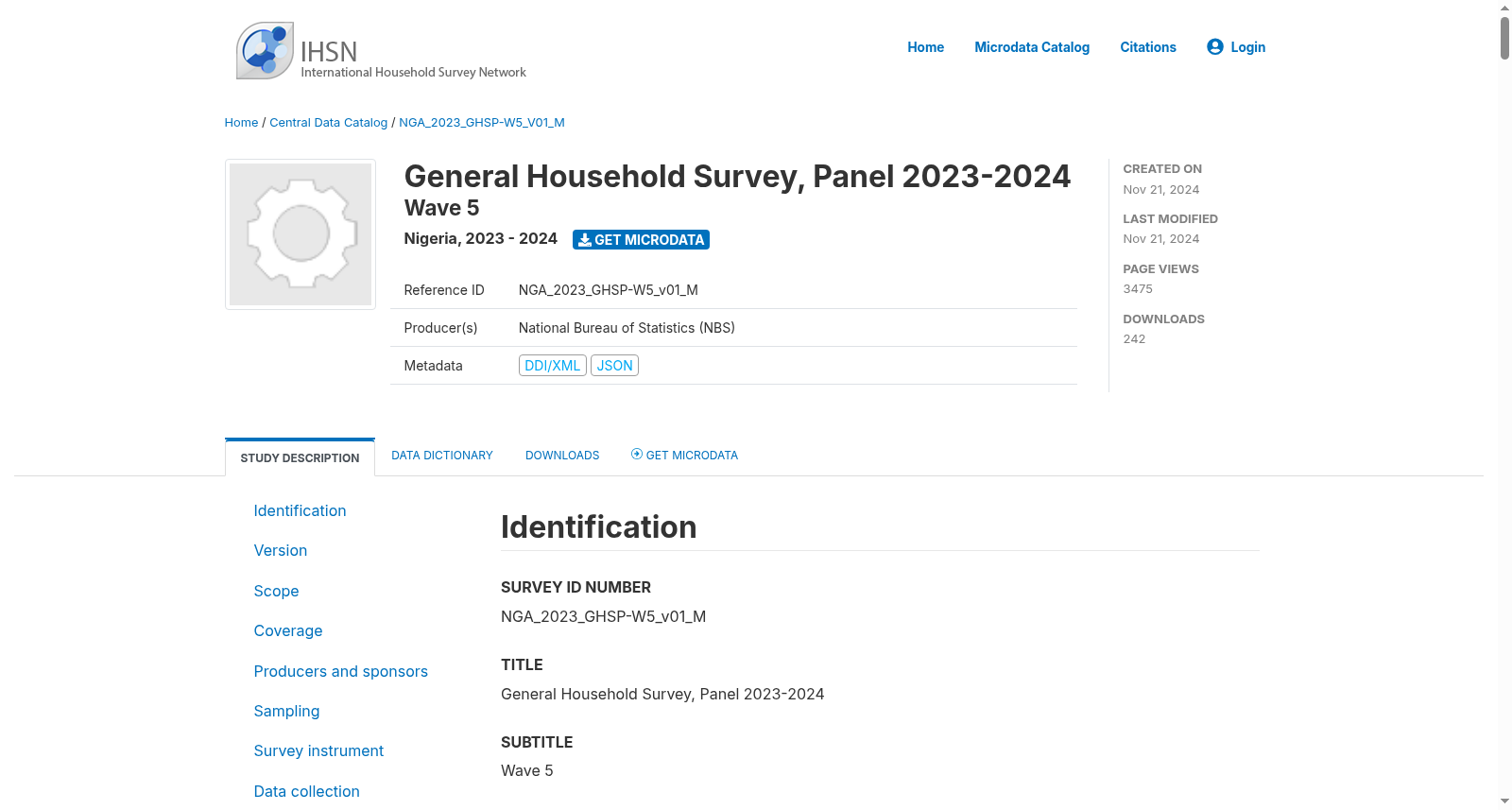
General Household Survey, Panel 2023-2024 - Nigeria
收藏catalog.ihsn.org2024-11-21 更新2025-01-15 收录
下载链接:
https://catalog.ihsn.org/catalog/12624
下载链接
链接失效反馈官方服务:
资源简介:
Abstract
---------------------------
The General Household Survey-Panel (GHS-Panel) is implemented in collaboration with the World Bank Living Standards Measurement Study (LSMS) team as part of the Integrated Surveys on Agriculture (ISA) program. The objectives of the GHS-Panel include the development of an innovative model for collecting agricultural data, interinstitutional collaboration, and comprehensive analysis of welfare indicators and socio-economic characteristics. The GHS-Panel is a nationally representative survey of approximately 5,000 households, which are also representative of the six geopolitical zones. The 2023/24 GHS-Panel is the fifth round of the survey with prior rounds conducted in 2010/11, 2012/13, 2015/16 and 2018/19. The GHS-Panel households were visited twice: during post-planting period (July - September 2023) and during post-harvest period (January - March 2024).
Geographic coverage
---------------------------
National
Analysis unit
---------------------------
• Households
• Individuals
• Agricultural plots
• Communities
Universe
---------------------------
The survey covered all de jure households excluding prisons, hospitals, military barracks, and school dormitories.
Kind of data
---------------------------
Sample survey data [ssd]
Sampling procedure
---------------------------
The original GHS‑Panel sample was fully integrated with the 2010 GHS sample. The GHS sample consisted of 60 Primary Sampling Units (PSUs) or Enumeration Areas (EAs), chosen from each of the 37 states in Nigeria. This resulted in a total of 2,220 EAs nationally. Each EA contributed 10 households to the GHS sample, resulting in a sample size of 22,200 households. Out of these 22,200 households, 5,000 households from 500 EAs were selected for the panel component, and 4,916 households completed their interviews in the first wave.
After nearly a decade of visiting the same households, a partial refresh of the GHS‑Panel sample was implemented in Wave 4 and maintained for Wave 5. The refresh was conducted to maintain the integrity and representativeness of the sample. The refresh EAs were selected from the same sampling frame as the original GHS‑Panel sample in 2010. A listing of households was conducted in the 360 EAs, and 10 households were randomly selected in each EA, resulting in a total refresh sample of approximately 3,600 households.
In addition to these 3,600 refresh households, a subsample of the original 5,000 GHS‑Panel households from 2010 were selected to be included in the new sample. This “long panel” sample of 1,590 households was designed to be nationally representative to enable continued longitudinal analysis for the sample going back to 2010. The long panel sample consisted of 159 EAs systematically selected across Nigeria’s six geopolitical zones.
The combined sample of refresh and long panel EAs in Wave 5 that were eligible for inclusion consisted of 518 EAs based on the EAs selected in Wave 4. The combined sample generally maintains both the national and zonal representativeness of the original GHS‑Panel sample.
Sampling deviation
---------------------------
Although 518 EAs were identified for the post-planting visit, conflict events prevented interviewers from visiting eight EAs in the North West zone of the country. The EAs were located in the states of Zamfara, Katsina, Kebbi and Sokoto. Therefore, the final number of EAs visited both post-planting and post-harvest comprised 157 long panel EAs and 354 refresh EAs. The combined sample is also roughly equally distributed across the six geopolitical zones.
Mode of data collection
---------------------------
Computer Assisted Personal Interview [capi]
Research instrument
---------------------------
The GHS-Panel Wave 5 consisted of three questionnaires for each of the two visits. The Household Questionnaire was administered to all households in the sample. The Agriculture Questionnaire was administered to all households engaged in agricultural activities such as crop farming, livestock rearing, and other agricultural and related activities. The Community Questionnaire was administered to the community to collect information on the socio-economic indicators of the enumeration areas where the sample households reside.
GHS-Panel Household Questionnaire: The Household Questionnaire provided information on demographics; education; health; labour; childcare; early child development; food and non-food expenditure; household nonfarm enterprises; food security and shocks; safety nets; housing conditions; assets; information and communication technology; economic shocks; and other sources of household income. Household location was geo-referenced in order to be able to later link the GHS-Panel data to other available geographic data sets (forthcoming).
GHS-Panel Agriculture Questionnaire: The Agriculture Questionnaire solicited information on land ownership and use; farm labour; inputs use; GPS land area measurement and coordinates of household plots; agricultural capital; irrigation; crop harvest and utilization; animal holdings and costs; household fishing activities; and digital farming information. Some information is collected at the crop level to allow for detailed analysis for individual crops.
GHS-Panel Community Questionnaire: The Community Questionnaire solicited information on access to infrastructure and transportation; community organizations; resource management; changes in the community; key events; community needs, actions, and achievements; social norms; and local retail price information.
The Household Questionnaire was slightly different for the two visits. Some information was collected only in the post-planting visit, some only in the post-harvest visit, and some in both visits.
The Agriculture Questionnaire collected different information during each visit, but for the same plots and crops.
The Community Questionnaire collected prices during both visits, and different community level information during the two visits.
Cleaning operations
---------------------------
CAPI: Wave five exercise was conducted using Computer Assisted Person Interview (CAPI) techniques. All the questionnaires (household, agriculture, and community questionnaires) were implemented in both the post-planting and post-harvest visits of Wave 5 using the CAPI software, Survey Solutions. The Survey Solutions software was developed and maintained by the Living Standards Measurement Unit within the Development Economics Data Group (DECDG) at the World Bank. Each enumerator was given a tablet which they used to conduct the interviews. Overall, implementation of survey using Survey Solutions CAPI was highly successful, as it allowed for timely availability of the data from completed interviews.
DATA COMMUNICATION SYSTEM: The data communication system used in Wave 5 was highly automated. Each field team was given a mobile modem which allowed for internet connectivity and daily synchronization of their tablets. This ensured that head office in Abuja had access to the data in real-time. Once the interview was completed and uploaded to the server, the data was first reviewed by the Data Editors. The data was also downloaded from the server, and Stata dofile was run on the downloaded data to check for additional errors that were not captured by the Survey Solutions application. An excel error file was generated following the running of the Stata dofile on the raw dataset. Information contained in the excel error files were then communicated back to respective field interviewers for their action. This monitoring activity was done on a daily basis throughout the duration of the survey, both in the post-planting and post-harvest.
DATA CLEANING: The data cleaning process was done in three main stages. The first stage was to ensure proper quality control during the fieldwork. This was achieved in part by incorporating validation and consistency checks into the Survey Solutions application used for the data collection and designed to highlight many of the errors that occurred during the fieldwork.
The second stage cleaning involved the use of Data Editors and Data Assistants (Headquarters in Survey Solutions). As indicated above, once the interview is completed and uploaded to the server, the Data Editors review completed interview for inconsistencies and extreme values. Depending on the outcome, they can either approve or reject the case. If rejected, the case goes back to the respective interviewer’s tablet upon synchronization. Special care was taken to see that the households included in the data matched with the selected sample and where there were differences, these were properly assessed and documented. The agriculture data were also checked to ensure that the plots identified in the main sections merged with the plot information identified in the other sections. Additional errors observed were compiled into error reports that were regularly sent to the teams. These errors were then corrected based on re-visits to the household on the instruction of the supervisor. The data that had gone through this first stage of cleaning was then approved by the Data Editor. After the Data Editor’s approval of the interview on Survey Solutions server, the Headquarters also reviews and depending on the outcome, can either reject or approve.
The third stage of cleaning involved a comprehensive review of the final raw data following the first and second stage cleaning. Every variable was examined individually for (1) consistency with other sections and variables, (2) out of range responses, and (3) outliers. However, special care was taken to avoid making strong assumptions when resolving potential errors. Some minor errors remain in the data where the diagnosis and/or solution were unclear to the data cleaning team.
Response rate
---------------------------
Since Wave 1, every effort has been made to track and interview households that had moved away from their original EA and keep attrition to a minimum. These efforts continued in Wave 5, particularly for the long panel sample. Households that had moved away from their previous location were interviewed in a separate tracking phase following both the post-planting and post-harvest visits. Of the 1,590 households interviewed in Wave 1 within these 159 EAs, 1,376 households were successfully interviewed in both visits of Wave 5. This implies an overall attrition rate since 2010 across these EAs of 13.5 percent. However, attrition is highly variable across zones and sectors. The highest attrition was found in rural EAs in South West (28.8 percent) and the lowest attrition in rural EAs in North Central (5.3 percent). Attrition was also higher among urban (17.8 percent) than rural (11.4 percent) households. Overall, 168 long panel households had moved and were interviewed in their new location (over 10 percent of the sample). The highest number of households that had moved was in the urban area in South West (47 households, accounting for 25.7 percent of the sample).
摘要
---------------------------
该综合家庭调查-面板(GHS-Panel)由世界银行生活标准测量研究(LSMS)团队与我国合作实施,作为综合农业调查(ISA)项目的一部分。GHS-Panel的目标包括开发收集农业数据的创新模型、加强机构间合作以及全面分析福利指标和社会经济特征。GHS-Panel是一项全国代表性的调查,覆盖约5,000户家庭,这些家庭也代表了六个地理政治区域。2023/24年度的GHS-Panel是调查的第五轮,之前的轮次分别在2010/11、2012/13、2015/16和2018/19年度进行。GHS-Panel的家庭被访问了两次:在作物种植后期(2023年7月至9月)和收获后期(2024年1月至3月)。
地理覆盖范围
---------------------------
全国
分析单元
---------------------------
• 家庭
• 个人
• 农业地块
• 社区
总体
---------------------------
调查涵盖了所有法定家庭,不包括监狱、医院、军营和学校宿舍。
数据类型
---------------------------
样本调查数据 [ssd]
抽样程序
---------------------------
原始GHS-Panel样本与2010年的GHS样本完全整合。GHS样本由每个尼日利亚州的60个初级抽样单位(PSU)或调查区域(EA)组成,这些单位是从37个州中选出的。这在全国范围内共有2,220个EA。每个EA为GHS样本贡献了10户家庭,从而形成了一个22,200户家庭的样本。在这22,200户家庭中,从500个EA中选出了5,000户家庭作为面板组件,其中4,916户家庭在第一轮完成了他们的访谈。
经过近十年的对同一家庭的访问后,在第四波中实施了GHS-Panel样本的部分刷新,并在第五波中维持了这种刷新。刷新是为了保持样本的完整性和代表性。刷新的EA是从与2010年原始GHS-Panel样本相同的抽样框架中选出的。在360个EA中进行了家庭清单编制,每个EA随机选择了10户家庭,从而形成了一个约3,600户家庭的总刷新样本。
除了这些3,600户刷新家庭外,还从2010年的原始5,000户GHS-Panel家庭中选出了子样本,以便将其纳入新的样本。这个由1,590户家庭组成的“长期面板”样本旨在在全国范围内具有代表性,以便对追溯到2010年的样本进行持续纵向分析。长期面板样本由跨越我国六个地理政治区的159个EA系统性地选择。
第五波中,符合条件的刷新和长期面板EA的合并样本基于第四波中选出的EA,共有518个EA。合并样本通常保持了原始GHS-Panel样本的全国和区域代表性。
抽样偏差
---------------------------
尽管确定了518个EA用于作物种植后期访问,但冲突事件阻止了访问国家西北地区的八个EA。这些EA位于赞法拉州、卡齐纳州、凯比州和索科托州。因此,最终访问了作物种植后期和收获后期的EA总数为157个长期面板EA和354个刷新EA。合并样本在大约六个地理政治区之间大致均匀分布。
数据收集方式
---------------------------
计算机辅助个人访谈 [capi]
研究工具
---------------------------
GHS-Panel第五波由三个问卷组成,每个访问一个。家庭问卷针对样本中的所有家庭进行。农业问卷针对所有从事农业活动(如作物种植、畜牧业和其他农业及相关活动)的家庭进行。社区问卷针对社区,以收集样本家庭居住的统计区域的社会经济指标。
GHS-Panel家庭问卷:家庭问卷提供了关于人口统计、教育、健康、劳动力、儿童保育、早期儿童发展、食品和非食品支出、家庭非农企业、食品安全和冲击、安全网、住房条件、资产、信息和通信技术、经济冲击以及其他家庭收入来源的信息。家庭位置进行了地理定位,以便将来能够将GHS-Panel数据与其他可用的地理数据集(即将推出)联系起来。
GHS-Panel农业问卷:农业问卷征求关于土地所有权和使用、农场劳动力、投入使用、GPS土地面积测量和家庭地块的坐标、农业资本、灌溉、作物收获和利用、动物保有和成本、家庭捕鱼活动以及数字农业信息。收集了一些作物层面的信息,以便对个别作物进行详细分析。
GHS-Panel社区问卷:社区问卷征求关于基础设施和交通的获取、社区组织、资源管理、社区变化、关键事件、社区需求、行动和成就、社会规范以及地方零售价格信息。
家庭问卷在两次访问中略有不同。一些信息仅在种植后期收集,一些仅在收获后期收集,一些在两次访问中都收集。
农业问卷在每次访问期间收集不同的信息,但针对相同的地块和作物。
社区问卷在两次访问期间都收集价格,并在两次访问期间收集不同的社区层面信息。
数据清理
---------------------------
CAPI:第五波作业使用计算机辅助个人访谈(CAPI)技术进行。所有问卷(家庭、农业和社区问卷)在第五波的种植后期和收获后期访问中都使用CAPI软件Survey Solutions实施。Survey Solutions软件由世界银行发展经济学数据组(DECDG)内的生活水平测量单位开发和维护。每个调查员都得到了一个平板电脑,他们使用它进行访谈。总的来说,使用Survey Solutions CAPI实施调查非常成功,因为它允许及时获得完成的访谈数据。
数据通信系统:第五波中使用的数据通信系统高度自动化。每个现场团队都得到了一个移动调制解调器,它允许互联网连接和每天同步他们的平板电脑。这确保了阿布贾总部可以实时访问数据。一旦访谈完成并上传到服务器,数据首先由数据编辑员进行审查。数据还从服务器下载,并在原始数据集上运行Stata dofile以检查Survey Solutions应用程序未捕获的额外错误。在运行Stata dofile后生成了Excel错误文件。excel错误文件中的信息随后被传达给相应的现场访谈员进行处理。这项监控活动在调查期间每天进行,包括种植后期和收获后期。
数据清理:数据清理过程分为三个主要阶段。第一阶段是在现场工作中确保适当的质量控制。这通过将验证和一致性检查纳入用于数据收集的Survey Solutions应用程序并旨在突出许多现场工作中发生的错误来实现。
第二阶段清理涉及使用数据编辑员和数据助理(总部在Survey Solutions)。如上所述,一旦访谈完成并上传到服务器,数据编辑员会审查完成的访谈,以查找不一致和极端值。根据结果,他们可以批准或拒绝案例。如果拒绝,案例将同步回相应访谈员的平板电脑。特别小心确保纳入数据中的家庭与选定的样本相匹配,如有差异,则对这些差异进行适当的评估和记录。还检查了农业数据,以确保在主要部分中识别的地块信息与在其他部分中识别的地块信息相匹配。观察到的附加错误被汇编成错误报告,并定期发送给团队。根据监督员的指示,根据对家庭的再次访问进行纠正。经过第一阶段清理的数据由数据编辑员批准。在数据编辑员在Survey Solutions服务器上批准访谈后,总部也会进行审查,并根据结果,可以拒绝或批准。
第三阶段清理涉及对第一阶段和第二阶段清理后的最终原始数据进行全面审查。每个变量都单独检查,以确保(1)与其他部分和变量的一致性,(2)超出范围的反应,以及(3)异常值。然而,在解决潜在错误时,特别小心避免做出强烈的假设。一些小的错误仍然存在,其中诊断和/或解决方案对数据清理团队来说不清楚。
响应率
---------------------------
自第一波以来,一直努力追踪和访谈从原始EA搬离的家庭,以将流失率降至最低。这些努力在第五波中继续进行,尤其是在长期面板样本中。从这些159个EA中在第一波访谈的1,590户家庭中,1,376户家庭在第五波的两次访问中均成功接受了访谈。这意味着自2010年以来这些EA的整体流失率为13.5%。然而,流失率在区域和部门之间高度不同。最高流失率发生在西南部的农村EA(28.8%),最低流失率发生在北部的农村EA(5.3%)。与农村家庭(11.4%)相比,城市家庭的流失率也更高(17.8%)。总的来说,有168户长期面板家庭搬迁,并在新位置接受了访谈(样本的10%以上)。西南部城市地区搬迁的家庭数量最多,为47户,占样本的25.7%。”
}
提供机构:
catalog.ihsn.org
搜集汇总
数据集介绍
背景与挑战
背景概述
尼日利亚2023-2024年一般家庭调查面板(GHS-Panel)第五轮数据是一个全国代表性的面板调查,覆盖约5,000户家庭,重点关注农业活动、福利指标和社会经济特征。调查分为种植后和收获后两个阶段,数据涵盖家庭、农业和社区三个层面的详细信息,具有全国和地缘政治区的代表性。
以上内容由遇见数据集搜集并总结生成



