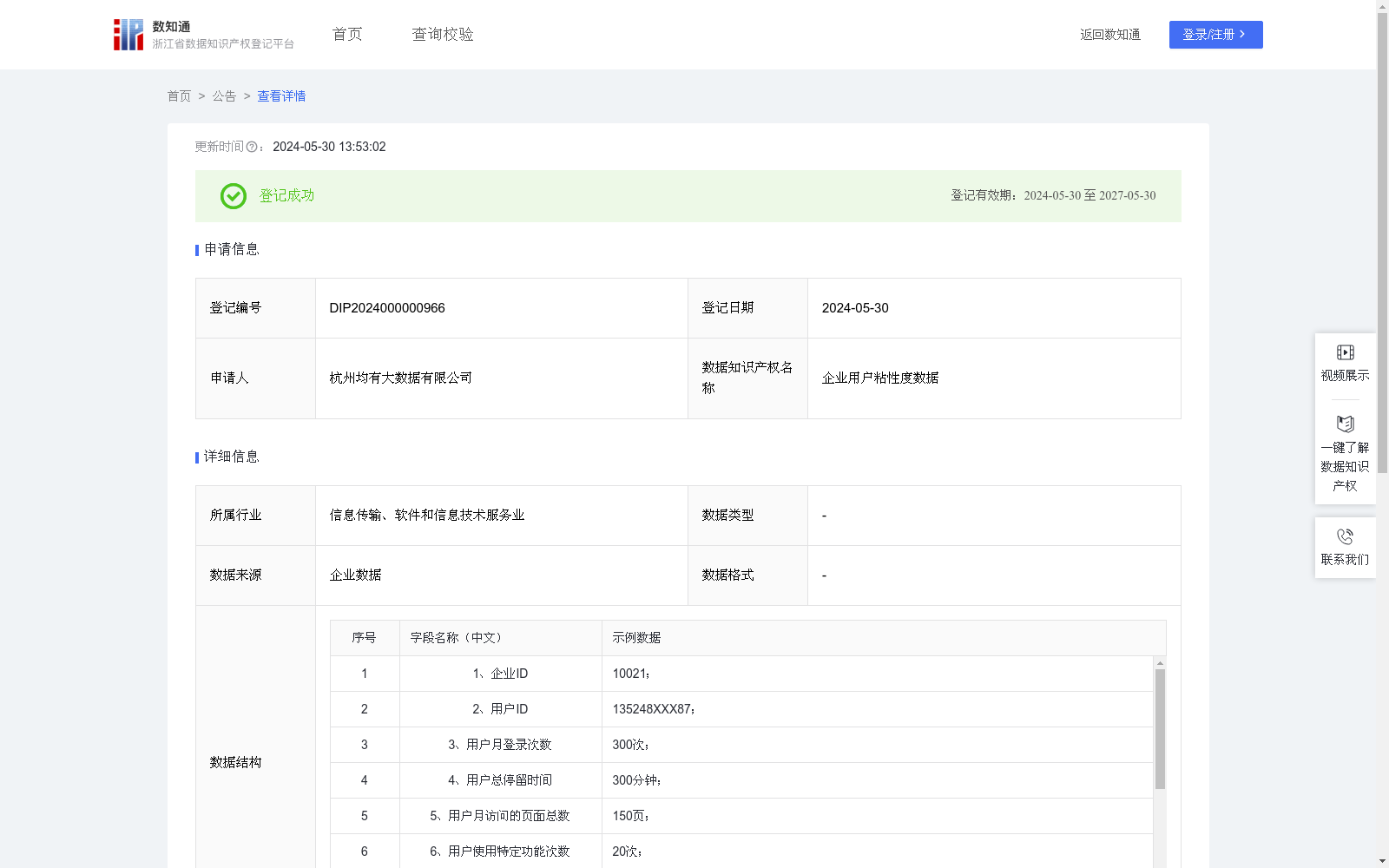
企业用户粘性度数据
收藏资源简介:
企业用户粘性度数据是指企业在运营过程中,用户对平台的持续使用和忠诚度表现。它反映了用户对平台的依赖程度和满意度,是衡量企业竞争力的重要指标之一。企业用户粘性度数据应用:1、产品优化:可以了解用户对产品的使用情况和满意度,从而发现产品的不足和改进空间。2、营销策略制定:企业可以根据自己的用户粘性度数据和市场调研结果,制定更加精准的营销策略。3、用户关系管理:通过对用户粘性度数据的监测和分析,可以帮助企业及时发现用户关系的变化和需求,及时调整用户关系管理策略。4、市场竞争力评估:通过对不同企业的用户粘性度数据进行比较和分析,可以评估企业在市场中的竞争地位和优势。5、投资决策:投资者可以通过分析企业的用户粘性度数据,评估企业的市场潜力和投资价值。6、流失预警:通过计算流失预警指标,企业可以预测出用户的流失可能性,从而及时采取措施进行干预和挽回。这有助于减少用户流失,提高用户的忠诚度和留存率。企业用户粘性度数据的计算和步骤:1、收集数据:通过采集用户月登录频率即用户月登录次数;平均停留时长:用户总停留时间、登录次数;页面浏览量:用户访问页面总数、登录次数;功能使用频率:特定功能月使用次数;交互操作次数:用户互动行为总数、登录次数;转化率:目标用户数、达成转化用户数:用户反馈与评分:正面反馈数、总反馈数等行为数据。2、处理数据:对收集到的数据进行清洗、整理和分析,确保数据的准确性和可靠性。3、数据计算:用户粘性度得分数据=w1*月登录频率+w2*平均停留时长+w3*页面浏览量+w4*功能使用频率+w5*交互操作次数+w6*转化率+w7*用户满意度=W1*(用户月登录次数/30天+w2*(用户总停留时间/登录次数)+w3*(用户访问页面总数/登录次数)+w4*(特定功能使用次数/30天)+w5*(用户互动行为总数/登录次数)+w6*(达成转化用户/目标用户数)+w7*(正面反馈数/总反馈数)。其中,w1至w7是根据业务重要性和历史数据分析得出的权重系数,且∑(w1 to w7)=1。5、数据应用于产品优化、营销策略制定、用户关系管理、市场竞争力评估、投资决策等方面。
Enterprise user stickiness data refers to the sustained usage and loyalty performance of users towards the platform during an enterprise's operation. It reflects the degree of user dependence on and satisfaction with the platform, and is one of the important indicators for measuring enterprise competitiveness. Applications of enterprise user stickiness data: 1. Product optimization: It helps understand users' product usage status and satisfaction, thereby identifying product deficiencies and areas for improvement. 2. Marketing strategy formulation: Enterprises can develop more precise marketing strategies based on their own user stickiness data and market research results. 3. User relationship management: By monitoring and analyzing user stickiness data, enterprises can timely detect changes in user relationships and user needs, and adjust user relationship management strategies accordingly. 4. Market competitiveness assessment: By comparing and analyzing the user stickiness data of different enterprises, the competitive position and advantages of enterprises in the market can be evaluated. 5. Investment decision-making: Investors can evaluate the market potential and investment value of an enterprise by analyzing its user stickiness data. 6. Churn warning: By calculating churn warning indicators, enterprises can predict the likelihood of user churn, and take timely measures for intervention and retention. This helps reduce user churn and improve user loyalty and retention rate. Calculation and procedures of enterprise user stickiness data: 1. Data collection: Collect behavioral data such as user monthly login frequency (i.e., monthly number of user logins); average stay duration (total user stay duration and number of logins); page views (total number of pages accessed by users and number of logins); function usage frequency (monthly usage times of specific functions); number of interactive operations (total number of user interaction behaviors and number of logins); conversion rate (number of target users and number of converted users); user feedback and ratings (number of positive feedbacks and total number of feedbacks). 2. Data processing: Clean, organize and analyze the collected data to ensure the accuracy and reliability of the data. 3. Data calculation: User stickiness score = w1 * monthly login frequency + w2 * average stay duration + w3 * page views + w4 * function usage frequency + w5 * number of interactive operations + w6 * conversion rate + w7 * user satisfaction = w1*(monthly number of user logins / 30 days) + w2*(total user stay duration / number of logins) + w3*(total number of pages accessed by users / number of logins) + w4*(monthly usage times of specific functions / 30 days) + w5*(total number of user interaction behaviors / number of logins) + w6*(number of converted users / number of target users) + w7*(number of positive feedbacks / total number of feedbacks). Among them, w1 to w7 are weight coefficients derived from business importance and historical data analysis, and ∑(w1 to w7) = 1. 5. Data application: Apply the data to product optimization, marketing strategy formulation, user relationship management, market competitiveness assessment, investment decision-making and other aspects.