
北半球长时间序列逐日雪深数据集(2000-2019)
收藏地球大数据科学工程2020-04-13 更新2025-12-20 收录
下载链接:
https://data.casearth.cn/dataset/6540b5a2819aec161bb7183d
下载链接
链接失效反馈官方服务:
资源简介:
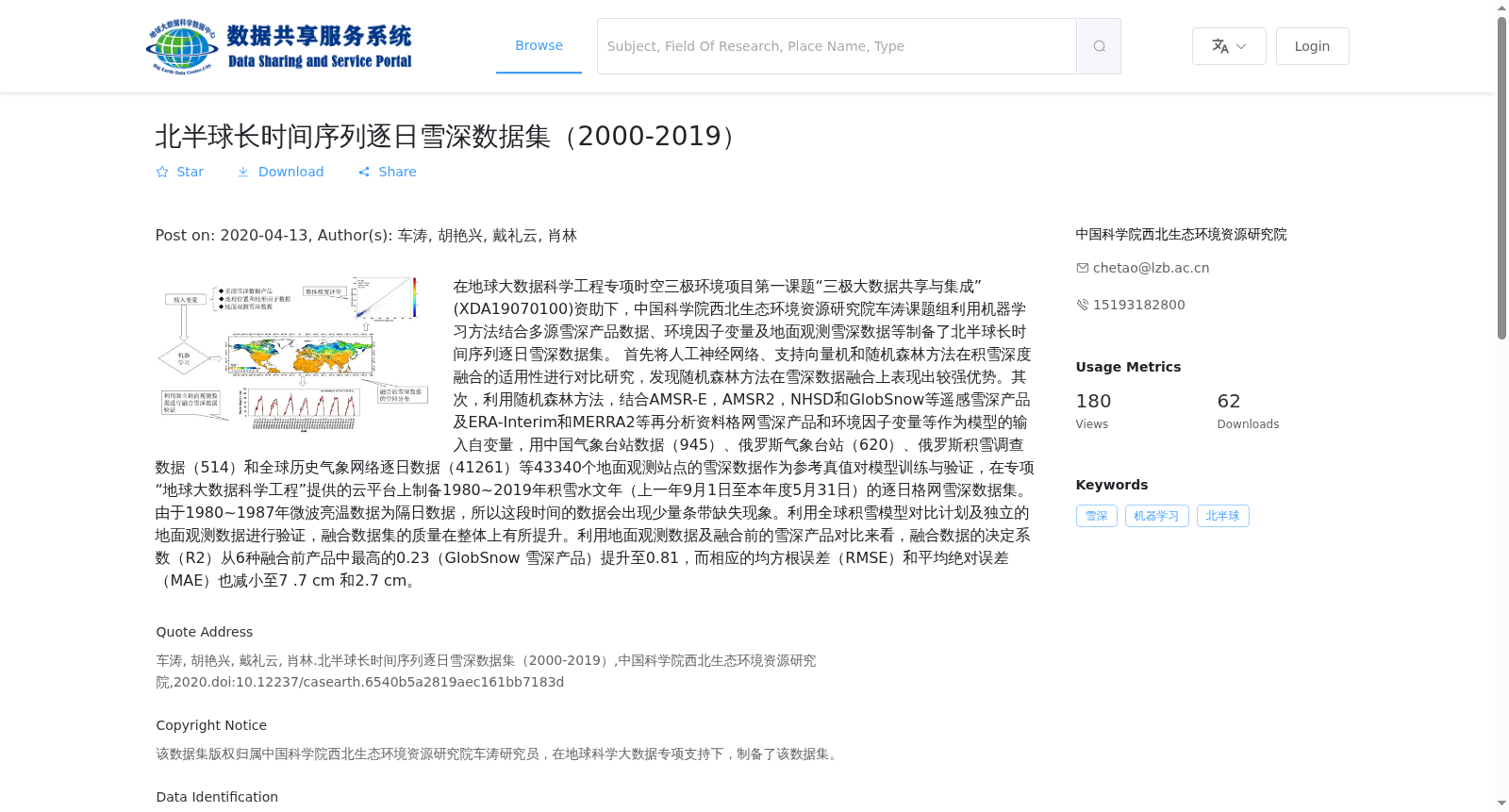
在地球大数据科学工程专项时空三极环境项目第一课题“三极大数据共享与集成” (XDA19070100)资助下,中国科学院西北生态环境资源研究院车涛课题组利用机器学习方法结合多源雪深产品数据、环境因子变量及地面观测雪深数据等制备了北半球长时间序列逐日雪深数据集。
首先将人工神经网络、支持向量机和随机森林方法在积雪深度融合的适用性进行对比研究,发现随机森林方法在雪深数据融合上表现出较强优势。其次,利用随机森林方法,结合AMSR-E,AMSR2,NHSD和GlobSnow等遥感雪深产品及ERA-Interim和MERRA2等再分析资料格网雪深产品和环境因子变量等作为模型的输入自变量,用中国气象台站数据(945)、俄罗斯气象台站(620)、俄罗斯积雪调查数据(514)和全球历史气象网络逐日数据(41261)等43340个地面观测站点的雪深数据作为参考真值对模型训练与验证,在专项“地球大数据科学工程”提供的云平台上制备1980~2019年积雪水文年(上一年9月1日至本年度5月31日)的逐日格网雪深数据集。由于1980~1987年微波亮温数据为隔日数据,所以这段时间的数据会出现少量条带缺失现象。利用全球积雪模型对比计划及独立的地面观测数据进行验证,融合数据集的质量在整体上有所提升。利用地面观测数据及融合前的雪深产品对比来看,融合数据的决定系数(R2)从6种融合前产品中最高的0.23(GlobSnow 雪深产品)提升至0.81,而相应的均方根误差(RMSE)和平均绝对误差(MAE)也减小至7
.7 cm 和2.7 cm。
Funded by the First Topic "Shared and Integrated Big Data for Three Poles and High Mountain Regions" (XDA19070100) of the Spatial-Temporal Three-Pole Environment Project under the Earth Big Data Science Special Program, the research group led by CHE Tao from the Northwest Institute of Eco-Environment and Resources, Chinese Academy of Sciences, developed a long-time-series daily snow depth dataset over the Northern Hemisphere using machine learning methods combined with multi-source snow depth products, environmental factor variables and in-situ observed snow depth data. First, a comparative study was conducted on the applicability of artificial neural network (ANN), support vector machine (SVM) and random forest (RF) methods for snow depth data fusion, and it was found that the random forest method exhibited strong advantages in snow depth data fusion. Second, the random forest method was employed, taking remote sensing snow depth products such as AMSR-E, AMSR2, NHSD and GlobSnow, gridded snow depth products from reanalysis datasets including ERA-Interim and MERRA2, and environmental factor variables as input independent variables, and using snow depth data from 43,340 in-situ observation stations (including 945 meteorological stations in China, 620 meteorological stations in Russia, 514 snow survey stations in Russia, and 41,261 daily data from the Global Historical Climatology Network (GHCN)) as reference true values for model training and validation. The daily gridded snow depth dataset for snow hydrological years (from September 1st of the previous year to May 31st of the current year) from 1980 to 2019 was generated on the cloud platform provided by the Earth Big Data Science Special Program. Due to the fact that microwave brightness temperature data from 1980 to 1987 were acquired on an alternate-day basis, a small number of stripe missing phenomena occurred in the data during this period. The fused dataset was validated using the Global Snow Model Intercomparison Project (GSMIP) and independent in-situ observation data, and its overall quality was improved. Compared with the pre-fusion snow depth products, the coefficient of determination (R²) of the fused data increased from 0.23, the highest value among the six pre-fusion products (GlobSnow snow depth product), to 0.81, while the corresponding root mean square error (RMSE) and mean absolute error (MAE) decreased to 7.7 cm and 2.7 cm, respectively.
创建时间:
2022-04-26
搜集汇总
数据集介绍
背景与挑战
背景概述
该数据集是北半球2000-2019年逐日雪深数据集,基于随机森林机器学习方法融合多源遥感产品、再分析资料和地面观测数据制备,空间分辨率为0.25°。其特点在于通过数据融合显著提升精度,决定系数达到0.81,均方根误差为7.7厘米,适用于积雪水文研究。
以上内容由遇见数据集搜集并总结生成


