open-index/open-wikipedia-text
收藏资源简介:
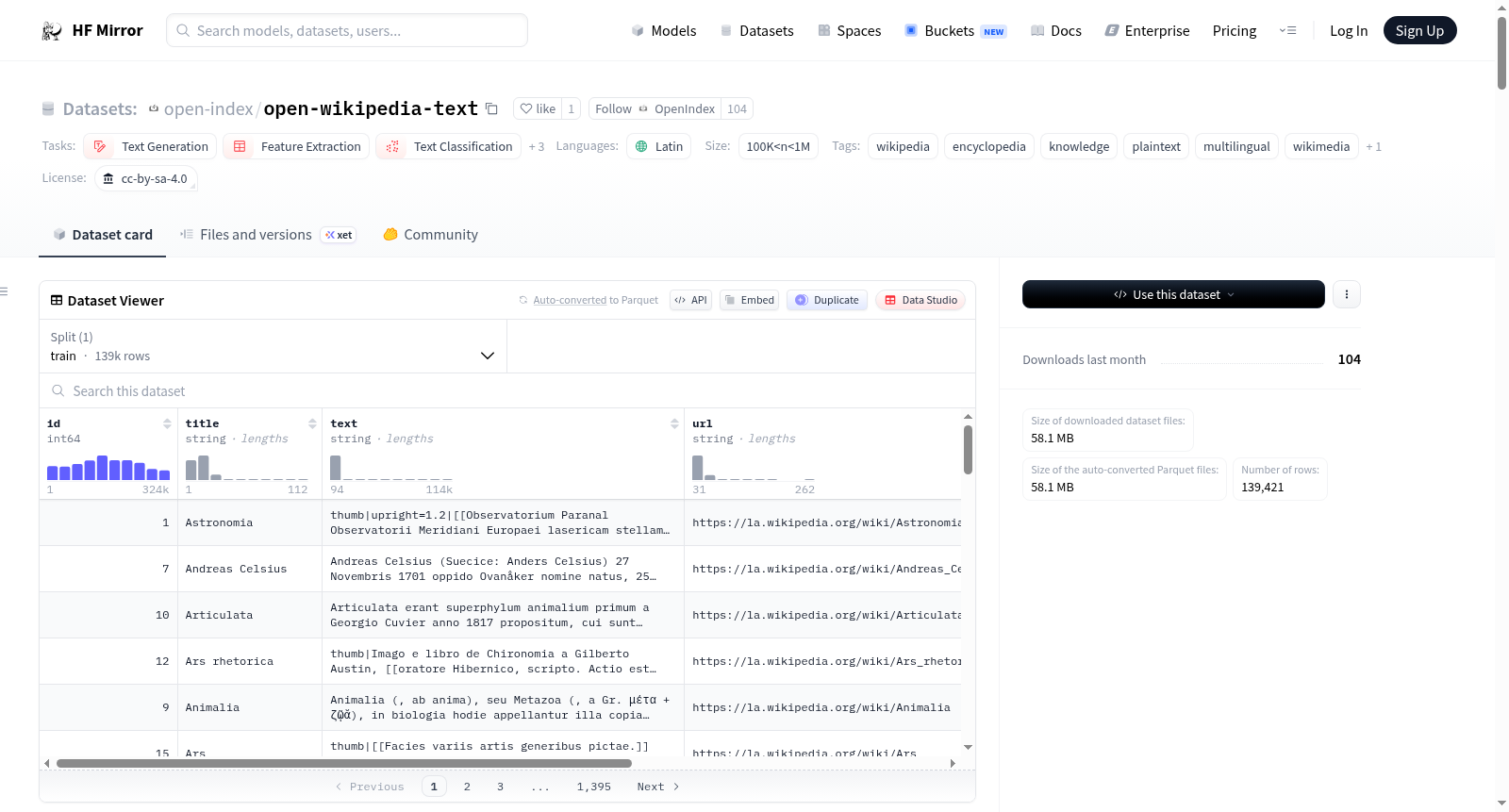
--- language: - la license: cc-by-sa-4.0 task_categories: - text-generation - feature-extraction - text-classification - question-answering - summarization - translation pretty_name: Open Wikipedia (Text) tags: - wikipedia - encyclopedia - knowledge - plaintext - multilingual - wikimedia - open-data size_categories: - 100K<n<1M configs: - config_name: la data_files: - split: train path: data/la/*.parquet dataset_info: - config_name: la features: - name: id dtype: int64 - name: title dtype: string - name: text dtype: string - name: url dtype: string - name: lang dtype: string - name: length dtype: int32 - name: timestamp dtype: string splits: - name: train num_examples: 139421 --- # Open Wikipedia (Text) > Every Wikipedia article as clean plain text, 139.4K articles across 1 languages ## What is it? This dataset contains every article from every language edition of [Wikipedia](https://www.wikipedia.org/), converted from raw MediaWiki markup into **clean plain text**. All formatting, templates, references, tables, HTML tags, and wiki syntax are stripped away, leaving only the readable content of each article. The source data comes from the official [Wikimedia database dumps](https://dumps.wikimedia.org/). Each language's full XML export is streamed, parsed, and converted article by article. The results are stored as sharded Apache Parquet files with Zstandard compression, organized by language. This is the plain text variant of the Open Wikipedia collection. If you need Markdown with preserved headings, bold, italic, code blocks, and links, see [open-index/open-wikipedia-markdown](https://huggingface.co/datasets/open-index/open-wikipedia-markdown). If you need the original MediaWiki source markup, see [open-index/open-wikipedia](https://huggingface.co/datasets/open-index/open-wikipedia). **139.4K articles** | **1 languages** | **Last updated: 2026-04-03** | **License: [CC BY-SA 4.0](https://creativecommons.org/licenses/by-sa/4.0/)** ## What is being released? The dataset is organized as one directory per language, with sharded Parquet files inside each: ``` data/ en/en-00000.parquet English, shard 0 en-00001.parquet English, shard 1 ... de/de-00000.parquet German fr/fr-00000.parquet French es/es-00000.parquet Spanish ja/ja-00000.parquet Japanese ... la/la-00000.parquet Latin ``` Each Parquet file contains up to 500,000 rows. Languages with fewer articles fit in a single shard. All files use Zstandard compression. ## How to download and use this dataset ### Using DuckDB DuckDB can read Parquet files directly from Hugging Face without downloading anything first. ```sql -- Count articles per language SELECT lang, COUNT(*) as articles FROM read_parquet('hf://datasets/open-index/open-wikipedia-text/data/*/*.parquet') GROUP BY lang ORDER BY articles DESC; ``` ```sql -- Full-text search across all languages SELECT title, lang, length, url FROM read_parquet('hf://datasets/open-index/open-wikipedia-text/data/*/*.parquet') WHERE text ILIKE '%artificial intelligence%' ORDER BY length DESC LIMIT 20; ``` ```sql -- Article length distribution for English SELECT percentile_disc(0.25) WITHIN GROUP (ORDER BY length) AS p25, percentile_disc(0.50) WITHIN GROUP (ORDER BY length) AS p50, percentile_disc(0.75) WITHIN GROUP (ORDER BY length) AS p75, percentile_disc(0.90) WITHIN GROUP (ORDER BY length) AS p90, percentile_disc(0.99) WITHIN GROUP (ORDER BY length) AS p99, AVG(length)::INT AS avg_length, MAX(length) AS max_length FROM read_parquet('hf://datasets/open-index/open-wikipedia-text/data/en/*.parquet'); ``` ```sql -- Total text volume per language (in GB) SELECT lang, COUNT(*) AS articles, ROUND(SUM(length) / 1e9, 2) AS text_gb FROM read_parquet('hf://datasets/open-index/open-wikipedia-text/data/*/*.parquet') GROUP BY lang ORDER BY text_gb DESC LIMIT 20; ``` ```sql -- Find the longest articles in each language SELECT lang, title, length, url FROM ( SELECT *, ROW_NUMBER() OVER (PARTITION BY lang ORDER BY length DESC) AS rn FROM read_parquet('hf://datasets/open-index/open-wikipedia-text/data/*/*.parquet') ) WHERE rn = 1 ORDER BY length DESC LIMIT 20; ``` ### Using `datasets` ```python from datasets import load_dataset # Load English Wikipedia ds = load_dataset("open-index/open-wikipedia-text", "en") print(ds["train"][0]["title"]) print(ds["train"][0]["text"][:500]) # Stream the full dataset without downloading everything ds = load_dataset("open-index/open-wikipedia-text", "en", split="train", streaming=True) for item in ds: print(item["title"], item["length"]) # Load a specific language ds = load_dataset("open-index/open-wikipedia-text", "de") print(f"German articles: {len(ds['train']):,}") ``` ### Using `huggingface_hub` ```python from huggingface_hub import snapshot_download # Download only English snapshot_download( "open-index/open-wikipedia-text", repo_type="dataset", local_dir="./wiki-text/", allow_patterns="data/en/*", ) ``` For faster downloads, install `pip install huggingface_hub[hf_transfer]` and set `HF_HUB_ENABLE_HF_TRANSFER=1`. ### Using the CLI ```bash # Download a single language huggingface-cli download open-index/open-wikipedia-text \ --include "data/la/*" \ --repo-type dataset --local-dir ./wiki-text/ ``` ### Sentence embeddings Plain text is the ideal input for embedding models. Here is a quick example: ```python from datasets import load_dataset from sentence_transformers import SentenceTransformer ds = load_dataset("open-index/open-wikipedia-text", "en", split="train") model = SentenceTransformer("all-MiniLM-L6-v2") # Embed the first 1000 article texts (truncated to 512 chars) texts = [row["text"][:512] for row in ds.select(range(1000))] embeddings = model.encode(texts, show_progress_bar=True) print(f"Embeddings shape: {embeddings.shape}") ``` ## Dataset statistics ### Languages | Language | Code | Articles | Shards | |----------|------|----------|--------| | Latin | `la` | 139.4K | 1 | ## Schema Every Parquet file shares the same schema: | Column | Type | Description | |--------|------|-------------| | `id` | `int64` | Wikipedia page ID, unique within each language edition | | `title` | `string` | Article title as it appears on Wikipedia | | `text` | `string` | Full article body as plain text, all markup removed | | `url` | `string` | Direct URL to the Wikipedia article | | `lang` | `string` | ISO 639 language code (e.g. `en`, `de`, `fr`, `ja`) | | `length` | `int32` | Plain text body length in bytes | | `timestamp` | `string` | Last revision timestamp in ISO 8601 format | ### Example instance Here is an example row from the English partition: ```json { "id": 12, "title": "Anarchism", "text": "Anarchism is a political philosophy and movement that is against all forms of authority and seeks to abolish...", "url": "https://en.wikipedia.org/wiki/Anarchism", "lang": "en", "length": 65210, "timestamp": "2025-12-15T08:22:01Z" } ``` The `text` field contains only readable content. All wiki syntax, HTML tags, templates, references, and formatting markers have been removed. ## What gets stripped Every element of MediaWiki markup is removed to produce clean plain text: | Element | Handling | |---------|----------| | `{{templates}}` | Removed entirely, including Infobox, Navbox, Taxobox, and all other templates | | `{| tables |}` | Removed | | `<ref>` citations | Removed, including named references | | `[[wiki links]]` | Replaced with the display text only (no URL, no brackets) | | `'''bold'''` / `''italic''` | Replaced with the plain text content | | `== Headings ==` | Replaced with the heading text only | | `<!-- comments -->` | Removed | | `[[File:]]` / `[[Image:]]` | Removed | | `[[Category:]]` | Removed | | `<code>`, `<pre>`, `<syntaxhighlight>` | Tag markup removed, content preserved as plain text | | All other HTML tags | Removed | | Magic words | `__NOTOC__`, `__FORCETOC__`, and similar directives are removed | ## How it works The pipeline processes all 1 Wikipedia language editions through the following steps: 1. **Download.** The latest `{lang}wiki-latest-pages-articles.xml.bz2` dump is streamed from [dumps.wikimedia.org](https://dumps.wikimedia.org/). Downloads support HTTP range resumption, so interrupted transfers pick up where they left off. 2. **Parse.** A streaming XML parser processes the bzip2-compressed dump without extracting it to disk. Only namespace-0 pages (articles) are kept. Redirects, talk pages, user pages, and all other namespaces are skipped. 3. **Strip.** Each article's wikitext is processed to remove all markup, templates, tables, references, HTML, and formatting. Wiki links are replaced with their display text. The result is clean, readable plain text. 4. **Filter.** Articles shorter than 100 bytes after conversion are excluded. This removes stubs, disambiguation pages, and other pages with minimal content. 5. **Shard.** Articles are written to Zstandard-compressed Parquet files, approximately 500,000 rows per shard. Multiple languages are processed in parallel using a worker pool. 6. **Publish.** Each language's shards are committed to this Hugging Face repository as they complete. ## Considerations ### Why plain text? Plain text is the right choice when you need clean input without any formatting noise. Common use cases include: - **Text embeddings.** Embedding models work best with pure text. Markdown markers like `**` and `##` add noise that can degrade similarity scores. - **Text classification.** Topic classifiers and sentiment models typically expect plain text input. - **BM25 and keyword search.** Traditional information retrieval benefits from clean text without markup artifacts. - **Tokenization and vocabulary analysis.** Formatting symbols consume tokens without adding semantic value. If you need document structure (headings, bold, code blocks, links), use the [Markdown variant](https://huggingface.co/datasets/open-index/open-wikipedia-markdown) instead. ### Known limitations - **Conversion is regex-based, not a full parser.** Some complex wikitext constructs may leave small artifacts. The vast majority of articles convert cleanly. - **Templates are stripped, not expanded.** Infoboxes and navigation templates are removed entirely rather than converted to their rendered text output. - **One snapshot in time.** This dataset represents a single snapshot of each language's dump. It does not track edit history. - **Dump availability varies.** Not all language editions have their dumps available at all times. ## Related datasets - [open-index/open-wikipedia-markdown](https://huggingface.co/datasets/open-index/open-wikipedia-markdown) - Same articles with Markdown formatting preserved. Headings, bold, italic, code blocks, and links are retained. - [open-index/open-wikipedia](https://huggingface.co/datasets/open-index/open-wikipedia) - Same articles in original MediaWiki wikitext markup with templates, tables, references, and all source elements. ## Thanks The content in this dataset was written by millions of Wikipedia editors worldwide and is hosted by the [Wikimedia Foundation](https://www.wikimedia.org/). The raw data comes from the [Wikimedia database dumps](https://dumps.wikimedia.org/), which the Foundation makes freely available for download. Wikipedia is one of humanity's greatest collaborative achievements. All credit for the content goes to the volunteer editors who write, review, and maintain it. This dataset is an independent conversion and is not affiliated with or endorsed by the Wikimedia Foundation. ## Licensing Wikipedia content is released under the [Creative Commons Attribution-ShareAlike 4.0 International License](https://creativecommons.org/licenses/by-sa/4.0/) (CC BY-SA 4.0). This dataset inherits that license. If you redistribute or build upon this data, you must give appropriate credit and share your contributions under the same license. ## Citation ```bibtex @dataset{open_wikipedia_text, title = {Open Wikipedia (Text)}, author = {Open Index}, year = {2026}, url = {https://huggingface.co/datasets/open-index/open-wikipedia-text}, license = {CC BY-SA 4.0}, publisher = {Hugging Face} } ``` _Last updated: 2026-04-03_