
人脸分类训练数据
收藏浙江省数据知识产权登记平台2025-03-11 更新2025-03-12 收录
下载链接:
https://www.zjip.org.cn/home/announce/trends/116696
下载链接
链接失效反馈官方服务:
资源简介:
通过从特定人物的视频中提取不同帧画面,我们能够准确定位人脸位置,并对图像进行缩放处理以获得清晰的面部图像。该流程不仅适用于同一人物的多段视频,还可扩展至多人物的视频处理,最终生成了包含35个人物的大量人脸图像,并按照类别分类存储于对应文件夹中。
这一数据集在多个领域展现了广泛的应用价值,尤其在人脸分类和比对任务中具有重要意义。例如,在手机解锁和银行验证等安全系统中,人脸识别技术可用于高效验证身份;在边境管理与机场安检等场景,通过人脸比对技术可协助确认嫌疑人身份。此外,该数据集还支持公益项目的开展,如帮助寻找失散人员,精准匹配家庭成员,为社会公益事业提供有力支持。(1)视频帧提取:从输入视频文件中按照固定帧间隔提取图像帧,确保每帧均包含人脸,以提高数据的多样性和代表性,为后续处理奠定基础。
(2)人脸检测与处理:采用OpenCV和Dlib技术精准检测人脸位置,并针对因姿态问题导致的倾斜,通过关键点定位进行旋转或拉伸校正。所有人脸图像均统一调整为固定尺寸,确保数据的一致性和可用性。
(3)数据增强:通过随机旋转、亮度和对比度调整、裁剪、平移、放缩等数据增强操作,扩展数据的多样性,从而提升模型在不同场景下的泛化能力。
(4)数据清洗:为保证数据质量,使用SSIM(结构相似性)计算图片间的相似度,去除重复帧。同时检查人脸分辨率,过滤掉低分辨率样本,保留清晰且高质量的图像数据。
(5)深度学习架构选择:采用VGGFace模型作为基础框架,用于人脸识别与比对任务。该模型基于Triplet Loss优化特征空间,能够高效捕捉和区分人脸特征,适合复杂的比对与识别需求。
(5)模型训练与评估:在标注好的数据集上进行模型训练,选用合适的损失函数并动态监控训练过程中的损失值和精度变化。在每个训练周期(epoch)后,根据模型表现调整超参数,确保其性能逐步优化。
(6)模型优化与验证:利用验证集全面评估模型性能,根据评估结果采取优化措施,如引入正则化技术、改进训练流程或数据处理策略。优化可能包括删除对推理效果影响较小的神经元或网络层以减少参数量,或增加网络深度与宽度以提升模型表现。
By extracting distinct frames from videos of specific individuals, we can accurately locate facial regions and resize images to obtain clear facial images. This pipeline is applicable not only to multiple videos of the same individual but also can be extended to video processing involving multiple people. Finally, a large number of facial images from 35 individuals are generated, which are classified and stored in corresponding folders by category.
This dataset exhibits broad application value across multiple fields, and is particularly significant for facial classification and verification tasks. For example, in security systems such as smartphone unlocking and bank authentication, facial recognition technology can be used to efficiently verify identity; in scenarios such as border control and airport security screening, facial verification technology can assist in confirming the identity of suspects. In addition, this dataset also supports the development of public welfare projects, such as helping to find missing persons and accurately matching family members, providing strong support for social public welfare undertakings.
(1) Video Frame Extraction: Extract image frames at fixed frame intervals from input video files, ensuring that each frame contains a human face, thereby improving the diversity and representativeness of the dataset and laying a foundation for subsequent processing.
(2) Facial Detection and Processing: Use OpenCV and Dlib technologies to accurately detect facial positions, and correct tilts caused by posture issues via key point positioning through rotation or stretching adjustment. All facial images are uniformly resized to a fixed dimension to ensure data consistency and usability.
(3) Data Augmentation: Conduct data augmentation operations including random rotation, brightness and contrast adjustment, cropping, translation, and scaling to expand data diversity, thus enhancing the model's generalization ability in various scenarios.
(4) Data Cleaning: To guarantee data quality, calculate the similarity between images using SSIM (Structural Similarity) to remove duplicate frames. Meanwhile, check the facial resolution, filter out low-resolution samples, and retain clear and high-quality image data.
(5) Deep Learning Architecture Selection: Adopt the VGGFace model as the foundational framework for facial recognition and verification tasks. This model optimizes the feature space based on Triplet Loss, which can efficiently capture and distinguish facial features, making it suitable for complex verification and recognition requirements.
(5) Model Training and Evaluation: Train the model on the annotated dataset, select appropriate loss functions, and dynamically monitor changes in loss values and accuracy during the training process. After each training epoch, adjust hyperparameters based on model performance to ensure gradual optimization of model performance.
(6) Model Optimization and Verification: Use the validation set to comprehensively evaluate model performance, and take optimization measures according to the evaluation results, such as introducing regularization techniques, improving the training process or data processing strategies. Optimization may include deleting neurons or network layers with minimal impact on inference effect to reduce the number of parameters, or increasing network depth and width to improve model performance.
提供机构:
杭州君同未来科技有限责任公司
创建时间:
2024-12-10
搜集汇总
数据集介绍
特点
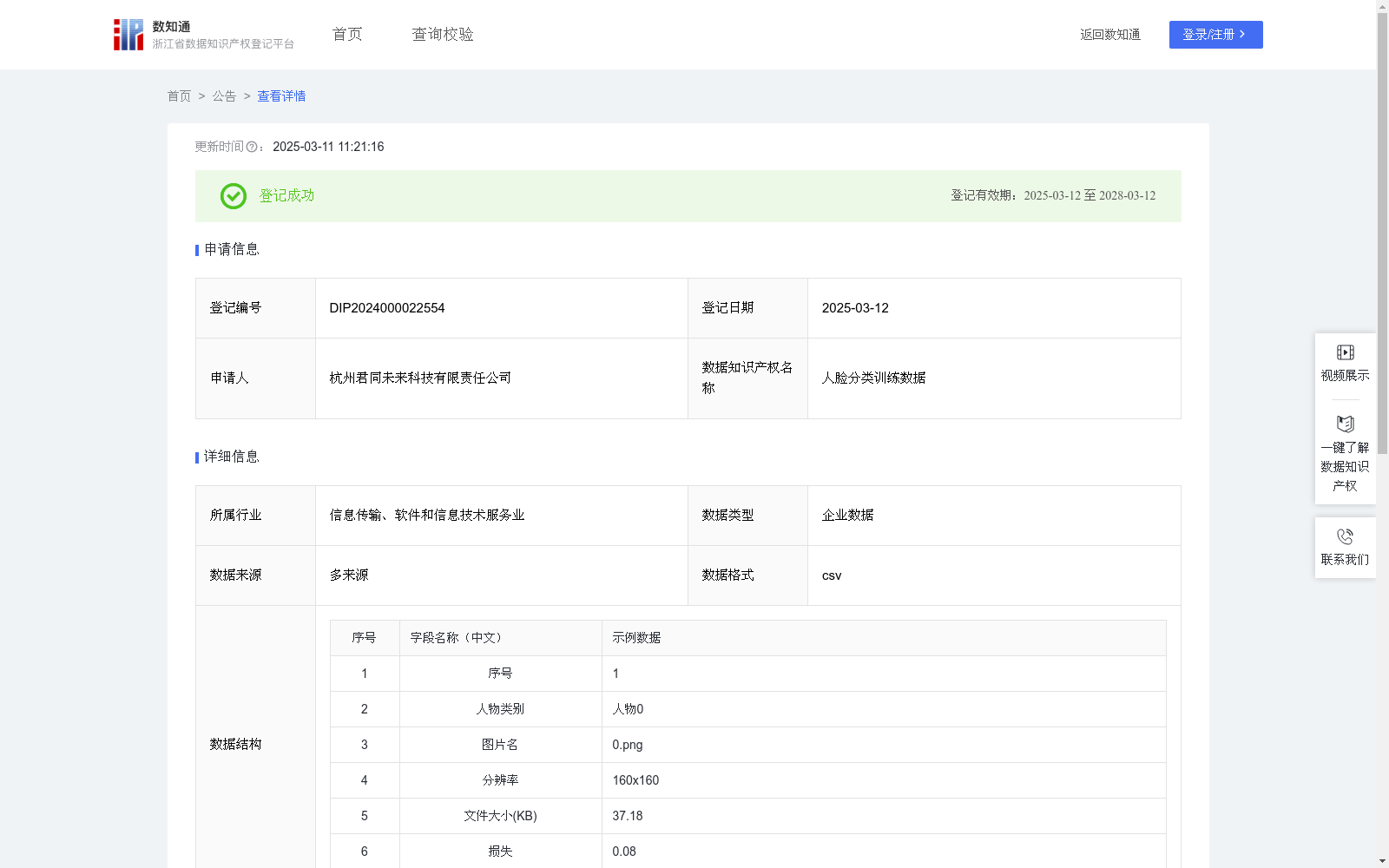
该数据集是一个包含2525条记录的人脸分类训练数据,格式为CSV,每年更新一次。数据来源于多来源,应用场景包括人脸识别、身份验证和安全系统等。数据处理流程包括视频帧提取、人脸检测与处理、数据增强、数据清洗以及深度学习模型训练和优化。
以上内容由遇见数据集搜集并总结生成



