
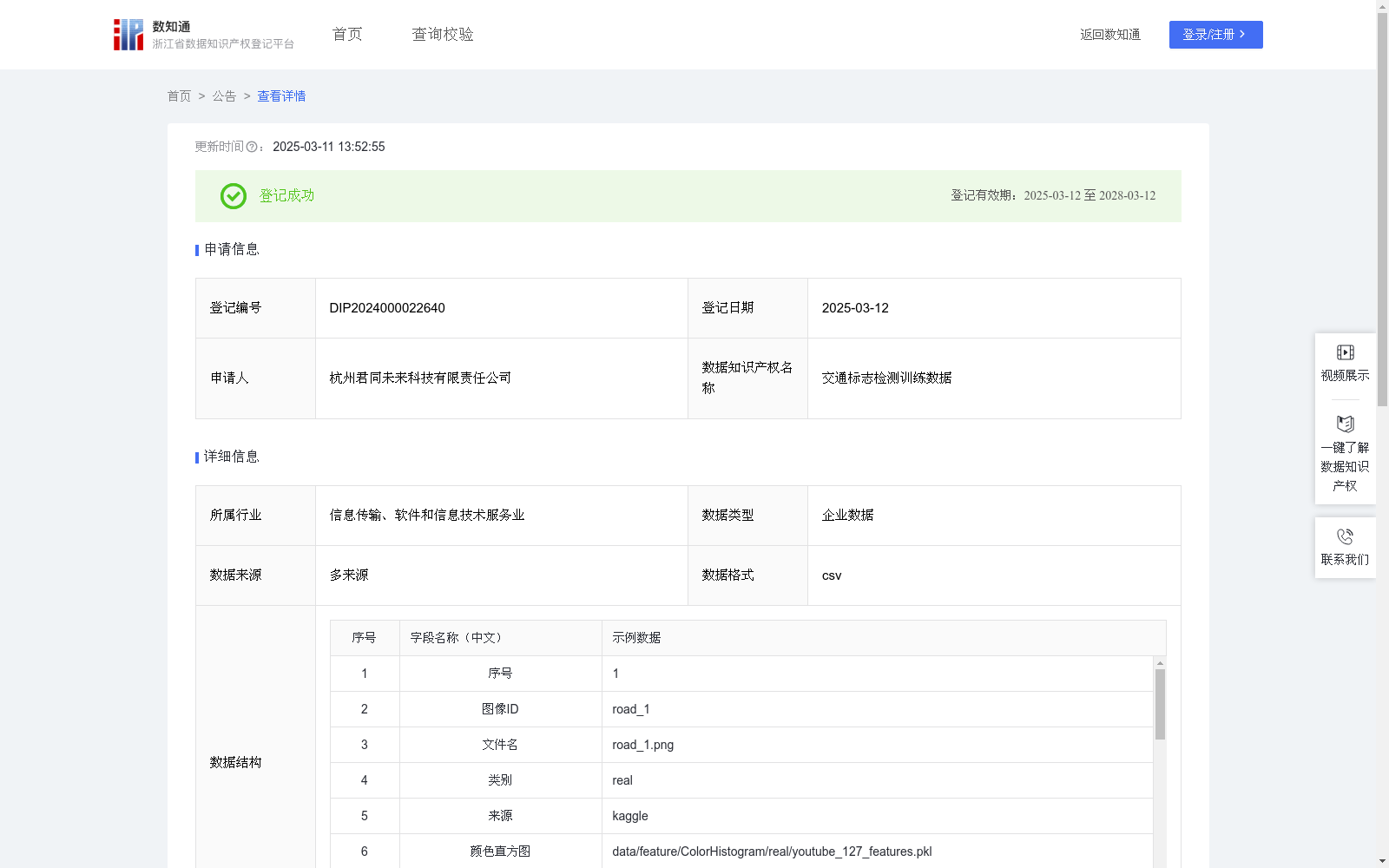
交通标志检测训练数据
收藏浙江省数据知识产权登记平台2025-03-11 更新2025-03-12 收录
下载链接:
https://www.zjip.org.cn/home/announce/trends/116729
下载链接
链接失效反馈官方服务:
资源简介:
通过数据处理和数据加工流程,智能交通标志检测训练数据集被有效优化,形成了高质量、标注准确的训练集。这一数据集能够为AI模型提供可靠且丰富的学习资源,使其能够全面理解和掌握交通标志的多样化特性,包括标志的多种类型、复杂的城市道路背景、变化多端的光照条件,以及多样化的天气场景(如晴天、雨天、雾天等)。通过在数据集上的训练,AI模型可以显著提升对交通标志的识别能力。它能够快速而准确地检测和分类多种标志,无论是在简单场景中还是复杂环境下都表现出优异的稳定性和可靠性。这种能力使其成为自动驾驶技术中的关键组成部分,为车辆提供实时交通标志识别和解读支持。同时,AI模型在智能交通管理系统中也扮演了重要角色,例如动态优化交通流量、减少交通拥堵等。
此外,经过训练的AI模型还可以应用于车辆辅助驾驶系统(ADAS),为驾驶员提供交通标志识别和驾驶建议,进一步提高驾驶安全性。在智能导航系统中,这些模型能够结合路况信息和标志识别,优化导航路径,为用户带来更智能的出行体验。通过广泛的应用,AI技术不仅提升了交通管理的效率,还为构建更安全、更便捷的出行环境奠定了基础。(1) 图像标准化处理
针对不同光照和天气条件,对图像进行动态标准化操作,包括亮度、对比度和饱和度的调整,以优化图像质量,确保在多样环境中的视觉一致性,为后续任务提供高质量输入。
(2) 数据增强
通过随机旋转、缩放、平移以及视角变换,模拟多种驾驶场景下的交通标志图像分布。利用生成对抗网络(GAN)生成在恶劣天气(如雨天、雾天、雪天)和高速运动条件下的交通标志图像,从而显著提升数据的多样性和模型的泛化能力。
(3) 关键视觉特征提取
基于交通标志的几何特性(如圆形、三角形、八边形)和颜色属性(如红色、蓝色、黄色)进行精准特征提取,提升模型对关键标志的识别能力。结合交通标志的环境上下文信息(如道路类型、车道标线),通过多模态融合策略辅助提高标志检测与分类的准确性。
(4) 深度学习架构选择
采用多任务学习(MTL)框架,将交通标志的检测与分类任务融合在同一架构内进行联合优化。此策略能在共享特征的同时减少任务间的冗余,提高模型的效率和性能。
(5) 模型训练与评估
采用分层训练策略,优先优化基础特征提取层,然后针对高层语义理解层进行精调,以提升模型的学习效率和效果。通过迁移学习利用在大规模图像数据集上预训练的深度模型,加速训练过程并显著提高模型性能。引入多维度评估指标,包括准确率、召回率、定位误差和识别延迟等,以全面衡量模型的效果和应用价值。
(6) 超参数调优
结合贝叶斯优化和随机搜索技术,系统化探索超参数空间(如学习率、批量大小和网络层数等),以寻找最优参数组合。采用交叉验证方法评估不同超参数设置下模型的性能,确保调优过程的稳健性和泛化能力。引入早停机制,根据验证集的实时表现动态调整训练轮次,有效防止过拟合并优化训练效率。(7)模型优化与验证:根据评估结果,对模型通过应用剪枝、量化和知识蒸馏等模型压缩技术,减少模型的参数量和计算需求,从而提升推理速度。然后在独立的测试集上验证模型的性能。
Through data processing and refinement workflows, the intelligent traffic sign detection training dataset has been effectively optimized, resulting in a high-quality, accurately annotated training set. This dataset provides reliable and abundant learning resources for AI models, enabling them to comprehensively understand and master the diverse characteristics of traffic signs, including various sign types, complex urban road backgrounds, variable lighting conditions, and diverse weather scenarios (e.g., sunny, rainy, foggy, etc.). Training AI models on this dataset can significantly enhance their traffic sign recognition capabilities. The models can quickly and accurately detect and classify multiple types of signs, demonstrating excellent stability and reliability in both simple scenarios and complex environments. This capability makes it a critical component of autonomous driving technology, providing real-time traffic sign recognition and interpretation support for vehicles. Meanwhile, AI models also play an important role in intelligent traffic management systems, such as dynamically optimizing traffic flow and reducing traffic congestion.
In addition, trained AI models can also be applied to Advanced Driver Assistance Systems (ADAS), providing drivers with traffic sign recognition and driving suggestions to further improve driving safety. In intelligent navigation systems, these models can combine road condition information and sign recognition to optimize navigation routes, bringing users a smarter travel experience. Through widespread applications, AI technology not only improves the efficiency of traffic management but also lays the foundation for building a safer and more convenient travel environment.
(1) Image Standardization Processing: For different lighting and weather conditions, dynamic standardization operations are performed on images, including adjustments to brightness, contrast, and saturation, to optimize image quality and ensure visual consistency across diverse environments, providing high-quality inputs for subsequent tasks.
(2) Data Augmentation: The distribution of traffic sign images in various driving scenarios is simulated through random rotation, scaling, translation, and perspective transformation. Generative Adversarial Networks (GANs) are used to generate traffic sign images under severe weather conditions (e.g., rainy, foggy, snowy) and high-speed motion conditions, significantly improving data diversity and model generalization ability.
(3) Key Visual Feature Extraction: Accurate feature extraction is performed based on the geometric characteristics (e.g., circular, triangular, octagonal) and color attributes (e.g., red, blue, yellow) of traffic signs, enhancing the model's ability to recognize key signs. Combined with environmental context information of traffic signs (e.g., road type, lane markings), multi-modal fusion strategies are adopted to assist in improving the accuracy of sign detection and classification.
(4) Deep Learning Architecture Selection: A Multi-Task Learning (MTL) framework is adopted, which fuses traffic sign detection and classification tasks into the same architecture for joint optimization. This strategy reduces redundancy between tasks while sharing features, improving model efficiency and performance.
(5) Model Training and Evaluation: A hierarchical training strategy is adopted, prioritizing the optimization of the basic feature extraction layer, followed by fine-tuning of the high-level semantic understanding layer, to improve the model's learning efficiency and effectiveness. Transfer learning is used to leverage deep models pre-trained on large-scale image datasets to accelerate the training process and significantly improve model performance. Multi-dimensional evaluation metrics, including accuracy, recall rate, localization error, and recognition latency, are introduced to comprehensively measure the model's performance and application value.
(6) Hyperparameter Tuning: Combining Bayesian Optimization and random search techniques, the hyperparameter space (e.g., learning rate, batch size, number of network layers, etc.) is systematically explored to find the optimal parameter combination. Cross-validation is used to evaluate the model's performance under different hyperparameter settings, ensuring the robustness and generalization ability of the tuning process. An early stopping mechanism is introduced, which dynamically adjusts the number of training epochs based on the real-time performance of the validation set, effectively preventing overfitting and optimizing training efficiency.
(7) Model Optimization and Verification: Based on the evaluation results, model compression techniques such as pruning, quantization, and knowledge distillation are applied to the model to reduce its parameter count and computational requirements, thereby improving inference speed. The model's performance is then verified on an independent test set.
提供机构:
杭州君同未来科技有限责任公司
创建时间:
2024-12-10
搜集汇总
数据集介绍
以上内容由遇见数据集搜集并总结生成



