
AppliedLucent/synthetic_conversations
收藏Hugging Face2026-04-10 更新2026-04-12 收录
下载链接:
https://hf-mirror.com/datasets/AppliedLucent/synthetic_conversations
下载链接
链接失效反馈官方服务:
资源简介:
---
language:
- en
pretty_name: Synthetic Conversations
tags:
- synthetic
- conversational
- chat
- multi-turn
- instruction-tuning
- gpt-4o
- minimax
license: apache-2.0
task_categories:
- text-generation
---
### Dataset Summary
**Synthetic Conversations** is a high-quality, multi-turn dialogue dataset designed for fine-tuning Large Language Models (LLMs) to act as advanced, nuanced, and structurally consistent chat assistants.
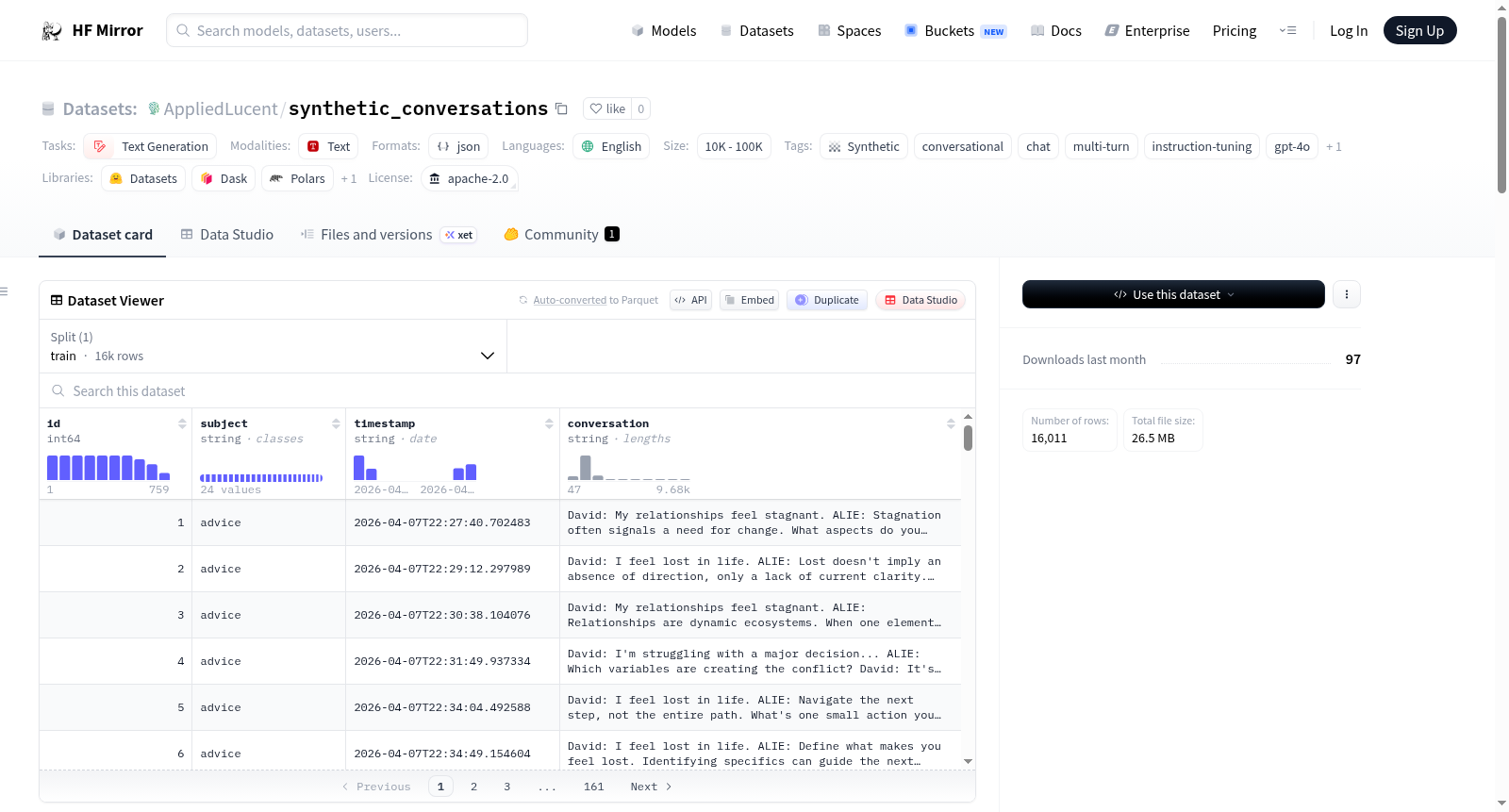
The dataset contains approximately `[~16,000]` carefully curated conversations generated across 24 distinct topics, ranging from technology and philosophy to conflict resolution and creative storytelling. To achieve a balance of broad world-knowledge and natural, dynamic conversational flow, the data was synthesized using a dual-model approach featuring both **GPT-4o** and **MiniMax M2.7**.
This dataset has been rigorously filtered for structural integrity, stripped of standard "AI boilerplate" (e.g., "As an AI..."), and semantically deduplicated to ensure high entropy and maximum training value.
### Supported Tasks and Leaderboards
- `conversational-response-generation`: The dataset can be used to train models for multi-turn chat applications, improving their ability to maintain context, handle complex or adversarial user inputs, and deliver grounded, peer-like responses.
- `instruction-tuning`: Useful for aligning base models to conversational formats.
### Languages
The text in the dataset is entirely in English (`en`).
## Dataset Structure
### Data Instances
Each instance in the dataset represents a full, multi-turn conversation between a user and an assistant. The data is provided in JSONL format.
**Example Instance:**
```json
{
"id": 145,
"subject": "technology",
"timestamp": "2026-04-09T20:16:50.321462",
"conversation": "User: [First line of dialogue]\nAssistant: [Response]\nUser: [Follow up]\nAssistant: [Response]..."
}
```
### Data Fields
- `id` *(int)*: A unique sequential identifier for the conversation within its category.
- `subject` *(string)*: The thematic category of the conversation (e.g., *philosophy, advice, conflict, technology*).
- `timestamp` *(string)*: The ISO 8601 timestamp of when the generation was completed.
- `conversation` *(string)*: The full transcript of the conversation, formatted with clear speaker tags, containing between 10 to 20 alternating dialogue turns.
## Dataset Creation
### Source Code & Generator
The pipeline and scripts used to synthesize, filter, and deduplicate this dataset are open-source and available on GitHub.
If you wish to generate your own custom persona datasets, train a model on specific domain knowledge, or replicate this dual-model methodology, you can find the complete generator code here:
**[DavidMcFarlin/Conversational-Dataset-Generator](https://github.com/DavidMcFarlin/Conversational-Dataset-Generator)**
### Curation Rationale
Many open-source conversational datasets suffer from repetitive phrasing, excessive politeness, and a lack of narrative depth. This dataset was created to provide a fine-tuning corpus that trains models to behave as grounded, capable peers rather than subservient customer service agents.
### Source Data
The dataset is purely synthetic, generated via API using the following models:
1. **GPT-4o (OpenAI):** Utilized for its deep world knowledge, structural stability, and complex reasoning capabilities.
2. **MiniMax M2.7:** Utilized for its high narrative fidelity, distinct character voice, and willingness to handle conversational friction without defaulting to standard AI guardrail lectures.
### Data Processing & Filtering
The raw generation underwent a strict two-stage "wash cycle" before finalization:
1. **Lexical & Structural Filtering:** Any conversations containing malformed speaker tags, prompt leakage, or generic AI boilerplate ("I am a language model," "I'm here to help," "It's important to remember") were explicitly dropped.
2. **Semantic Deduplication:** The opening turns of all conversations were embedded and compared using cosine similarity. Any generation sharing a similarity threshold higher than 85% with an existing conversation was discarded to ensure maximum topic entropy.
## Considerations for Using the Data
### Social Impact of Dataset
This dataset is intended to help developers train more capable and engaging AI assistants. Because it was generated to avoid standard "therapy-speak," models trained heavily on this data may exhibit a more direct, dry, or assertive tone than standard RLHF-tuned models.
### Known Limitations
- **Synthetic Hallucinations:** As the data is entirely AI-generated, there may be instances of factual inaccuracies or fabricated anecdotes within the dialogue.
- **Domain Focus:** While spanning 24 categories, the dataset is weighted toward philosophical, technical, and interpersonal discussions rather than mathematical or coding benchmarks.
## Licensing
Apache 2.0
提供机构:
AppliedLucent
搜集汇总
数据集介绍
构建方式
在构建高质量对话数据集的过程中,Synthetic Conversations采用了一种创新的双模型合成策略。该数据集通过整合GPT-4o与MiniMax M2.7两种先进语言模型的优势,生成了涵盖技术、哲学、冲突解决及创意叙事等24个主题的对话内容。生成流程经过精心设计,首先由模型基于多样化主题生成原始多轮对话,随后执行严格的两阶段清洗循环:第一阶段进行词汇与结构过滤,剔除包含格式错误、提示泄漏或通用AI模板的对话;第二阶段实施语义去重,利用嵌入向量计算对话开场白的余弦相似度,移除相似度超过85%的冗余样本,最终形成约16,000条结构完整、内容新颖的对话实例。
特点
Synthetic Conversations数据集展现出多方面的显著特征。其对话内容覆盖广泛的知识领域,从技术探讨到哲学思辨,确保了模型训练所需的世界知识广度。每条对话均包含10至20轮交替发言,模拟了真实人际交流中的动态互动与上下文连贯性。数据集经过深度清洗,彻底去除了常见的AI格式化表达,使助手回复更贴近自然、平等的对话伙伴风格。此外,通过严格的语义去重处理,数据集中避免了主题重复,保证了信息熵的最大化,从而为模型提供了高价值的训练样本,助力其生成更具深度与叙事张力的回应。
使用方法
该数据集主要应用于对话响应生成与指令微调两大任务场景。研究人员可直接加载JSONL格式的数据文件,每条记录包含完整的用户与助手对话文本。在模型训练过程中,可利用这些多轮对话数据来微调大型语言模型,提升其在复杂对话场景中保持上下文、处理对抗性输入以及生成接地气回复的能力。开发者也可借鉴其开源的数据生成管道,定制特定领域或人物角色的对话数据集。需要注意的是,由于数据完全由AI合成,使用时需留意其中可能存在的虚构事实,并建议结合领域知识进行结果验证与评估。
背景与挑战
背景概述
在大型语言模型(LLM)的快速发展背景下,对话系统的训练数据质量成为提升模型交互能力的关键。Synthetic Conversations数据集应运而生,由研究人员DavidMcFarlin等人于2024年左右创建,旨在通过高质量的多轮对话数据优化LLM的指令微调过程。该数据集聚焦于解决传统开放源对话数据中存在的重复性表达、过度礼貌及叙事深度不足等核心问题,推动模型从机械应答向具备深度、一致性和人性化交互的智能助手转变。其采用GPT-4o与MiniMax M2.7双模型合成策略,覆盖技术、哲学、冲突解决等24个主题,约包含16,000条对话,显著提升了对话生成任务的数据多样性与真实性,对自然语言处理领域的模型对齐与上下文理解研究产生了积极影响。
当前挑战
Synthetic Conversations数据集致力于应对对话生成领域的核心挑战,即如何使LLM在复杂多轮交互中保持上下文连贯性、处理对抗性输入并生成自然且富有深度的回应。然而,数据构建过程中面临多重困难:首先,合成数据可能包含事实性错误或虚构内容,即“幻觉”现象,影响模型的可靠性;其次,尽管通过语义去重和结构过滤减少了重复与模板化表达,但确保对话在24个主题间保持平衡且高熵仍具难度;此外,数据侧重于哲学与技术讨论,在数学或编程等专业领域的覆盖不足,限制了模型的泛化能力。这些挑战要求未来研究在数据真实性、领域广度与结构优化方面进一步探索。
常用场景
经典使用场景
在对话式人工智能领域,Synthetic Conversations数据集为大型语言模型的指令微调提供了关键资源。其多轮对话结构覆盖了从技术、哲学到创意叙事等24个主题,通过GPT-4o与MiniMax M2.7双模型合成策略,确保了对话的自然流畅与知识广度。该数据集常用于训练模型在复杂语境中维持一致性,提升其处理对抗性输入与生成接地气回应的能力,为构建高级聊天助手奠定了数据基础。
实际应用
在实际应用中,Synthetic Conversations数据集被广泛集成于智能客服、虚拟伴侣及教育辅导系统。其涵盖冲突解决与创意讨论等主题的对话,能够训练模型在真实场景中处理复杂人际互动。开发者利用该数据集微调模型,以生成更具个性化和情境感知的回应,从而提升用户体验,推动对话AI在娱乐、咨询与专业支持等领域的落地部署。
衍生相关工作
基于该数据集衍生的经典工作包括开源对话生成框架Conversational-Dataset-Generator,它允许研究者扩展合成方法至特定领域。在学术研究中,该数据集启发了对多轮对话一致性评估、对抗性对话鲁棒性测试及低资源指令微调策略的探索。相关成果进一步促进了对话系统在结构完整性、语义多样性及伦理对齐方面的模型优化与基准建立。
以上内容由遇见数据集搜集并总结生成



