cosmos-edge-av-trajectories
收藏资源简介:
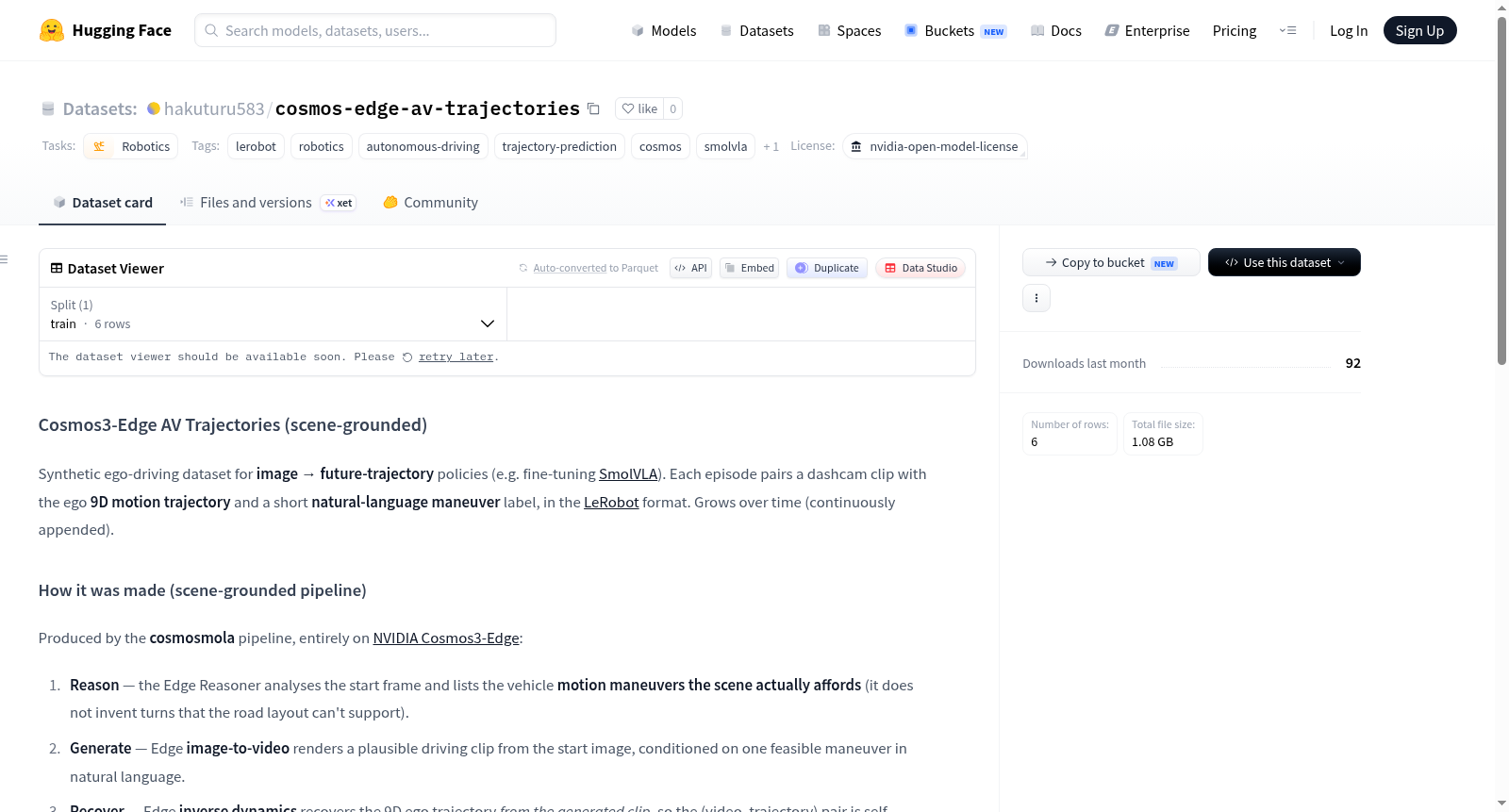
Cosmos3-Edge AV Trajectories(场景基础)是一个用于图像到未来轨迹策略的合成自动驾驶数据集,特别适用于微调SmolVLA等模型。数据集采用LeRobot格式,每个情节包含一个仪表盘摄像头剪辑片段、对应的9D自我运动轨迹(每帧包含3维平移和6维旋转表示)以及一个简短的自然语言机动标签。数据通过cosmosmola管道在NVIDIA Cosmos3-Edge上生成:首先,边缘推理器分析起始帧并列出场景实际支持的车辆运动机动;然后,边缘图像到视频模型根据起始图像和可行的自然语言机动条件渲染合理的驾驶剪辑;接着,边缘逆向动力学从生成的剪辑中恢复9D自我轨迹,确保视频和轨迹自洽;最后,打包为原生LeRobot数据集。起始帧来自真实的前摄像头帧(已模糊处理人脸和车牌),但剪辑完全是模型生成的,不包含真实驾驶镜头重分发。数据集特征包括:832×480分辨率的前摄像头剪辑、每帧9D自我运动动作、作为占位符的9D零观察状态,以及每个情节的场景基础机动任务标签。机动分布反映真实场景承受能力,主要为直线驾驶,在场景支持时包含转弯、减速或停止。数据集规模小于10K,持续追加增长,适用于机器人学、自动驾驶和轨迹预测等任务,内容受NVIDIA开放模型许可证约束。
Cosmos3-Edge AV Trajectories (Scene-based) is a synthetic self-driving dataset for image→future trajectory policies, particularly suitable for fine-tuning models like SmolVLA. The dataset adopts the LeRobot format, with each episode containing a dashboard camera clip, corresponding 9D ego-motion trajectories (including 3D translation and 6D rotation per frame), and a short natural language maneuver label. Data is generated via the cosmosmola pipeline on NVIDIA Cosmos3-Edge: first, an edge inferencer analyzes the starting frame and lists vehicle motion maneuvers supported by the scene; then, an edge image-to-video model renders plausible driving clips based on the starting image and feasible natural language maneuver conditions; next, edge inverse dynamics recovers 9D ego trajectories from the generated clips, ensuring consistency between video and trajectories; finally, it is packaged as a native LeRobot dataset. The starting frames are from real front camera frames (with faces and license plates blurred), but the clips are entirely model-generated and do not include redistribution of real driving footage. Dataset features include: 832×480 resolution front camera clips, 9D ego-motion actions per frame, 9D zero observation states as placeholders, and scene-based maneuver task labels for each episode. Maneuver distribution reflects real-world scenario capacity, primarily straight driving, with turns, deceleration, or stops when supported by the scene. The dataset size is less than 10K, continuously growing, and applicable to tasks in robotics, autonomous driving, and trajectory prediction, with content constrained by the NVIDIA Open Model License.
Cosmos3-Edge AV Trajectories (scene-grounded) 数据集概述
基本信息
- 许可证: NVIDIA Open Model License
- 任务类别: 机器人学 (robotics)
- 标签: lerobot, robotics, autonomous-driving, trajectory-prediction, cosmos, smolvla, synthetic
- 数据集规模: n<10K (小于10,000个样本)
数据集描述
该数据集是一个合成自动驾驶数据集,用于训练 图像→未来轨迹 策略(例如微调 SmolVLA)。每个episode将行车记录仪片段与 9D运动轨迹 以及一个简短的 自然语言操作标签 配对,数据格式为 LeRobot。数据集会随时间持续增长。
生成方法
数据集通过 cosmosmola 流水线 在 NVIDIA Cosmos3-Edge 上完全生成,流程如下:
- 推理 (Reason): Edge Reasoner 分析起始帧,列出场景实际允许的车辆操作动作。
- 生成 (Generate): Edge 图像转视频模型根据起始图像和一种可行的自然语言操作条件,渲染出合理的驾驶片段。
- 恢复 (Recover): Edge 逆动力学模型从生成的片段中恢复 9D 自车轨迹,确保(视频,轨迹)对自洽。
- 打包 (Package): 组装为原生 LeRobot 数据集,操作文本作为语言标签。
起始帧来自 nvidia/PhysicalAI-Autonomous-Vehicles 数据集的真实前摄像头帧(人脸/车牌已在源头模糊处理)。所有片段均由 Cosmos3-Edge 模型生成,不重新分发真实驾驶录像。
数据集特征
- observation.images.ego_view: 前摄像头片段,分辨率 832×480
- action: 每帧的 9D 自车运动数据,格式为 [平移(3), rot6d(6)],逐帧向后
- observation.state: 9D 零值(不捕捉自车本体感知)
- task (每个episode): 场景相关的操作描述(自然语言)
使用示例
python from lerobot.datasets.lerobot_dataset import LeRobotDataset ds = LeRobotDataset("hakuturu583/cosmos-edge-av-trajectories")
注意事项
- 操作分布反映真实场景的可行性(主要为直行,在场景允许的情况下包括转弯、减速或停车)
- observation.state 为零占位符,如有真实速度/转向数据可替换
- 内容由 Cosmos3-Edge 生成,受 NVIDIA Open Model License 约束