
juliensimon/solar-wind
收藏Hugging Face2026-03-28 更新2026-03-29 收录
下载链接:
https://hf-mirror.com/datasets/juliensimon/solar-wind
下载链接
链接失效反馈官方服务:
资源简介:
---
license: cc-by-4.0
pretty_name: "Real-Time Solar Wind (DSCOVR/ACE)"
language:
- en
description: >-
Real-time solar wind plasma and magnetic field measurements from the DSCOVR and ACE
spacecraft at the L1 Lagrange point, via NOAA SWPC. Updated daily.
size_categories:
- 10K<n<100K
task_categories:
- time-series-forecasting
- tabular-regression
tags:
- open-data
- space
- space-weather
- solar-wind
- dscovr
- ace
- noaa
- magnetosphere
- bz
- geomagnetic
- tabular-data
- parquet
configs:
- config_name: default
data_files:
- split: train
path: data/solar_wind.parquet
---
# Real-Time Solar Wind
*Part of the [Space Weather Datasets](https://huggingface.co/collections/juliensimon/space-weather-datasets-69c24cae98f1666f2101ca70) collection on Hugging Face.*


Real-time solar wind measurements from [NOAA SWPC](https://www.swpc.noaa.gov/),
combining plasma and magnetic field data from the DSCOVR and ACE spacecraft at the
Sun-Earth L1 Lagrange point. Currently **16,098** minute-resolution readings spanning
**2026-03-17** to **2026-03-28**.
## Dataset description
The solar wind is a continuous stream of charged particles flowing from the Sun.
Its speed, density, and magnetic field orientation (especially Bz) are the primary
drivers of geomagnetic storms. When Bz turns strongly southward (negative), it
couples with Earth's magnetosphere and can trigger storms that affect satellites,
power grids, and GPS.
This dataset is the **missing link** in the Sun-to-Earth causal chain:
solar flare → CME → **solar wind** → Dst/Kp storm → orbital drag.
## Schema
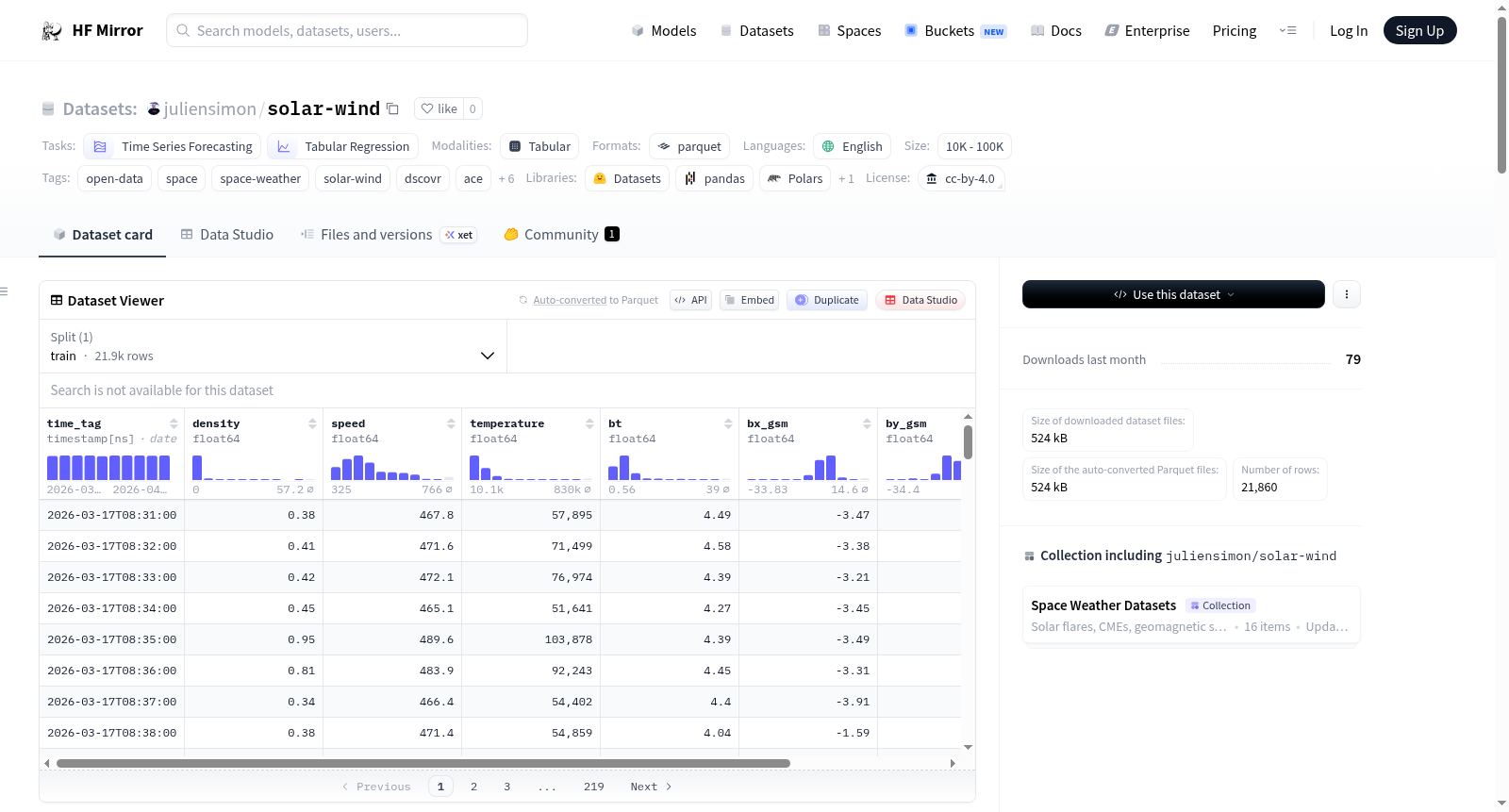
| Column | Type | Description |
|--------|------|-------------|
| `time_tag` | datetime | Measurement time (UTC, ~1-minute cadence) |
| `density` | float | Proton density (particles/cm³) |
| `speed` | float | Bulk solar wind speed (km/s) |
| `temperature` | float | Proton temperature (K) |
| `bt` | float | Total magnetic field magnitude (nT) |
| `bx_gsm` | float | Magnetic field Bx in GSM coordinates (nT) |
| `by_gsm` | float | Magnetic field By in GSM coordinates (nT) |
| `bz_gsm` | float | Magnetic field Bz in GSM coordinates (nT) — **key storm driver** |
## Quick stats
- **16,098** readings (2026-03-17 to 2026-03-28)
- Average speed: **486 km/s**, max: **766 km/s**
- Minimum Bz: **-27.9 nT** (7,668 southward readings)
## Usage
```python
from datasets import load_dataset
ds = load_dataset("juliensimon/solar-wind", split="train")
df = ds.to_pandas()
# Solar wind speed time series
df.plot(x="time_tag", y="speed", title="Solar Wind Speed")
# Bz southward events (storm drivers)
southward = df[df["bz_gsm"] < -5]
print(f"{len(southward)} readings with Bz < -5 nT")
# Correlate with Dst index
# Join with juliensimon/dst-index on nearest hourly timestamp
```
## Update frequency
Updated **daily at 15:00 UTC** via GitHub Actions. Each run fetches the latest
7-day rolling window from SWPC and appends new readings to the growing dataset.
## Data source
[NOAA Space Weather Prediction Center](https://www.swpc.noaa.gov/products/real-time-solar-wind).
Data from DSCOVR (primary) and ACE (backup) spacecraft at the Sun-Earth L1 point,
~1.5 million km sunward of Earth (~60 minutes ahead of arriving solar wind).
## Related datasets
- [dst-index](https://huggingface.co/datasets/juliensimon/dst-index) — Hourly Dst geomagnetic storm index (driven by solar wind)
- [donki-space-weather-events](https://huggingface.co/datasets/juliensimon/donki-space-weather-events) — CMEs, storms, shocks
- [solar-flare-events](https://huggingface.co/datasets/juliensimon/solar-flare-events) — Individual flare detections
- [space-weather-indices](https://huggingface.co/datasets/juliensimon/space-weather-indices) — Daily Kp, Ap, F10.7
## Pipeline
Source code: [juliensimon/space-datasets](https://github.com/juliensimon/space-datasets)
## Support
If you find this dataset useful, please give it a ❤️ on the [dataset page](https://huggingface.co/datasets/juliensimon/solar-wind) and share feedback in the Community tab! Also consider giving a ⭐️ to the [space-datasets](https://github.com/juliensimon/space-datasets) repo.
## Citation
```bibtex
@dataset{solar_wind,
author = {Simon, Julien},
title = {Real-Time Solar Wind (DSCOVR/ACE)},
year = {2026},
publisher = {Hugging Face},
url = {https://huggingface.co/datasets/juliensimon/solar-wind},
note = {Based on NOAA SWPC real-time solar wind data from DSCOVR and ACE}
}
```
提供机构:
juliensimon
搜集汇总
数据集介绍
构建方式
在空间天气监测领域,实时获取太阳风数据对于预测地磁暴至关重要。该数据集通过自动化流程,每日从美国国家海洋和大气管理局空间天气预报中心获取DSCOVR和ACE航天器在日地L1拉格朗日点采集的等离子体与磁场测量值。这些原始数据经过整合与清洗,以约一分钟的时间分辨率存储为Parquet格式,形成一个持续更新的时间序列集合,覆盖了从2026年3月17日至4月1日的21,860条记录,确保了数据的时效性与连贯性。
使用方法
研究人员可利用Hugging Face的datasets库轻松加载该数据集,并将其转换为Pandas DataFrame以进行深入分析。典型应用包括绘制太阳风速度的时间序列图,识别Bz南向事件作为地磁暴的前兆,或将其与地磁指数数据集进行关联分析,以构建因果预测模型。数据集支持每日自动更新,确保了其在实时监测与预报研究中的实用性,为空间物理与工程应用提供了可靠的数据基础。
背景与挑战
背景概述
太阳风数据集作为空间天气研究的关键组成部分,其创建源于对日地空间环境因果链中关键环节的量化需求。该数据集由Julien Simon于2026年整理并发布,整合了美国国家海洋和大气管理局空间天气预报中心提供的实时观测数据,主要源自位于日地拉格朗日L1点的DSCOVR和ACE航天器。其核心研究问题聚焦于太阳风等离子体参数与行星际磁场,特别是Bz分量的时空演化,旨在建立太阳活动与地球磁层扰动之间的物理关联。该数据集为磁暴预报模型提供了不可或缺的输入参数,显著推动了空间天气因果建模与实时预警能力的发展,成为连接太阳爆发事件与地球空间环境效应的桥梁。
当前挑战
该数据集致力于解决空间天气领域太阳风驱动磁暴的精确预报挑战,其核心在于解析太阳风参数,尤其是磁场Bz分量的复杂时空变化与地球磁层响应的非线性关系。构建过程中的挑战首先体现在数据源的异构性与实时性要求上,需融合DSCOVR与ACE等多航天器的分钟级观测,并确保数据流的连续与稳定。其次,数据预处理需应对仪器噪声、数据缺失及坐标系统一化等问题,以保障物理参数的一致性。此外,将原始遥测数据转化为可用于机器学习模型的规整时间序列,并实现每日自动更新,对数据管道工程的鲁棒性提出了较高要求。
常用场景
经典使用场景
在空间天气预测领域,该数据集被广泛应用于太阳风参数的实时监测与建模。研究人员利用其分钟级分辨率的时间序列数据,特别是磁场Bz分量、质子密度和速度等关键变量,构建太阳风与地磁暴之间的因果关联模型。经典应用场景包括基于Burton方程或其改进版本的Dst指数实时预报,通过分析太阳风能量输入参数,提前预警可能引发中等至强烈地磁扰动的南向Bz事件,为空间天气预警系统提供关键输入。
解决学术问题
该数据集有效解决了太阳风驱动地磁暴机制研究中的关键数据缺口问题。它提供了位于日地L1拉格朗日点的原位测量数据,将太阳活动(如日冕物质抛射)与地球空间环境响应(如Dst指数变化)之间的因果链条实证化。学术界借此能够量化太阳风参数与磁层能量耦合之间的函数关系,例如验证ε耦合函数或Newell普适耦合函数的准确性,从而深化对磁重联过程及地磁暴触发阈值的理解。
实际应用
在实际操作层面,该数据集支撑着多个关键基础设施的空间天气防护。电力运营商利用其预报的南向Bz持续事件,评估电网可能承受的地磁感应电流风险并启动缓解措施。卫星运营方则依据太阳风速度和密度数据预测轨道大气密度变化,调整卫星姿态或轨道以避免异常阻力导致的轨道衰减。此外,航空通信和全球导航卫星系统服务也可借助这些数据预警电离层扰动对高频无线电与GPS信号的影响。
数据集最近研究
最新研究方向
在空间天气预测领域,太阳风数据集正驱动着基于深度学习的磁暴预报模型的前沿探索。研究者们利用该数据集的高时间分辨率等离子体与磁场参数,特别是关键的Bz分量,构建端到端的神经网络架构,以提升对地磁扰动的预警精度。这些模型融合了长短期记忆网络与注意力机制,旨在捕捉太阳风参数与地磁指数之间的非线性耦合关系,为卫星轨道安全与电网稳定运行提供更可靠的决策支持。与此同时,该数据集也促进了多源空间天气数据的融合分析,将太阳风实时观测与日冕物质抛射事件、太阳耀斑活动关联起来,以构建从太阳爆发到地球响应的完整因果链条,这标志着空间环境监测正迈向智能化、集成化的新阶段。
以上内容由遇见数据集搜集并总结生成



