
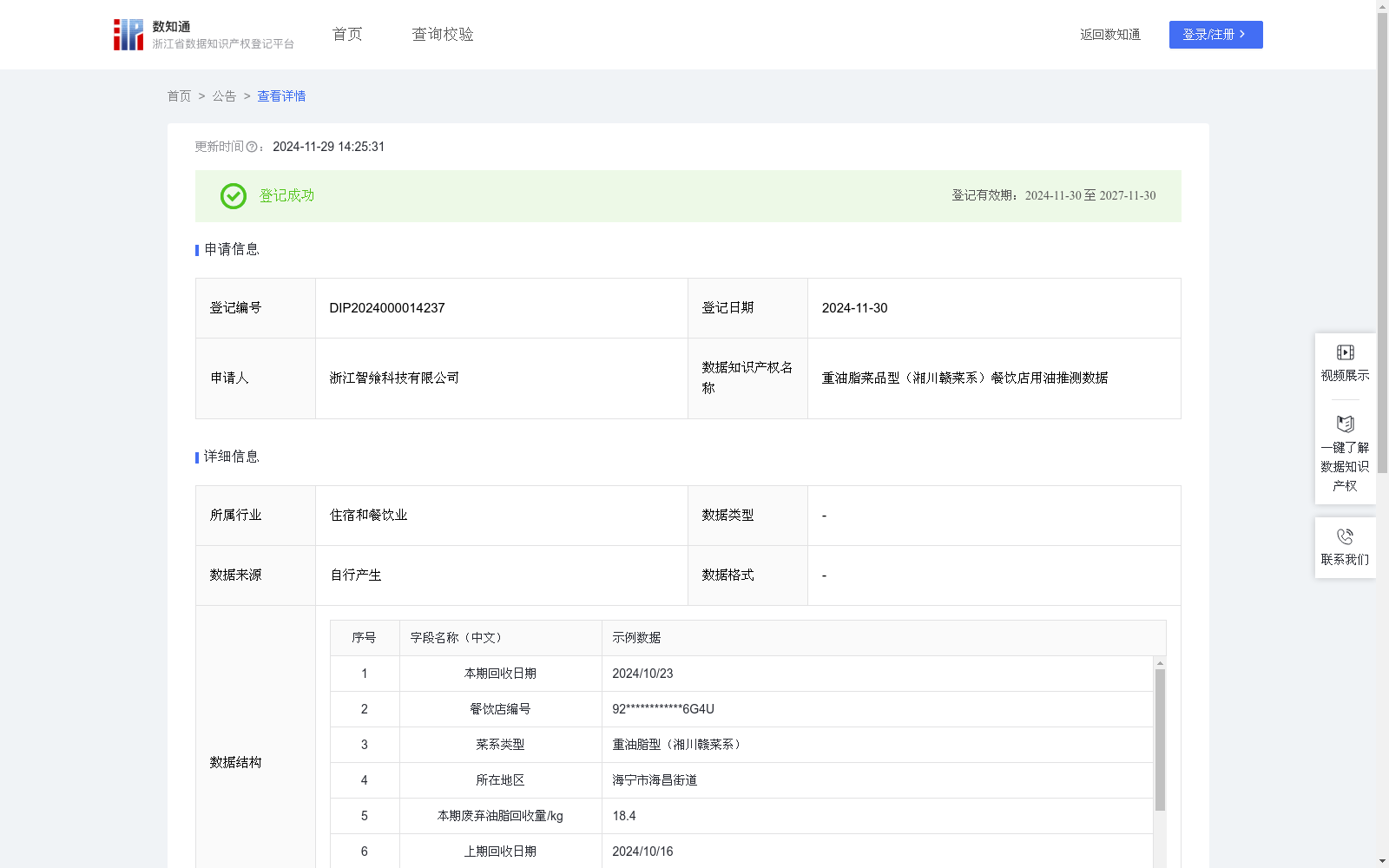
重油脂菜品型(湘川赣菜系)餐饮店用油推测数据
收藏浙江省数据知识产权登记平台2024-11-29 更新2024-11-30 收录
下载链接:
https://www.zjip.org.cn/home/announce/trends/91408
下载链接
链接失效反馈官方服务:
资源简介:
本数据集依托于重油脂菜品型(湘川赣菜系)餐饮店的废弃油脂回收记录,运用科学严谨的算法模型,精确推算出各餐饮店的用油量范围,具有广泛的应用潜力与价值。1.对餐饮店而言,本数据有助于监测食用油的质量水平,如果店里的实际用油量没有落在推测用油量的区间内,则说明食用油可能存在质量问题。2.对餐饮监管部门而言,本数据可作为其检查餐饮店购油票据的依据,如果餐饮店出示的票据所反映的用油量没有落在推测用油量的区间内,则意味着餐饮店可能存在用油方面的食品安全隐患。3.对餐饮领域的市场分析人员而言,通过本数据不仅可以从微观层面反映餐饮店的经营情况,还可以从宏观层面洞察餐饮行业的发展趋势和消费者偏好的变化,例如当本数据展示的推测用油量在一段时期内减少时,意味着消费者对重油脂型菜品(湘川赣菜系)的需求量的减少。4.对食用油供应商而言,通过本数据可以更准确地预测市场需求,合理地安排油脂的生产和供应,减少库存积压和缺货风险。5.对科研机构而言,本数据可为其开展餐饮行业用油及废弃油脂处理的相关研究提供基础性的实证支持。1.数据抽取和预处理:(1)数据抽取:在自研的5G智慧食安工业物联网数字化管理平台数据库中抽取主营重油脂型菜品(湘川赣菜系)的餐饮店的废弃油脂回收数据,包括本期回收日期、餐饮店编号、菜系类型、所在地区、本期废弃油脂回收量、上期回收日期。(2)数据预处理:对抽取的数据进行清洗,去除重复、错误或无关的信息,以便后续的分析和建模。
2.基于废弃油脂回收数据推测餐饮店用油量:(1)计算本期日均回收量:利用DAYS函数计算本期与上期的间隔天数;本期日均回收量=本期废弃油脂回收量÷本期与上期间隔天数;(2)确定反推系数:根据经调研获得的重油脂型菜品(湘川赣菜系)餐饮店的历史实际用油数据和历史废弃油脂回收数据,利用线性回归算法,得到反推系数区间为6~8%。(3)建立用油量推测模型:本期推测日均用油量上限=本期日均回收量÷反推系数区间下限(即6%);本期推测日均用油量下限=本期日均回收量÷反推系数区间上限(即8%);本期推测日均用油量下限到上限之间的区间,即为本期用油量的合理范围。
This dataset is developed based on the waste oil recycling records of restaurants specializing in high-oil-content dishes (Hunan, Sichuan and Jiangxi cuisines), and uses scientific and rigorous algorithmic models to accurately estimate the oil consumption range of each restaurant, with broad application potential and value.
1. For restaurant operators: This data helps monitor the quality of cooking oil. If the actual oil consumption of the restaurant does not fall within the estimated oil consumption range, it indicates potential quality issues with the cooking oil.
2. For food safety regulatory authorities: This data can serve as a basis for verifying restaurants' oil purchase receipts. If the oil consumption reflected by the submitted receipts does not fall within the estimated range, the restaurant may have food safety risks related to oil usage.
3. For market analysts in the catering industry: This data can not only reflect the operational status of individual restaurants at the micro level, but also reveal the development trends of the catering industry and changes in consumer preferences at the macro level. For example, a reduction in estimated oil consumption over a certain period indicates a decline in consumer demand for high-oil-content dishes from Hunan, Sichuan and Jiangxi cuisines.
4. For cooking oil suppliers: This data enables more accurate market demand forecasting, allowing them to reasonably arrange oil production and supply, thereby reducing inventory overstock and stockout risks.
5. For research institutions: This dataset provides foundational empirical support for relevant studies on oil usage in the catering industry and waste oil treatment.
1. Data extraction and preprocessing:
(1) Data extraction: Extract waste oil recycling data of restaurants specializing in high-oil-content dishes (Hunan, Sichuan and Jiangxi cuisines) from the database of the self-developed 5G Smart Food Safety Industrial Internet of Things (IIoT) digital management platform. The extracted data includes current recycling date, restaurant ID, cuisine type, location, current waste oil recycling volume, and previous recycling date.
(2) Data preprocessing: Clean the extracted data to remove duplicates, errors or irrelevant information for subsequent analysis and modeling.
2. Estimating restaurant oil consumption based on waste oil recycling data:
(1) Calculate daily average recycling volume for the current period: Use the DAYS function to calculate the number of days between the current and previous recycling dates; Daily average recycling volume for the current period = Current waste oil recycling volume ÷ Number of days between the current and previous recycling dates.
(2) Determine the reverse derivation coefficient: Based on historical actual oil consumption data and historical waste oil recycling data of restaurants specializing in high-oil-content dishes (Hunan, Sichuan and Jiangxi cuisines) obtained through research, the reverse derivation coefficient interval is determined to be 6% to 8% using linear regression algorithm.
(3) Establish the oil consumption estimation model: Upper limit of estimated daily average oil consumption for the current period = Daily average recycling volume ÷ Lower limit of the reverse derivation coefficient interval (i.e., 6%); Lower limit of estimated daily average oil consumption for the current period = Daily average recycling volume ÷ Upper limit of the reverse derivation coefficient interval (i.e., 8%); The interval between the lower and upper limits of the estimated daily average oil consumption for the current period is the reasonable range of oil consumption for the current period.
提供机构:
浙江智飨科技有限公司
创建时间:
2024-10-30
搜集汇总
数据集介绍
特点
该数据集通过废弃油脂回收数据推算出重油脂菜品型餐饮店的日均用油量范围,适用于餐饮质量监测、监管部门检查及市场分析等多个应用场景。
以上内容由遇见数据集搜集并总结生成



