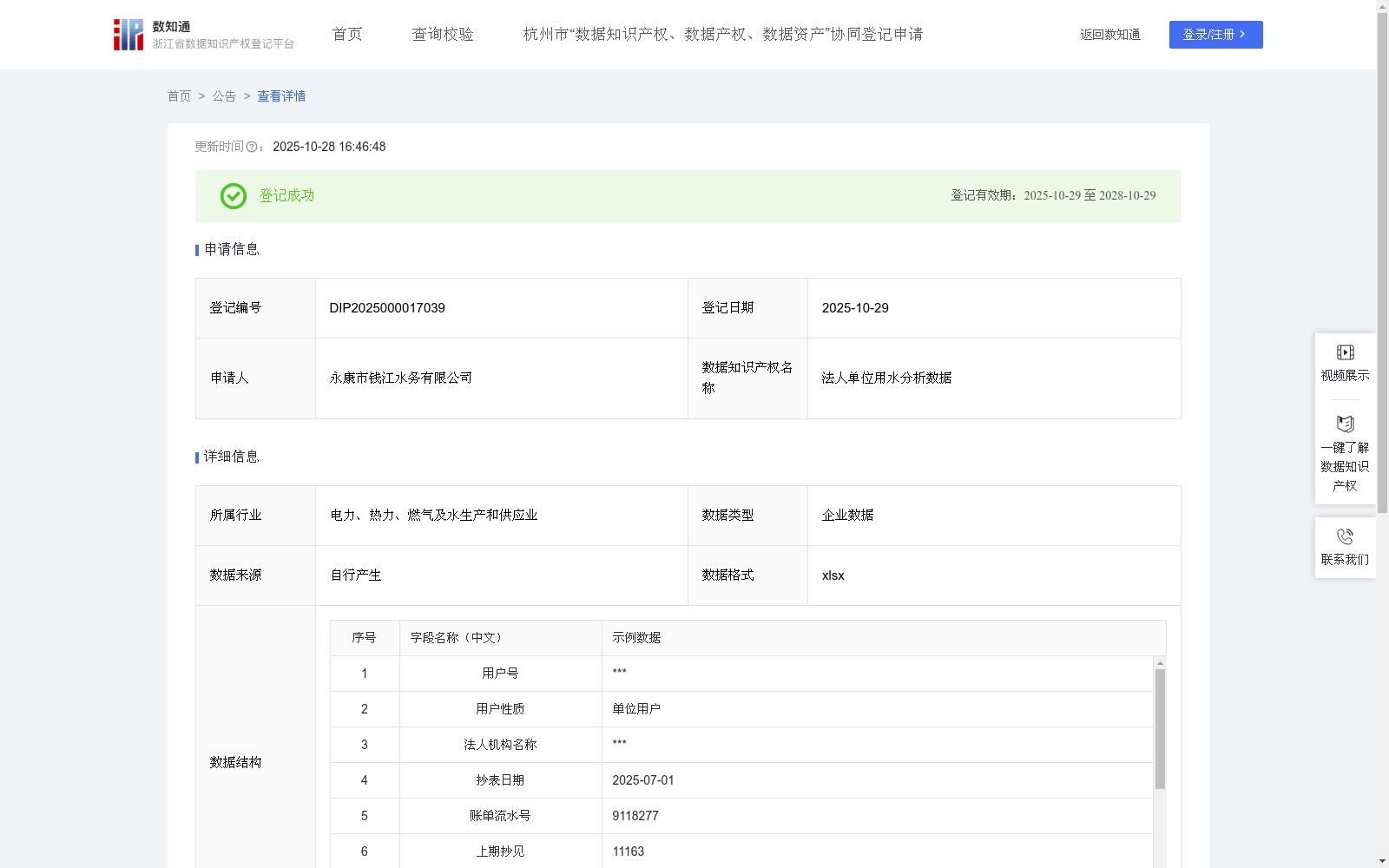
法人单位用水分析数据
收藏资源简介:
通过采集法人单位用水数据,水务公司作为供水和监管方,能够根据用水数据的变化情况,识别客户群体、发现异常用水(漏损或经营风险)、优化管网调度和预测收入,而用水单位(法人或自然人)作为水的使用者和成本承担方,能够根据用水数据的变化情况,监控自身用水成本波动、排查漏损、评估生产效率和水效、验证节水项目成果等。法人单位用水分析数据算法规则包括以下步骤:1、数据采集:采集各个法人单位的用水数据;2、数据处理:在采集到的数据中对本期日均(一期按30天计)以及环比变化率进行计算,计算公式为本期日均=本期水量/30,环比变化率=【(本期水量-上期水量)/上期水量】*100%;3、数据统计:以本期日均数据和环比变化率数据,统计分析该期用水情况,当环比下降或为0时反应企业经营状况较差,当环比上升时反应企业经营状况良好;4、数据应用:根据用水分析数据,识别客户群体、发现异常用水(漏损或经营风险)、优化管网调度和预测收入,同时方便用水单位监控自身用水成本波动、排查漏损、评估生产效率和水效、验证节水项目成果。
By collecting water consumption data of legal entities, water utilities, as water suppliers and regulators, can identify customer groups, detect abnormal water consumption (including leakage or operational risks), optimize water network scheduling and forecast revenue based on changes in water consumption data. Meanwhile, water users (legal entities or natural persons), as water consumers and cost bearers, can monitor their own water cost fluctuations, identify leaks, assess production efficiency and water use efficiency, and verify the outcomes of water-saving projects based on changes in their own water consumption data. The algorithm rules for water consumption analysis data of legal entities include the following steps: 1. Data Collection: Collect water consumption data of various legal entities. 2. Data Processing: Calculate the daily average water consumption in the current period (one period is defined as 30 days) and the month-on-month change rate from the collected data. The specific calculation formulas are as follows: Daily average water consumption in current period = Current period water volume / 30; Month-on-month change rate = [(Current period water volume - Previous period water volume) / Previous period water volume] * 100%. 3. Data Statistics: Conduct statistical analysis of the water consumption situation of the current period using the daily average data and month-on-month change rate data. A month-on-month decrease or zero growth indicates poor business performance of the enterprise, while a month-on-month increase signals sound business operation. 4. Data Application: Based on the water consumption analysis data, water utilities can identify customer groups, detect abnormal water consumption (leakage or operational risks), optimize water network scheduling and forecast revenue. Meanwhile, water users can utilize the data to monitor their own water cost fluctuations, identify leaks, assess production efficiency and water use efficiency, and verify the outcomes of water-saving projects.