soumyaBharadwaj/ErrorBench
收藏资源简介:
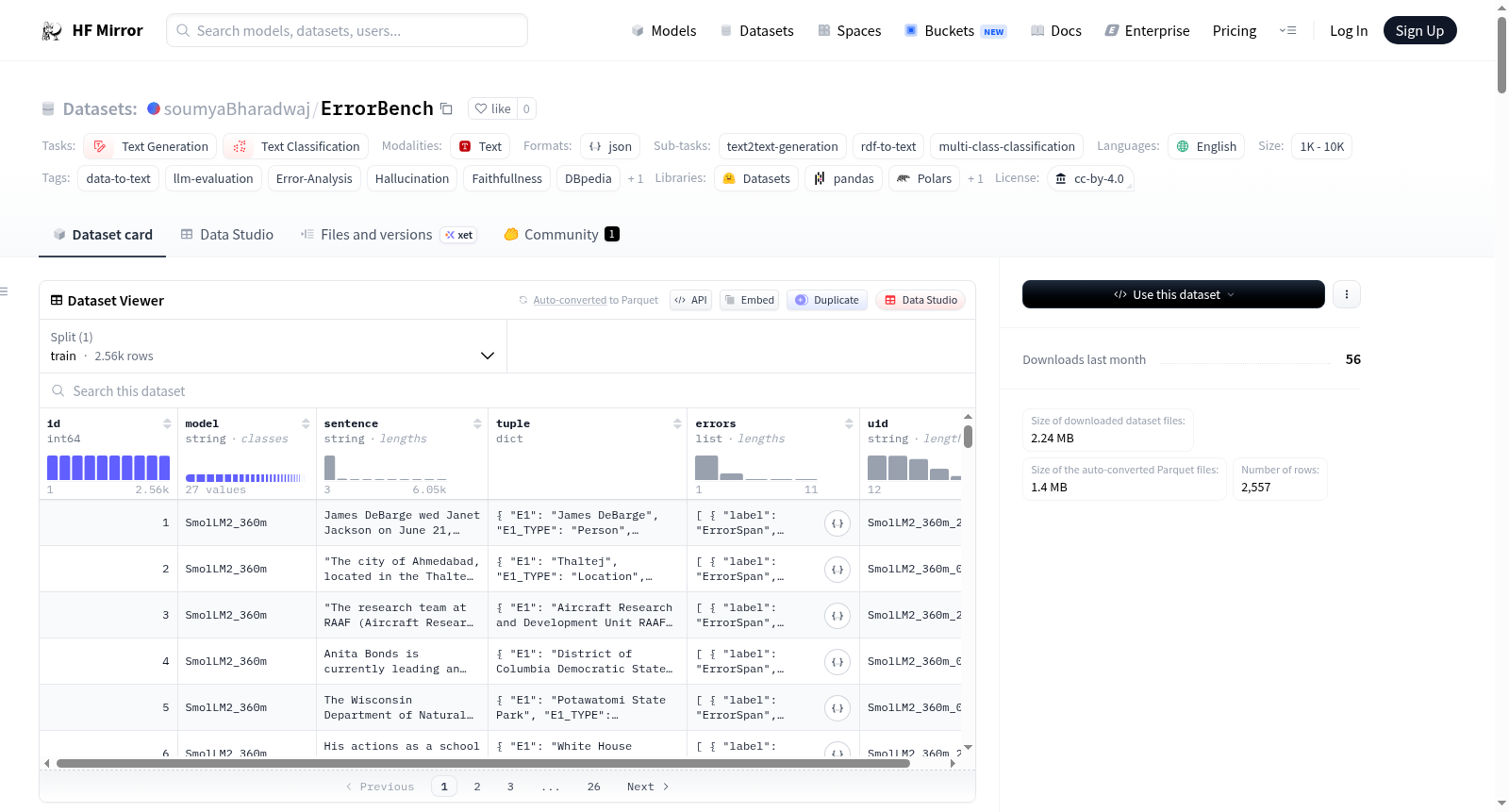
--- language: en license: mit pretty_name: ErrorBench size_categories: - 1K<n<10K task_categories: - text-generation - text-classification task_ids: - text2text-generation - rdf-to-text - multi-class-classification paperswithcode_id: errorbench dataset_info: citation: | @inproceedings{bharadwaj2026errorbench, title={ErrorBench: Fine-Grained Error Analysis of Multi-Family LLMs in Data-to-Text Generation}, author={Soumya Bharadwaj and Ashish Anand}, booktitle={International Joint Conference on Neural Networks (IJCNN)}, year={2026} } tags: - data-to-text - llm-evaluation - Error-Analysis - Hallucination - Faithfullness - DBpedia - Text-Generation --- # ErrorBench: Fine-Grained Error Analysis of Multi-Family LLMs in Data-to-Text Generation ## Dataset Summary ErrorBench is a human-annotated, span-level benchmark for analyzing generation errors in Large Language Models (LLMs) for Data-to-Text (D2T) generation. The dataset consists of sentences generated from structured DBpedia triples and annotated with fine-grained span-level error labels across 10 error categories. The dataset was introduced in our IJCNN 2026 paper, **"ErrorBench: Fine-Grained Error Analysis of Multi-Family LLMs in Data-to-Text Generation."** It is designed to support detailed analysis of generation failures such as hallucination, omission, prompt leakage, incoherence, and entity or relation errors, which are not captured by traditional surface-level metrics like BLEU or ROUGE. Each input tuple is paired with outputs from multiple LLMs, enabling cross-model comparative error analysis, meta-evaluation, and the development of automatic error detection systems for LLM-generated text. ErrorBench provides a reusable span-annotated benchmark for studying reliability, faithfulness, and error behavior across LLM families and model scales in structured data-to-text generation. ## Example of Span-Level Error Annotation  *Figure: Example of span-level error annotation showing a Llama2-7B output with multiple simultaneous errors: Partial Entity Mismatch, Relation Ambiguity, Addition, and Spell/Format errors, alongside the grounded input tuple.* --- ## Dataset Statistics * Total tuples: **224** * Total generated sentences: **6,048** * Error-annotated sentences: **≈2,557** * Total annotated error spans: **≈4,732** * LLM families evaluated: **9** * Total model variants: **27** * Annotation type: **Manual span-level annotation** --- ## LLM Families and Model Scales  *Figure: Overview of model families and parameter scales considered in our comparative error analysis. For each family, colors transition from light to dark, representing lower to higher parameter models.* --- ## Task Description The task is **Data-to-Text Generation** from structured tuples of the form: (Entity1, Entity1 Type, Relation, Entity2, Entity2 Type) Models generate a sentence describing the relation between the entities. The generated sentence is then manually annotated for span-level errors. --- ## Dataset Structure Each instance in the dataset contains the following fields: | Field | Description | | ----------------- | -------------------------------------- | | id | Global unique numeric ID for the instance| | uid | Original model-specific instance ID | | model | Model name that generated the sentence | | sentence | Model generated sentence | | tuple.E1 | Entity 1 | | tuple.E1_TYPE | Entity 1 type | | tuple.RELATION | Relation | | tuple.E2 | Entity 2 | | tuple.E2_TYPE | Entity 2 type | | errors.label | Error span label | | errors.spans | Character span indices | | errors.text | Text span containing the error | | errors.error_type | Error category | **Note:** Since the dataset combines outputs from 27 different models, the original tuple IDs repeat across models. Therefore: - `id` = global unique dataset ID - `uid` = original model-specific instance identifier (ModelName_TupleID) --- ## Example Instance ```json { "id": "17", "model": "DeepSeekr1_1.5b", "sentence": "Ray Mendoza was a trainer for Villano IV, who led him against Spanish colonial rule. Moving towards Spain, he played a crucial role in battling correctly with other soldiers of his time.", "tuple": { "E1": "Villano IV", "E1_TYPE": "Person", "RELATION": "trainer", "E2": "Ray Mendoza", "E2_TYPE": "Person" }, "errors": [ { "label": "ErrorSpan", "spans": [52, 94], "text": "who led him against Spanish colonial rule.", "error_type": "Addition" }, { "label": "ErrorSpan", "spans": [95, 115], "text": "Moving towards Spain", "error_type": "Addition" } ], "uid": "DeepSeekr1_1.5b_178" } ``` --- ## Instance Identification Each tuple appears once for each model. Therefore, the dataset contains multiple entries corresponding to the same input tuple but generated by different models. To avoid ID conflicts: - `id` is a globally unique identifier for each dataset entry. - `uid` identifies the original tuple and model combination in the format: --- ## Error Taxonomy (10 Categories) | Error Type | Description | | ----------------------- | ---------------------------------------- | | Entity Omission | Required entity missing from sentence | | Relation Omission | Relation not expressed | | Addition | Extra information not present in tuple | | Repetition | Repeated tokens or phrases | | Spelling/Format Drift | Formatting or spelling issues | | Prompt Echo | Prompt or reasoning leakage | | Relation Ambiguity | Relation expressed unclearly | | Entity Type Change | Entity type incorrectly expressed | | Incoherence | Sentence is meaningless or contradictory | | Partial Entity Mismatch | Entity partially incorrect | --- ## Annotation Process All generated sentences were manually annotated using span-level annotation. Annotation procedure: 1. The minimal erroneous span was identified. 2. The span was assigned one of the 10 error categories. 3. Missing entities or relations were annotated using special tags: * [MISSING_E1] * [MISSING_E2] * [MISSING_RELATION] Annotation was performed using the BRAT annotation tool by an expert annotator following strict guidelines to ensure consistency. --- ## Evaluation Metrics The dataset supports evaluation using two metrics: **Total Error Span Rate (TESR):** Average number of error spans per sentence. **Generation Quality Index (GQI):** Percentage of completely error-free sentences. TESR measures error density, while GQI measures overall generation success rate. --- ## Intended Use ErrorBench can be used for: * Evaluating Data-to-Text generation systems * Fine-grained error analysis of LLMs * Hallucination detection * Faithfulness evaluation * Training automatic error detection models * Studying scaling effects in LLM generation * Prompt engineering research * Benchmarking structured text generation systems --- ## Dataset Creation Pipeline 1. Structured triples were collected from DBpedia. 2. Sentences were generated using 27 LLM variants from 9 model families. 3. Each model generated one sentence per tuple. 4. Generated sentences were manually annotated. 5. Span-level error labels were assigned using a 10-category taxonomy. --- ## Citation If you use this dataset, please cite: ``` @inproceedings{bharadwaj2026errorbench, title={ErrorBench: Fine-Grained Error Analysis of Multi-Family LLMs in Data-to-Text Generation}, author={Bharadwaj, Soumya and Anand, Ashish}, booktitle={International Joint Conference on Neural Networks (IJCNN)}, year={2026}, organisation={IEEE} } ``` --- ## License This dataset is released under the MIT License. --- ## Contact Soumya Bharadwaj Indian Institute of Technology Guwahati India --- ## Tags Data-to-Text, LLM Evaluation, Error Analysis, Hallucination, Faithfulness, Benchmark Dataset, DBpedia, Text Generation