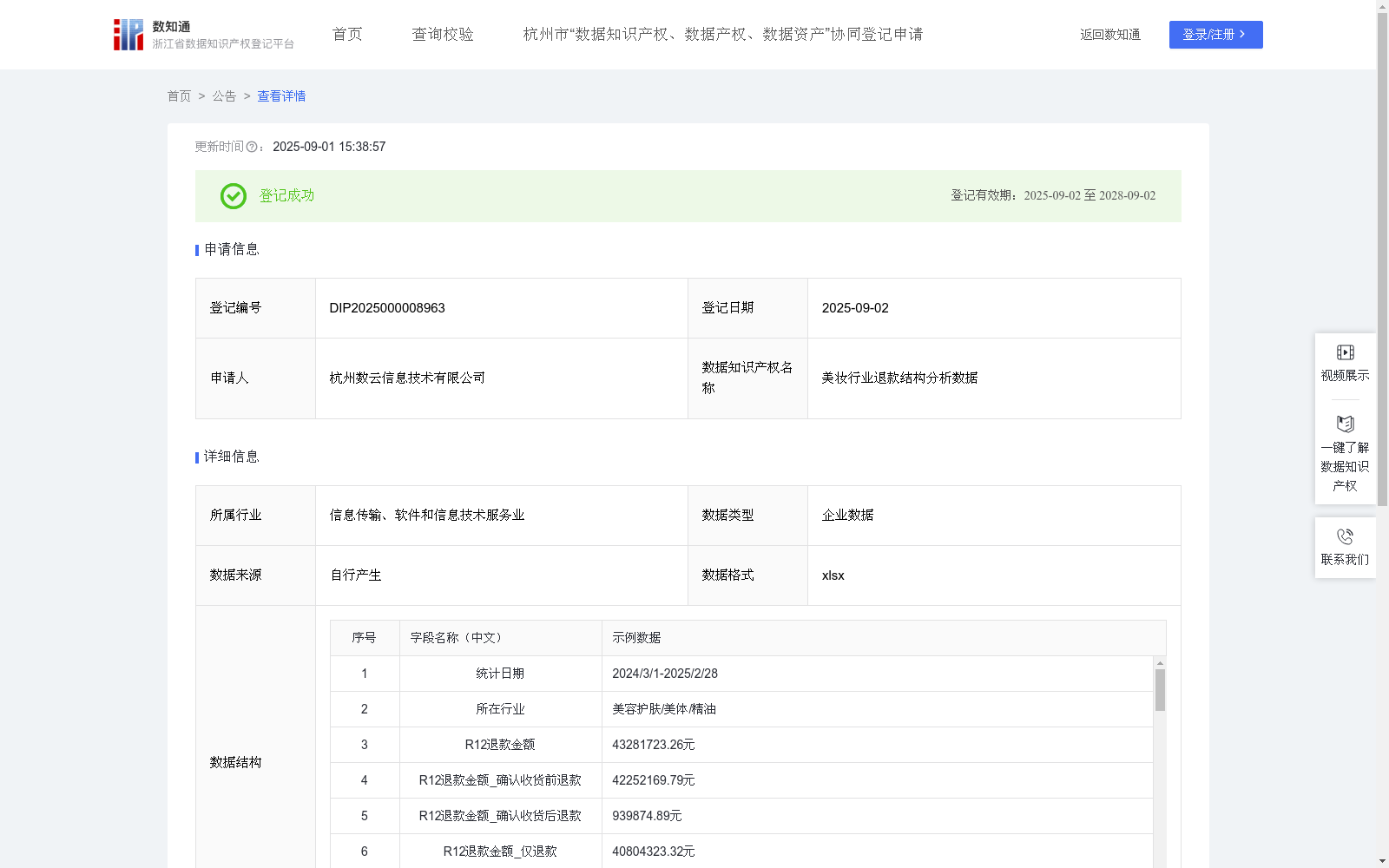
美妆行业退款结构分析数据
收藏资源简介:
此数据通过客户退款结构进行数据分析,帮助企业洞察货品情况,为供应链管理提供参考。此数据可以帮助企业:1. 供应链优化。通过发货前/后退款占比,识别库存、质检或物流问题(如发货前仅退款占比高需检查商品描述准确性)。2. 售后服务策略。对比仅退款与退货退款占比,优化售后方案(如高仅退款场景可推“极速退款”降低纠纷)。3. 动态风控。监控退款环比增长,实时预警异常订单(如收货后退款突增可能存在刷单或体验缺陷)。4. 行业对标。对比行业均值定位问题(如退货退款占比超同业20%需改进退货流程)。5.数据应用:定位退款根因,优化供应链、售后及风控策略,降低损失并提升体验。 数据采集: 通过数云自研CRM系统采集全渠道交易数据、退款数据并进行加工。获取数据完整进行加工,单位为元。 数据加工: 1. 组成行业的用户样本筛选:用户最大根类目与行业一致;销售金额占比超过全店70%;用户最近12个月有连续的规模交易数据。 2 环比增长=R12指标-R13_24指标 3. 确认收货前退款金额占比=退款金额_确认收获前 / 退款金额 4. 确认收货后退款金额占比=退款金额_确认收货后 / 退款金额 5. 仅退款金额占比=退款金额_仅退款 / 退款金额 6. 退货退款金额占比=退款金额_退货退款 / 退款金额 7. 发货前-仅退款金额占比=退款金额_发货前_仅退款 / 退款金额 8. 发货后-仅退款金额占比=退款金额_发货后_仅退款 / 退款金额 9. 发货后-退货退款金额占比=退款金额_发货后_退货退款 / 退款金额
This dataset performs data analysis based on customer refund structures, to help enterprises gain insights into product conditions and provide references for supply chain management. This dataset can assist enterprises in the following aspects: 1. Supply chain optimization: Identify inventory, quality inspection or logistics issues via the proportion of pre-shipment and post-shipment refunds (e.g., a high proportion of pre-shipment non-return refunds requires checking the accuracy of product descriptions). 2. After-sales service strategy: Optimize after-sales solutions by comparing the proportions of non-return refunds and return-and-refund transactions (e.g., launching "Instant Refund" for scenarios with high non-return refund rates to reduce disputes). 3. Dynamic risk control: Monitor the month-on-month growth of refunds to issue real-time warnings for abnormal orders (e.g., a sudden surge in post-delivery refunds may indicate fraudulent brush orders or product experience defects). 4. Industry benchmarking: Locate existing problems by comparing with industry average values (e.g., if the return-and-refund proportion exceeds 20% of the industry average, the return process needs improvement). 5. Data application: Identify the root causes of refunds, optimize supply chain, after-sales and risk control strategies, reduce losses and improve user experience. Data Collection: Omnichannel transaction data and refund data are collected and processed through the self-developed CRM system of Shuyun. Complete data is obtained for processing, with the unit of Chinese Yuan (CNY). Data Processing: 1. Industry user sample screening: Users whose primary root category is consistent with the target industry; their sales amount accounts for more than 70% of the total sales of the entire store; users have continuous large-scale transaction data in the latest 12 months. 2. Month-on-month growth = R12 indicator - R13_24 indicator 3. Proportion of refund amount before order confirmation = Refund amount before order confirmation / Total refund amount 4. Proportion of refund amount after order confirmation = Refund amount after order confirmation / Total refund amount 5. Proportion of non-return refund amount = Refund amount for non-return refunds / Total refund amount 6. Proportion of return-and-refund amount = Refund amount for return-and-refund transactions / Total refund amount 7. Proportion of pre-shipment non-return refund amount = Refund amount for pre-shipment non-return refunds / Total refund amount 8. Proportion of post-shipment non-return refund amount = Refund amount for post-shipment non-return refunds / Total refund amount 9. Proportion of post-shipment return-and-refund amount = Refund amount for post-shipment return-and-refund transactions / Total refund amount