
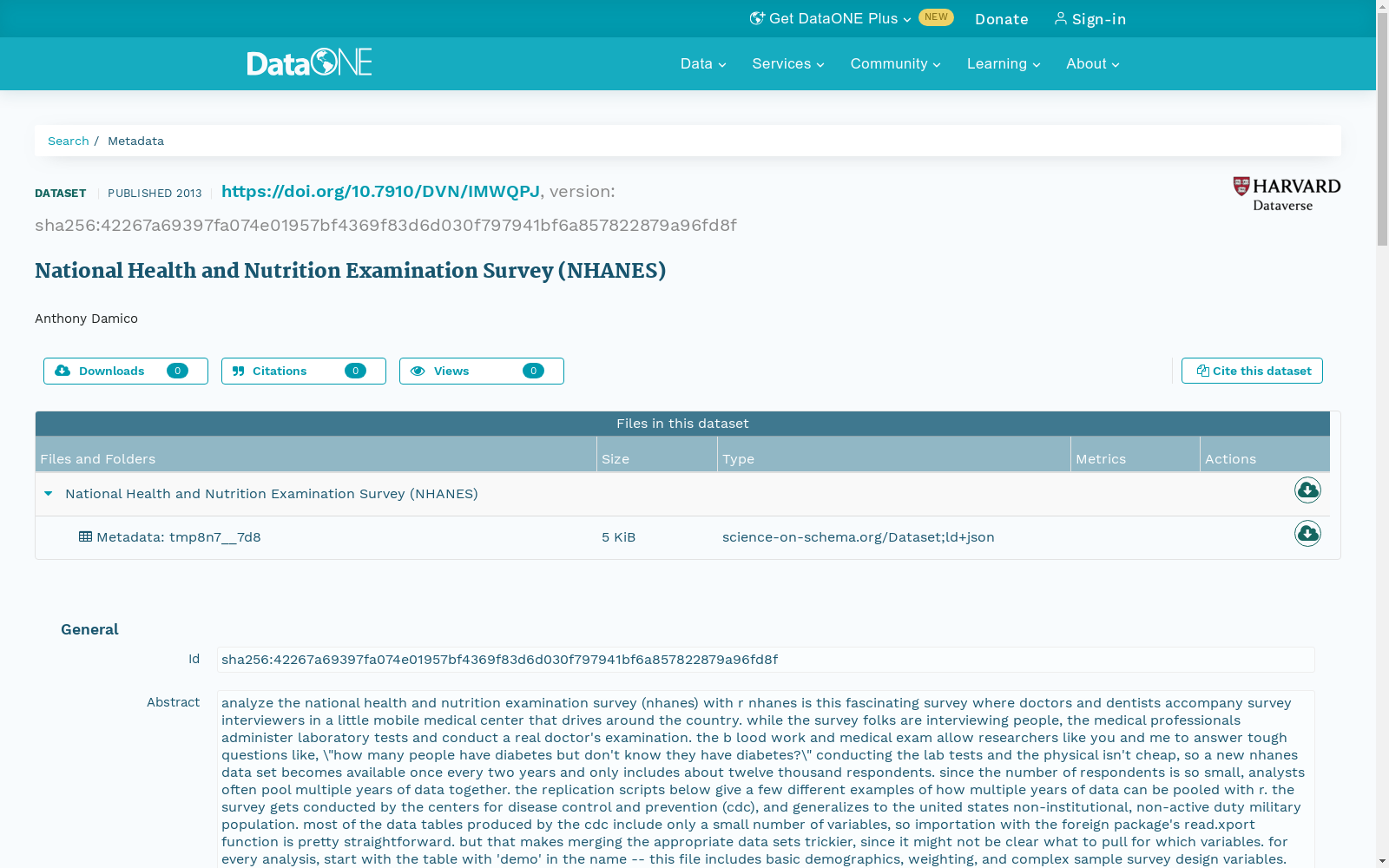
National Health and Nutrition Examination Survey (NHANES)
收藏DataONE2015-04-11 更新2024-06-27 收录
下载链接:
https://search.dataone.org/view/sha256:42267a69397fa074e01957bf4369f83d6d030f797941bf6a857822879a96fd8f
下载链接
链接失效反馈官方服务:
资源简介:
analyze the national health and nutrition examination survey (nhanes) with r nhanes is this fascinating survey where doctors and dentists accompany survey interviewers in a little mobile medical center that drives around the country. while the survey folks are interviewing people, the medical professionals administer laboratory tests and conduct a real doctor's examination. the b lood work and medical exam allow researchers like you and me to answer tough questions like, \"how many people have diabetes but don't know they have diabetes?\" conducting the lab tests and the physical isn't cheap, so a new nhanes data set becomes available once every two years and only includes about twelve thousand respondents. since the number of respondents is so small, analysts often pool multiple years of data together. the replication scripts below give a few different examples of how multiple years of data can be pooled with r. the survey gets conducted by the centers for disease control and prevention (cdc), and generalizes to the united states non-institutional, non-active duty military population. most of the data tables produced by the cdc include only a small number of variables, so importation with the foreign package's read.xport function is pretty straightforward. but that makes merging the appropriate data sets trickier, since it might not be clear what to pull for which variables. for every analysis, start with the table with 'demo' in the name -- this file includes basic demographics, weighting, and complex sample survey design variables. since it's quick to download the files directly from the cdc's ftp site, there's no massive ftp download automation script. this new github repository co ntains five scripts: 2009-2010 interview only - download and analyze.R download, import, save the demographics and health insurance files onto your local computer load both files, limit them to the variables needed for the analysis, merge them together perform a few example variable recodes create the complex sample survey object, using the interview weights run a series of pretty generic analyses on the health insurance ques tions 2009-2010 interview plus laboratory - download and analyze.R download, import, save the demographics and cholesterol files onto your local computer load both files, limit them to the variables needed for the analysis, merge them together perform a few example variable recodes create the complex sample survey object, using the mobile examination component (mec) weights perform a direct-method age-adjustment and matc h figure 1 of this cdc cholesterol brief replicate 2005-2008 pooled cdc oral examination figure.R download, import, save, pool, recode, create a survey object, run some basic analyses replicate figure 3 from this cdc oral health databrief - the whole barplot replicate cdc publications.R download, import, save, pool, merge, and recode the demographics file plus cholesterol laboratory, blood pressure questionnaire, and blood pressure laboratory files match the cdc's example sas and sudaan syntax file's output for descriptive means match the cdc's example sas and sudaan synta x file's output for descriptive proportions match the cdc's example sas and sudaan syntax file's output for descriptive percentiles replicate human exposure to chemicals report.R (user-contributed) download, import, save, pool, merge, and recode the demographics file plus urinary bisphenol a (bpa) laboratory files log-transform some of the columns to calculate the geometric means and quantiles match the 2007-2008 statistics shown on pdf page 21 of the cdc's fourth edition of the report click here to view these five scripts for more detail about the national health and nutrition examination survey (nhanes), visit: the cdc's nhanes homepage the national cancer institute's page of nhanes web tutorials notes: nhanes includes interview-only weights and interview + mobile examination component (mec) weights. if you o nly use questions from the basic interview in your analysis, use the interview-only weights (the sample size is a bit larger). i haven't really figured out a use for the interview-only weights -- nhanes draws most of its power from the combination of the interview and the mobile examination component variables. if you're only using variables from the interview, see if you can use a data set with a larger sample size like the current population (cps), national health interview survey (nhis), or medical expenditure panel survey (meps) instead. confidential to sas, spss, stata, sudaan users: why are you still riding around on a donkey after we've invented the internal combustion engine? time to transition to r. :D
本研究基于R语言的nhanes包,对美国国家健康与营养调查(National Health and Nutrition Examination Survey, NHANES)展开分析。这项引人入胜的调查项目独具特色:医生与牙医会随同调查访员,搭乘流动医疗中心在全美巡回开展工作。当访员完成受访者访谈时,医护人员将同步进行实验室检测与正式的临床体格检查。血液检测与医学检查结果,可帮助包括你我在内的研究者解答诸多棘手问题,例如「有多少糖尿病患者尚未确诊」。
由于实验室检测与体格检查的成本高昂,全新的NHANES数据集每两年更新一次,样本量仅约12000名受访者。鉴于样本规模有限,分析师通常会合并多个年度的数据集进行分析。下文提供的复现脚本,将展示多种利用R语言合并多年度数据集的实操示例。
本调查由美国疾病控制与预防中心(Centers for Disease Control and Prevention, CDC)主导,其样本可推广至美国非机构化、非现役军人的全体人群。CDC生成的多数数据表仅包含少量变量,因此借助foreign包的read.xport函数完成数据导入操作相对简便。但这也使得对应数据集的合并工作更具挑战性,因为用户可能难以明确各变量对应的提取来源。
所有分析均需以名称包含「demo」的数据表作为起点——该文件包含基础人口学信息、加权变量与复杂抽样调查设计相关参数。由于可直接从CDC的FTP站点快速下载所需文件,因此无需编写大规模的FTP自动下载脚本。
本GitHub仓库包含五个脚本:
1. **2009-2010年仅访谈数据:下载与分析.R**:下载、导入并将人口统计学与健康保险相关文件保存至本地;加载两个文件,筛选分析所需的变量并完成合并;执行若干示例变量重编码操作;使用访谈权重创建复杂抽样调查对象;针对健康保险相关问题开展一系列通用分析。
2. **2009-2010年访谈+实验室数据:下载与分析.R**:下载、导入并将人口统计学与胆固醇相关文件保存至本地;加载两个文件,筛选分析所需的变量并完成合并;执行若干示例变量重编码操作;使用移动检查组件(Mobile Examination Component, MEC)权重创建复杂抽样调查对象;采用直接法进行年龄标准化,并复现CDC胆固醇简报中的图1。
3. **2005-2008年合并CDC口腔检查数据.R**:下载、导入、保存、合并、重编码并创建调查对象,开展基础分析;复现CDC口腔健康数据简报中的图3——完整条形图。
4. **复现CDC出版物分析.R**:下载、导入、保存、合并、重编码人口统计学文件、胆固醇实验室数据、血压问卷与血压实验室数据;匹配CDC示例SAS与SUDAAN语法文件中描述性均值的输出结果;匹配该语法文件中描述性比例的输出结果;匹配该语法文件中描述性百分位数的输出结果。
5. **复现人类化学物质暴露报告.R(用户贡献脚本)**:下载、导入、保存、合并、重编码人口统计学文件与尿液双酚A(Bisphenol A, BPA)实验室数据;对部分列进行对数变换以计算几何均值与分位数;匹配CDC第四版报告PDF第21页中2007-2008年的统计数据。
若需了解更多关于NHANES的详细信息,可访问:CDC的NHANES官方主页,以及美国国家癌症研究所的NHANES网络教程页面。
### 备注
NHANES包含仅访谈权重与访谈+移动检查组件(MEC)权重。若分析仅使用基础访谈环节的问题,应使用仅访谈权重(此时样本量略大)。笔者尚未找到仅使用访谈权重的合理应用场景——NHANES的统计效力主要来源于访谈与移动检查组件数据的结合。若仅使用访谈环节的变量,不妨考虑使用样本量更大的数据集,例如当前人口调查(Current Population Survey, CPS)、全国健康访谈调查(National Health Interview Survey, NHIS)或医疗支出面板调查(Medical Expenditure Panel Survey, MEPS)。
致SAS、SPSS、Stata、SUDAAN用户:在我们早已发明内燃机的时代,为何仍在骑驴?是时候转向R语言了。:D
创建时间:
2023-11-21
搜集汇总
数据集介绍
构建方式
National Health and Nutrition Examination Survey (NHANES) 数据集的构建基于美国国家健康与营养调查项目,该项目由美国疾病控制与预防中心(CDC)主导。NHANES 通过多阶段分层抽样方法,从美国各地随机选取代表性样本,涵盖不同年龄、性别、种族和收入水平的个体。调查内容包括详细的问卷调查、体格检查、实验室检测和营养评估,确保数据的全面性和代表性。
使用方法
NHANES 数据集的使用方法多样,适用于公共卫生、流行病学、营养学等多个研究领域。研究者可以通过 CDC 官方网站下载数据,并利用统计软件如 SAS、R 或 Stata 进行数据分析。使用时需注意数据清洗和标准化处理,以确保结果的准确性和可靠性。此外,NHANES 数据集的丰富性允许进行多变量分析和纵向研究,为复杂健康问题的探索提供了有力支持。
背景与挑战
背景概述
National Health and Nutrition Examination Survey (NHANES) 是由美国疾病控制与预防中心(CDC)自1971年开始实施的一项综合性健康调查项目。该数据集通过收集来自美国各地的样本,旨在评估美国人口的健康和营养状况。NHANES不仅涵盖了常规的健康指标,如体重、血压和胆固醇水平,还包括了详细的饮食习惯、生活方式和环境暴露数据。这一数据集的核心研究问题在于揭示健康与营养之间的复杂关系,并为公共卫生政策制定提供科学依据。NHANES的影响力不仅限于美国,其数据被广泛应用于全球健康研究,成为评估和改善公共健康的重要工具。
当前挑战
NHANES数据集在构建过程中面临多重挑战。首先,数据收集涉及复杂的样本选择和多阶段抽样方法,确保样本的代表性是一个重大挑战。其次,数据的质量控制和标准化处理要求极高,因为涉及的变量众多且复杂,任何微小的误差都可能影响研究结果的可靠性。此外,数据的安全性和隐私保护也是一个关键问题,因为涉及大量个人敏感信息。在应用层面,如何有效地整合和分析这些海量数据,以揭示潜在的健康趋势和风险因素,也是研究人员面临的一大挑战。
发展历史
创建时间与更新
National Health and Nutrition Examination Survey (NHANES) 始于1971年,由美国疾病控制与预防中心(CDC)发起,旨在通过综合性的健康和营养调查,提供全国范围内的健康状况数据。自其创建以来,NHANES 每两年进行一次更新,以反映美国人口的健康和营养状况的最新变化。
重要里程碑
NHANES 的重要里程碑包括1999年引入计算机辅助个人访谈(CAPI)和计算机辅助人体测量(CABS)技术,显著提高了数据收集的效率和准确性。2005年,NHANES 开始采用电子健康记录(EHR)系统,进一步增强了数据的可追溯性和完整性。此外,2010年,NHANES 引入了基因组学数据,标志着其从传统健康调查向多维度健康评估的转变。
当前发展情况
当前,NHANES 已成为全球健康和营养研究的重要参考数据集,其数据被广泛应用于公共卫生政策制定、疾病预防和健康促进研究。近年来,NHANES 不断扩展其数据收集范围,包括环境暴露、心理健康和社会经济因素等多个领域,以提供更全面的健康评估。此外,NHANES 的数据开放政策促进了国际合作和跨学科研究,对全球健康科学的发展产生了深远影响。
发展历程
- NHANES首次启动,旨在评估美国人口的健康和营养状况。
- NHANES转变为连续滚动调查,每年进行一次,以提供更及时的健康和营养数据。
- NHANES开始收集基因组数据,标志着其数据范围的扩展。
- NHANES引入电子健康记录数据,进一步丰富了其数据内容。
常用场景
经典使用场景
在公共卫生领域,National Health and Nutrition Examination Survey (NHANES) 数据集被广泛用于研究美国人口的健康和营养状况。该数据集通过详细的问卷调查和体检数据,提供了关于饮食习惯、生活方式、疾病风险因素等多方面的信息。研究者利用这些数据可以分析不同人群的健康差异,评估公共卫生政策的有效性,以及预测未来健康趋势。
解决学术问题
NHANES 数据集解决了公共卫生领域中关于人口健康状况的量化问题。通过大规模的样本数据,研究者能够识别出影响健康的多种因素,如饮食、运动、遗传等,并量化这些因素对健康的影响程度。此外,NHANES 数据集还为流行病学研究提供了宝贵的资源,帮助科学家们理解慢性疾病的发病机制和预防策略。
实际应用
在实际应用中,NHANES 数据集被用于制定和评估公共卫生政策。例如,基于该数据集的研究结果,政府可以制定针对性的营养指南和健康促进计划,以改善国民的健康状况。此外,医疗机构和保险公司也利用这些数据来评估疾病风险,制定个性化的健康管理方案,从而提高医疗服务的效率和效果。
数据集最近研究
最新研究方向
在公共卫生领域,National Health and Nutrition Examination Survey (NHANES) 数据集的最新研究方向主要集中在慢性疾病的风险因素分析与预防策略上。近年来,随着全球慢性疾病负担的增加,研究人员利用NHANES数据集深入探讨了肥胖、糖尿病、心血管疾病等常见慢性病的发病机制及其与生活方式、遗传因素的关系。此外,NHANES数据集还被广泛应用于环境暴露与健康效应的研究,特别是在空气污染、化学物质暴露等方面,为制定公共卫生政策提供了科学依据。这些研究不仅有助于识别高风险人群,还为个性化医疗和健康干预措施的开发提供了重要数据支持。
相关研究论文
- 1National Health and Nutrition Examination Survey (NHANES): Sample Design and Estimation ProceduresCenters for Disease Control and Prevention (CDC) · 2012年
- 2Trends in Prevalence of Hypertension in the United States, 2001-2018American Medical Association · 2020年
- 3Association Between Dietary Patterns and Mortality Among US AdultsAmerican Medical Association · 2019年
- 4Prevalence and Trends of Obesity Among US Adults, 1999-2018American Medical Association · 2020年
- 5Association Between Sugar-Sweetened Beverage Consumption and Mortality in the United StatesAmerican Medical Association · 2019年
以上内容由遇见数据集搜集并总结生成



