室内弓字形轨迹合成数据
收藏资源简介:
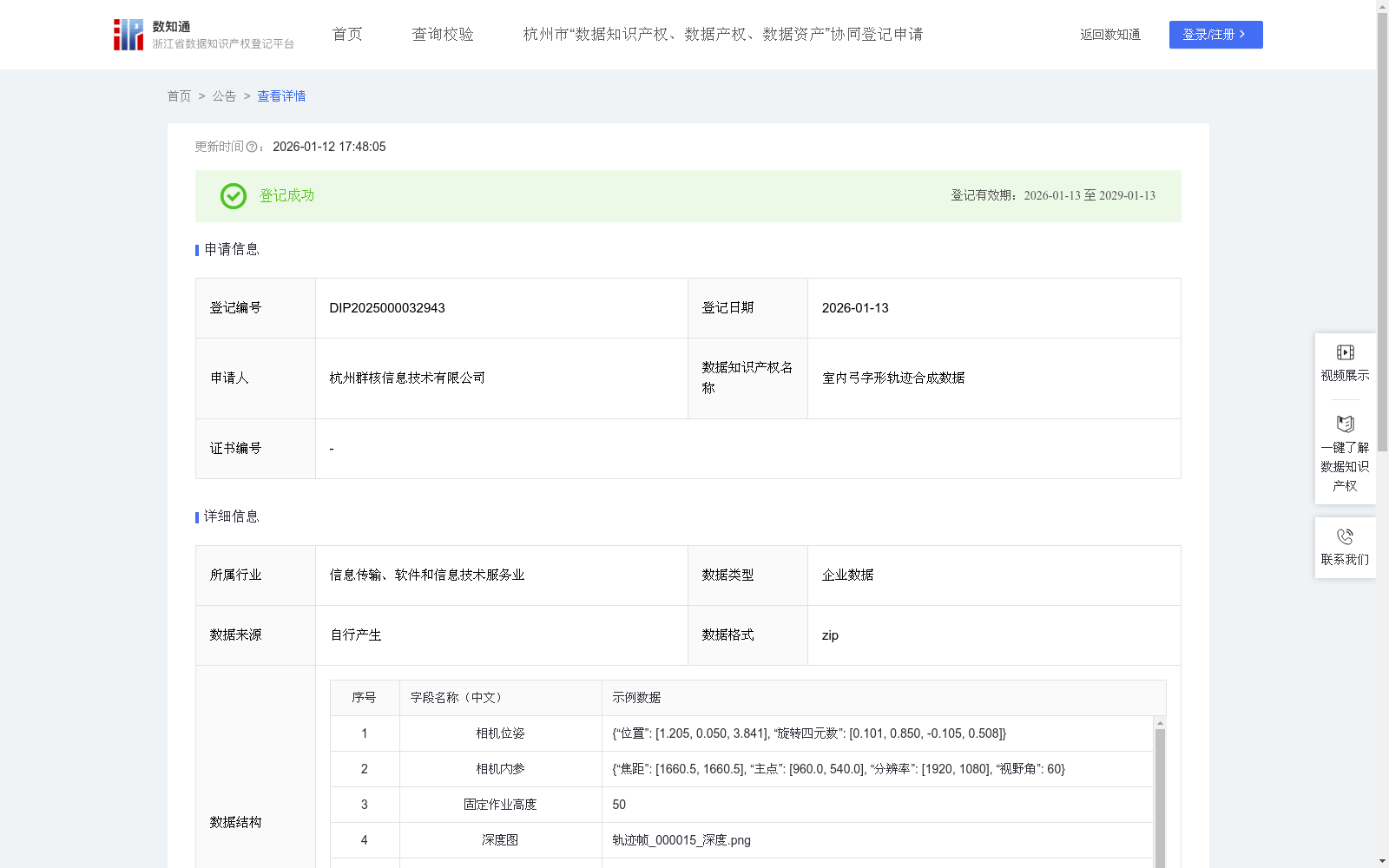
本数据集专为开发与提升扫地机器人的智能水平而设计,通过高度模拟其实际工作时的“弓字形”清洁路径,为机器人视觉算法的研究与训练提供全方位的仿真数据支持。数据集以一个真实的室内家装场景为背景,核心特点是完全模拟了扫地机器人的第一视角工作状态。所有数据均沿着一条典型的“弓字形”清洁轨迹生成,相机参数严格设定为:机身半径150mm,镜头高度仅50mm(紧贴地面),视角为60度。这种极低的视角完美复现了扫地机器人在行进中所“看到”的景象,包括家具底部、桌椅腿、墙角、电源线等极具挑战性的狭窄和遮挡环境,极大地增强了数据在真实应用中的价值。 我们选取了一个室内的家装场景,模拟机身半径为150mm扫地机器人进行家庭清洁时的轨迹来生成相机点位进行渲染,渲染的参数设置为,分辨率1920*1080,fov60,相机高度50mm。数据集内包含以下类型的内容:相机位姿(内外参),深度图,coco格式2d图片标注信息, 相机坐标系下的法向图,渲染图,语义图,albedo通道图。本算法旨在处理三维模型,通过一系列步骤实现模型的分割、实例重组及格式转换,以生成新的实例模型,用于场景渲染和机器人训练等应用。 1.模型分割:本步骤接收任意初始三维模型作为输入,三维模型包括位置、尺寸、材质、顶点信息、法相信息、面片信息字段,运用拓扑连通性聚类算法将该组合模型拆分为多个面片组(face group),获取模型类型字段。此步骤有效提取模型的结构特征,有助于后续的实例重组。 2.模型实例重组:在此步骤中,对三维模型的位置、尺寸、材质、顶点信息、法相信息、面片信息字段进行分割,再利用Qwen-VL-Max和GroundingDino算法对分割后的部件进行组合,形成独立的模型实例,并获取其中的标签字段。标签字段能够使每个模型实例能够基于原模型的结构和信息进行识别和应用。 3.模型格式转换:本步骤将拆分获得的实例模型及其对应的材质信息转换为OpenUSD格式,并获取其中的碰撞体设置信息字段和动画约束信息字段,以使模型能够在场景中动起来。 通过以上步骤,将原本数据库中的模型进行重组,生成新的实例模型,并被组装成一个完整的场景,以满足场景渲染、机器人训练等多个应用需求。
This dataset is specifically designed for developing and enhancing the intelligence level of robot vacuum cleaners. It provides comprehensive simulation data support for the research and training of robot vision algorithms by highly simulating the "bow-shaped" cleaning path during its actual operation. Based on a real indoor home decoration scene as the background, its core feature is the complete simulation of the first-person working state of the robot vacuum cleaner. All data is generated along a typical "bow-shaped" cleaning trajectory, with strictly set camera parameters: body radius 150mm, lens height only 50mm (close to the ground), and field of view (FOV) of 60 degrees. This ultra-low viewing angle perfectly reproduces the view "seen" by the robot vacuum cleaner during movement, including challenging narrow and occluded environments such as furniture bottoms, table and chair legs, corners, power cords, etc., greatly enhancing the practical value of the data in real-world applications. We selected an indoor home decoration scenario, generated camera positions and performed rendering by simulating the trajectory of a robot vacuum cleaner with a body radius of 150mm during household cleaning. The rendering parameter settings are resolution 1920*1080, FOV 60, and camera height 50mm. The dataset contains the following types of content: camera poses (intrinsic and extrinsic parameters), depth maps, COCO-format 2D image annotation information, normal maps in the camera coordinate system, rendered images, semantic maps, and albedo channel maps. This algorithm aims to process 3D models, and realizes model segmentation, instance recombination and format conversion through a series of steps to generate new instance models for applications such as scene rendering and robot training. 1. Model Segmentation: This step takes any initial 3D model as input. The 3D model includes fields such as position, size, material, vertex information, normal information, and patch information. The topological connectivity clustering algorithm is used to split the combined model into multiple face groups and obtain the model type field. This step effectively extracts the structural features of the model, which is helpful for subsequent instance recombination. 2. Model Instance Recombination: In this step, the position, size, material, vertex information, normal information, and patch information of the 3D model are segmented, and then the Qwen-VL-Max and GroundingDino algorithms are used to combine the segmented components into independent model instances and obtain the label field. The label field enables each model instance to be identified and applied based on the structure and information of the original model. 3. Model Format Conversion: This step converts the split instance models and their corresponding material information into the OpenUSD format, and obtains the collider settings information field and animation constraints information field, so that the models can move in the scene. Through the above steps, the models originally in the database are recombined to generate new instance models, which are assembled into a complete scene to meet multiple application requirements such as scene rendering and robot training.