
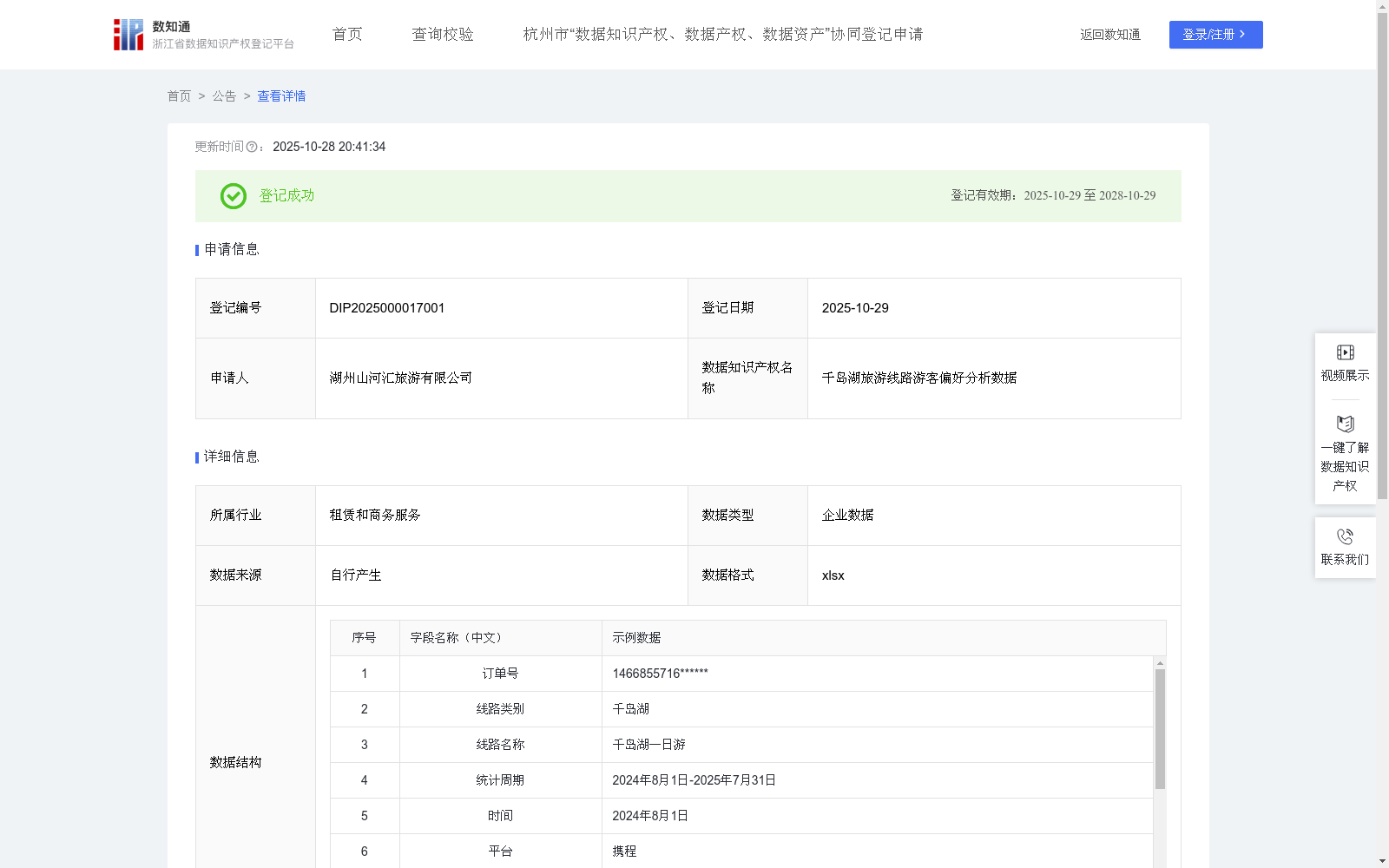
千岛湖旅游线路游客偏好分析数据
收藏浙江省数据知识产权登记平台2025-10-28 更新2025-10-29 收录
下载链接:
https://www.zjip.org.cn/home/announce/trends/6392932
下载链接
链接失效反馈官方服务:
资源简介:
千岛湖旅游线路游客偏好分析数据可以帮助公司分析游客对千岛湖旅游线路的偏好,优化旅游资源的配置,可以合理安排人力、物力资源 ,通过数据分析,了解客户对千岛湖线路的偏好,实现精准广告投放和市场推广,提高营销效果和资源利用效率,根据低中高偏好分别精准定位目标客群,通过数据分析优化产品设计,避免同质化,例如传统景区升级、挖掘在地文化,淡旺季动态调整、配套设施升级,数据驱动的精准营销,例如渠道选择、内容策略、会员体系等,结合 0TA 平台和短视频营销。1.数据收集:收集企业近一年公司的内部后台数据,包括订单号、线路类别、线路名称、时间、平台、出行人数、游客偏好指数R等数据进行分析,计算出千岛湖旅游线路出行人数的偏好指数。 2.数据预处理:对采集的数据进行整理,去除重复记录,将单位进行修改并统一。 3.数据计算:总线路出行人数=所有线路出行人数之和;游客偏好指数R=千岛湖线路出行人数/总线路出行人数; 4.数据分级应用:根据公式计算对游客偏好指数R进行分级评价:当0%<R≤10%时,为低偏好; 当10%<R≤25%时为中偏好; R>25%时,为高偏好。 如:高偏好线路可提升营收与利润空间、优化资源倾斜效率、塑造品牌核心竞争力,中偏好线路可挖掘升级为高偏好线路的潜力、平衡产品结构风险、满足细分客户需求,低偏好线路可减少无效成本投入、决定线路淘汰或改造、反向指导市场调研方向等。
Tourist preference analysis data of Qiandao Lake tour routes can help enterprises analyze tourists' preferences for Qiandao Lake tour routes, optimize the allocation of tourism resources, and reasonably arrange human and material resources. Through data analysis, enterprises can understand customers' preferences for Qiandao Lake tour routes, achieve targeted advertising and marketing promotion, improve marketing effectiveness and resource utilization efficiency, and accurately locate target customer groups based on low, medium and high preference levels. In addition, data analysis can be used to optimize product design and avoid homogenization, such as upgrading traditional scenic spots, exploring local culture, dynamically adjusting arrangements for peak and off-peak seasons, upgrading supporting facilities, and data-driven precise marketing including channel selection, content strategy, membership system and other aspects, combined with OTA platforms and short-video marketing.
1. Data Collection: Collect the internal backend data of the enterprise over the past year, including order number, tour category, tour name, time, platform, number of travelers, tourist preference index R and other data for analysis, and calculate the preference index of the number of travelers for Qiandao Lake tour routes.
2. Data Preprocessing: Organize the collected data, remove duplicate records, and modify and unify the units.
3. Data Calculation: Total number of travelers across all tour routes = the sum of the number of travelers for each individual tour route; For a given Qiandao Lake tour route, the tourist preference index R = number of travelers on that route / total number of travelers across all tour routes.
4. Data Grading and Application: Grade and evaluate the tourist preference index R for each tour route using the aforementioned formula: when 0% < R ≤ 10%, it is classified as low preference; when 10% < R ≤ 25%, it is classified as medium preference; when R > 25%, it is classified as high preference. For example, high-preference tour routes can expand revenue and profit margins, improve resource allocation efficiency, and cultivate the core brand competitiveness; medium-preference routes have the potential to be upgraded to high-preference ones, helping balance product structure risks and meet the demands of segmented customer groups; low-preference routes can help reduce invalid cost inputs, support decisions on route elimination or renovation, and reversely guide the direction of market research, and so on.
提供机构:
湖州山河汇旅游有限公司
创建时间:
2025-08-21
搜集汇总
数据集介绍
以上内容由遇见数据集搜集并总结生成



