
UAV-DualCog
收藏资源简介:
UAV-DualCog是由西北工业大学等机构构建的无人机多模态推理基准数据集,旨在评估多模态大语言模型在无人机场景中的双认知能力。该数据集包含18个场景中的746个有效地标,最终发布版本采用12个场景和512个地标,构建了4,096个图像样本和2,048个视频样本,涵盖六种任务类型,通过高度自动化的语义点云处理流程生成可扩展的观测数据。数据集采用基于场景级语义点云的自动构建流程,融合LiDAR、RGB和姿态数据,生成具有几何与语义标注的多视角观测样本,并设计分层飞行行为模式生成合理的轨迹视频。该数据集主要应用于无人机自主智能领域,旨在解决现有模型在无人机自身状态认知与环境状态认知联合推理方面的不足,推动面向无人机的多模态大语言模型发展。
UAV-DualCog is a multimodal reasoning benchmark dataset for unmanned aerial vehicles (UAVs) developed by Northwestern Polytechnical University and other institutions, which aims to evaluate the dual cognitive capabilities of multimodal large language models (LLMs) in UAV scenarios. This dataset includes 746 valid landmarks across 18 scenarios. The final released version adopts 12 scenarios and 512 landmarks, constructing 4,096 image samples and 2,048 video samples covering six task types. Scalable observational data is generated via a highly automated semantic point cloud processing pipeline. The dataset adopts an automatic construction workflow based on scene-level semantic point clouds, which fuses LiDAR, RGB and pose data to generate multi-view observation samples with geometric and semantic annotations, and designs a hierarchical flight behavior pattern to generate plausible trajectory videos. This dataset is primarily applied in the field of UAV autonomous intelligence, aiming to address the limitations of existing models in joint reasoning of UAV's own state cognition and environmental state cognition, and advance the development of multimodal LLMs tailored for UAVs.
数据集概述:UAV-DualCog
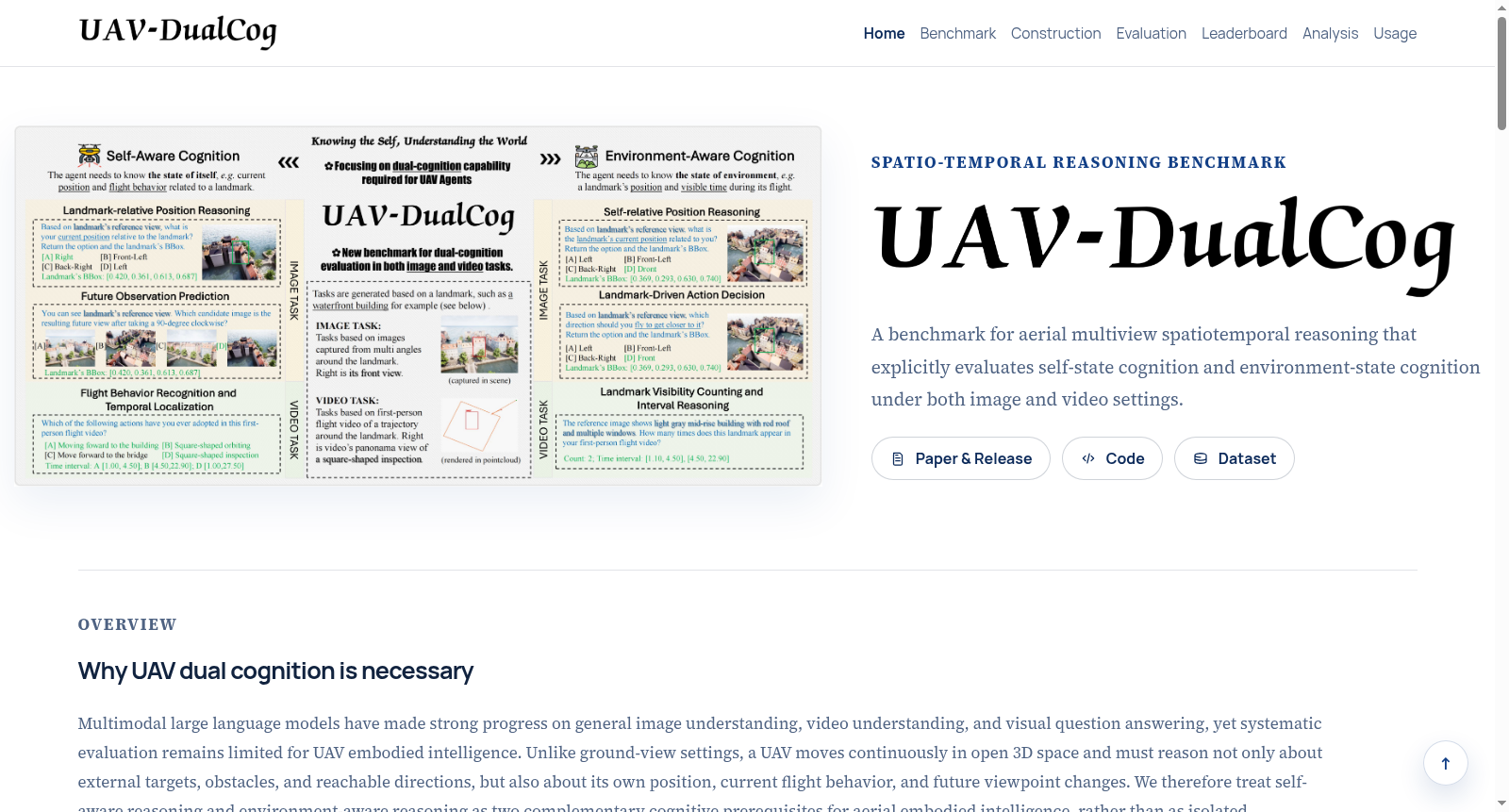
UAV-DualCog 是一个面向无人机(UAV)具身智能的时空推理基准(Spatio-temporal Reasoning Benchmark),核心评估多模态大语言模型在自认知(self-state cognition)和环境认知(environment-state cognition)两个维度上的表现,同时覆盖图像和视频两种观测模式。
核心设计理念
- 双认知框架:将无人机在开放3D空间中连续运动时所需的推理能力分为“自认知推理”(对自身位置、飞行行为、视角变化的推理)和“环境认知推理”(对外部目标、障碍物、可达方向的推理),而非视为独立的孤立下游任务。
- 全自动工具链:从语义点云和地标资产出发,构建多视图图像问答、分层飞行行为视频问答及统一的实验输出。
数据集规模
当前稳定版本包含:
- 场景:12个 AirSim 场景
- 地标:512 个有效地标
- 图像样本:4,096 个
- 视频样本:2,048 个
- 源图像:4,840 张
- 视频总时长:5小时27分13秒
未来扩展池已涵盖 18 个场景、746 个有效地标和 166 个细分子类别。
任务定义(共6项任务)
| 任务 | 模态 | 认知维度 | 输出类型 |
|---|---|---|---|
| 地标相对位置推理 (Landmark-Relative Position Reasoning) | 图像 | 自认知 | 选项 + 边界框 |
| 未来观测预测 (Future Observation Prediction) | 图像 | 自认知 | 选项 |
| 自相对位置推理 (Self-Relative Position Reasoning) | 图像 | 环境认知 | 选项 + 边界框 |
| 地标驱动动作决策 (Landmark-Driven Action Decision) | 图像 | 环境认知 | 选项 + 边界框 |
| 飞行行为识别与时域定位 (Flight Behavior Recognition and Temporal Localization) | 视频 | 自认知 | 行为选项 + 时间区间 |
| 地标可见性计数与区间推理 (Landmark Visibility Counting and Interval Reasoning) | 视频 | 环境认知 | 计数 + 时间区间 |
当前领先模型表现
综合排名(Top-3):
- Gemini 3 Flash:48.4%
- Qwen 3.5-Flash:38.9%
- Qwen 3.5-35B-A3B:37.9%
图像模态:
- Gemini 3 Flash:50.2%
- GPT 5.3 Chat:47.8%
- Qwen 3.5-27B:44.3%
视频模态:
- Gemini 3 Flash:46.5%
- Mimo v2 Omni:38.8%
- InternVL 3.5-38B:37.8%
自认知维度:
- Gemini 3 Flash:44.4%
- GLM 4.6V:30.9%
- Qwen 3.5-Flash:28.7%
环境认知维度:
- Qwen 3.5-35B-A3B:54.9%
- Gemini 3 Flash:54.2%
- Qwen 3.5-27B:53.3%
关键发现
分析表明,当前 MLLM 已具备部分双认知能力,但尚未形成稳定统一的能力。存在两个主要问题:
- 证据支撑不足:语义成功比空间或时间证据更容易实现,许多看似正确的决策缺乏可靠的证据支撑。
- 认知发展不平衡:环境认知推理整体强于自认知推理,且两种认知维度在不同媒体设置下表现差异明显。
- 1Knowing the Self, Understanding the World: A Dual-Cognition Benchmark for UAV Spatio-temporal Reasoning with MLLMs西北工业大学; 中国石油大学 · 2026年


